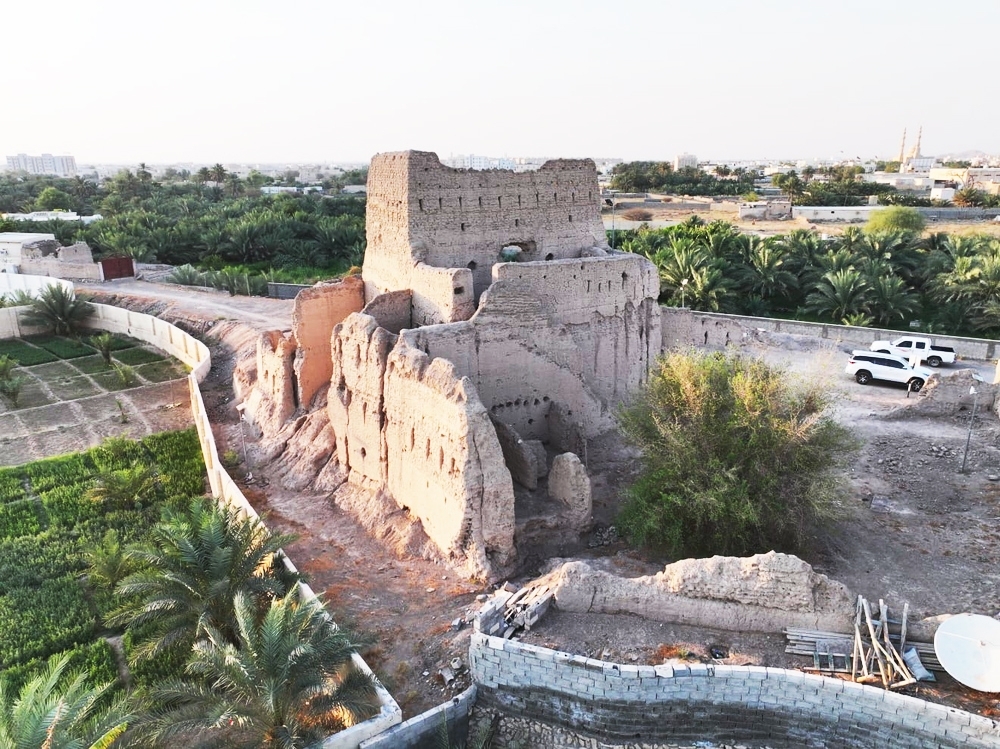
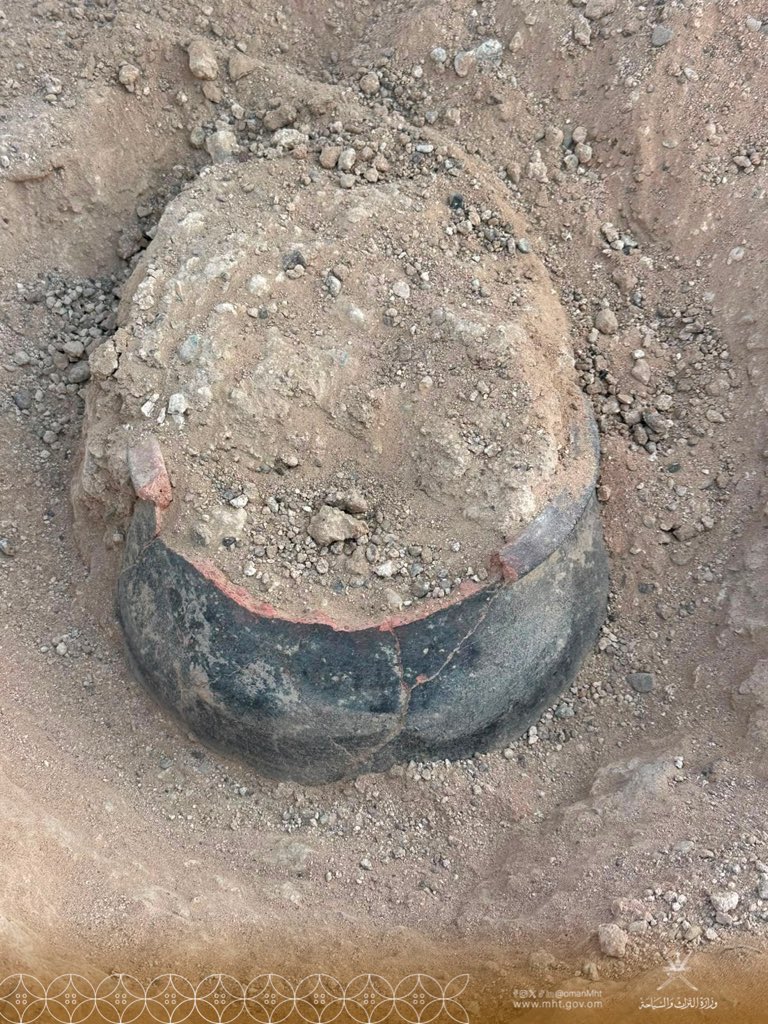
Preliminary excavations at the historic Bait Bahr House in northern Oman have uncovered a medium-sized ceramic jar, while geophysical surveys have detected possible foundations and walls buried around the 250-year-old building.
The work is being conducted in the Wilayat of Al Buraimi by Oman’s Ministry of Heritage and Tourism, in cooperation with the Office of the Governor of Al Buraimi. It forms part of a wider project to restore the deteriorating landmark and prepare it for public use.
According to the ministry, the ceramic vessel will undergo further examination to help establish the chronological sequence of activity at the site. No date or original function has yet been assigned to the jar, making laboratory analysis and comparison with regional pottery essential before firm conclusions can be reached.
Underground structures detected around the house
Before excavation began, specialists conducted a geophysical survey around Bait Bahr. The results indicated possible buried walls and foundations that may belong to structures extending beyond the visible building.
Four trial trenches were subsequently opened to investigate these anomalies, identify archaeological features and determine the historic property’s original boundaries.
A specialist team is now documenting the exposed remains and collecting field data that will guide the restoration process. The investigators are expected to distinguish original architectural elements from later additions before any major reconstruction work begins.
Hamid bin Rashid al Zaidi, Director of the Heritage and Tourism Department in Al Buraimi Governorate, said the excavations were part of the preparations for restoring the site. A consultancy firm appointed to the project is also producing studies and conservation proposals for evaluation.
The broader objective, he explained, is to turn historic buildings into visitor attractions that complement the cultural landscape of Al Buraimi Oasis.
A fortified residence with a prison and palm gardens
Bait Bahr—also written as Bait Bahar—is located in Sa’ra, one of the historic settlements within the centre of Al Buraimi. The building is reportedly named after a man known as Bahar and is estimated to have been constructed approximately 250 years ago.
Although commonly called a “house,” the structure also possessed many characteristics of a small fort. It rises across three floors and once served as the headquarters of the local sheikh. Its interior contained rooms with different administrative and domestic functions, as well as a prison known locally as Al Tamoura.
A walled palm grove stood between the northern enclosure and the main building. Its trees were irrigated by a traditional falaj, an underground and surface-channel system used for distributing water across settlements and agricultural land.
Earlier descriptions of the building also refer to “a mysterious pathway that leads to somewhere not yet discovered.” The passage could not be fully investigated because of the structure’s deteriorated condition. The present excavations may establish whether it formed part of an escape route, water system, storage area or another architectural feature.
Bait Bahr belongs to a much older oasis landscape
The house itself dates to the late Islamic period, but it stands within a cultural landscape occupied for thousands of years.
Historical accounts describe the wider Buraimi Oasis as a group of nine date-palm settlements: Hili, Masudi, Qattara, Jimi, Hamasa, Sa’ra, Muwaiji, Mutarid and Al Ain. Today, this connected oasis landscape is divided by the border between Oman and the United Arab Emirates.
The Buraimi Oasis Landscape Archaeology Project was established to investigate what researchers called the region’s “historic unity and shared heritage,” particularly because archaeological work had previously concentrated largely on the Emirati side of the oasis.
Surveys on the Omani side identified remains from several periods. These included evidence of a Bronze Age cemetery, an Iron Age mud-brick settlement, and an early Islamic village containing substantial buildings with walls preserved to approximately 2.3 metres.
Archaeologists also documented agricultural fields and dispersed settlement from around AD 1650–1800, followed by the construction of forts during the nineteenth and early twentieth centuries. The researchers concluded that the oasis’s “archaeological record stretches back at least 4,000 years.”
This long sequence makes the ceramic jar and the newly detected structures at Bait Bahr potentially important. Even if they belong to the building’s relatively recent occupation, they may reveal how political authority, agriculture and domestic life were organised within the oasis during the past several centuries.
Restoration will extend beyond the historic building
The project will not be limited to repairing Bait Bahr itself. Al Buraimi Governorate has also invited consultancy proposals for redeveloping the surrounding old neighbourhood and improving the pathways leading to the site.
Obaid bin Salim al Kaabi, Director of the Projects Department at Al Buraimi Municipality, said the plan is intended to preserve the district’s traditional urban identity while preparing it for future cultural and tourism projects.
For now, the most important questions remain underground. The ceramic jar has not yet been dated, and the walls detected by geophysical survey have not been fully interpreted. Continued excavation may reveal whether they belong solely to the 250-year-old residence or preserve evidence of earlier occupation beneath one of Oman’s historic oasis settlements.