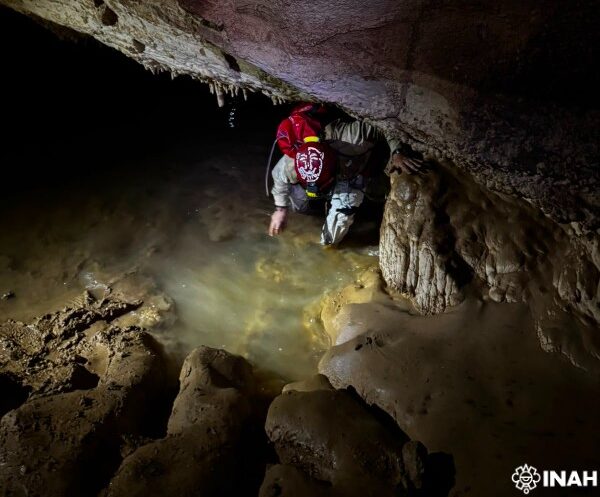
Archaeologists have documented 179 pre-Hispanic objects inside a difficult-to-reach cave in the Mexican state of Chiapas, revealing a ceremonial landscape that remained largely undisturbed for more than a thousand years.
Named Mundo Zoque Cave, the site contains 13 separate ritual deposits filled with incense burners, bowls and effigy urns decorated with human figures and animals. Preliminary analysis dates the objects to the regional Late Classic period, between AD 600 and 900.
Mexico’s National Institute of Anthropology and History, or INAH, described the discovery as one of the most important archaeological finds made in the region in recent decades.
A Hidden Cave Near the Arco del Tiempo
The cave lies near the Arco del Tiempo, a monumental natural rock arch in the La Venta River Canyon, within the municipality of Cintalapa. Extending for approximately 100 metres, the cavern can only be entered after a rappel descent of more than 10 metres.
This hazardous access appears to have protected the archaeological remains from centuries of looting and disturbance.
Local guide Jairo Díaz Barreiro located the cave and reported it to the INAH Chiapas Center in January 2026. Archaeologists, cave specialists, and professional climbers subsequently examined the site between February and June.
The investigation was directed by archaeologist Josuhé Lozada Toledo as part of an ongoing project documenting caves throughout the La Venta River Canyon.
Jaguars, Owls and Serpents
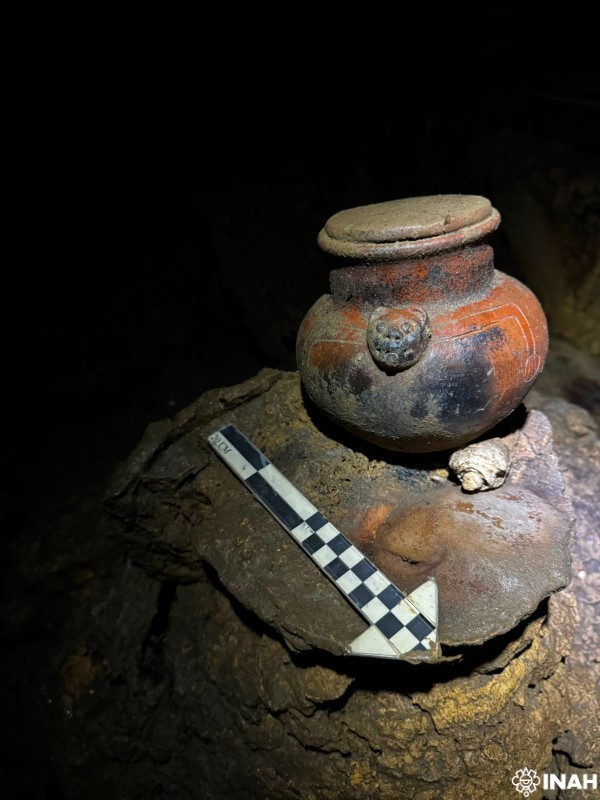
Researchers identified ceramic incense burners, effigy urns and bowls arranged in deliberate groups throughout the cave. Many of the objects carry images of jaguars, owls and serpents—animals closely associated with caves, darkness and the supernatural world in Zoque belief.
According to Lozada Toledo, the jaguar symbolized darkness and served as a guardian of the underworld and the heart of the mountain. The owl was connected with night and wisdom, while the serpent represented power and the cycle of life and death.
Several incense burners are decorated with forms resembling the thorns of the ceiba tree, which was considered sacred by ancient Mesoamerican communities. Their placement suggests that they may have marked a ceremonial route leading deeper into the cavern.
Narrow passages eventually open into larger chambers filled with stalactites and stalagmites, creating a natural setting that the Zoque may have understood as an entrance to the underworld, known as ts’uan.
A Ceremonial Journey Underground
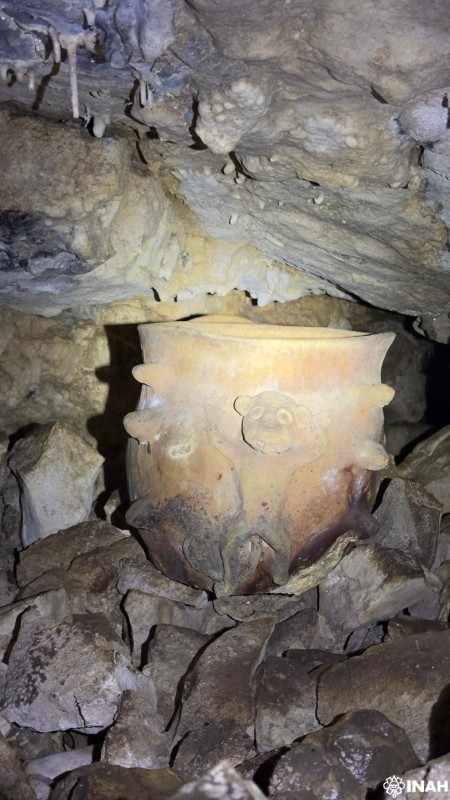
Around 30 metres from the entrance, archaeologists encountered a water-filled passage, or siphon. It can only be crossed during the dry season because it becomes submerged when seasonal rains arrive.
Beyond this point, two ascending chambers contain additional ritual deposits. In the eastern chamber, bowls were placed beside stalagmites that had been intentionally modified to resemble human figures.
A second chamber to the south held groups of bowls in different sizes, including examples with handles shaped like human figures.
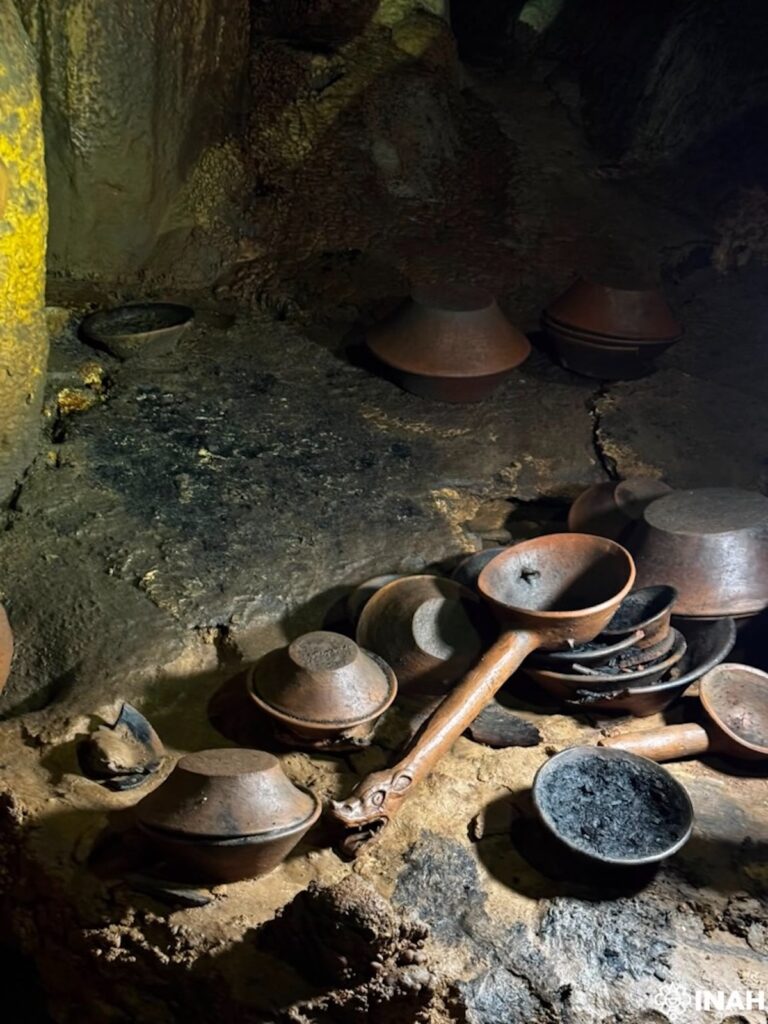
The ceremonial route ends in a principal chamber containing five deposits and large quantities of fine orange ceramic ware. Among the most striking objects is an incense burner bearing a cross-shaped design representing the four directions of the universe and its centre, a Mesoamerican cosmological symbol known as the quincunx.
The vessel has a 32-centimetre-long handle ending in the figure of a serpent with open jaws.
Rituals for Rain and Fertility
The arrangement of the offerings suggests that Mundo Zoque Cave was not used as a settlement or shelter. Archaeologists believe it functioned as a sacred ceremonial space, probably connected with rituals intended to bring rain and ensure agricultural fertility.
Caves were often regarded in Mesoamerica as places where water, clouds and fertility originated, as well as entrances linking the human world with the realm of ancestors and supernatural beings.
Future work will include additional exploration, three-dimensional photogrammetric recording and specialist analysis of the ceramic objects. Researchers also plan to examine residues preserved inside the vessels, which may help determine what substances were burned, stored or offered during ceremonies conducted deep beneath the Chiapas landscape.