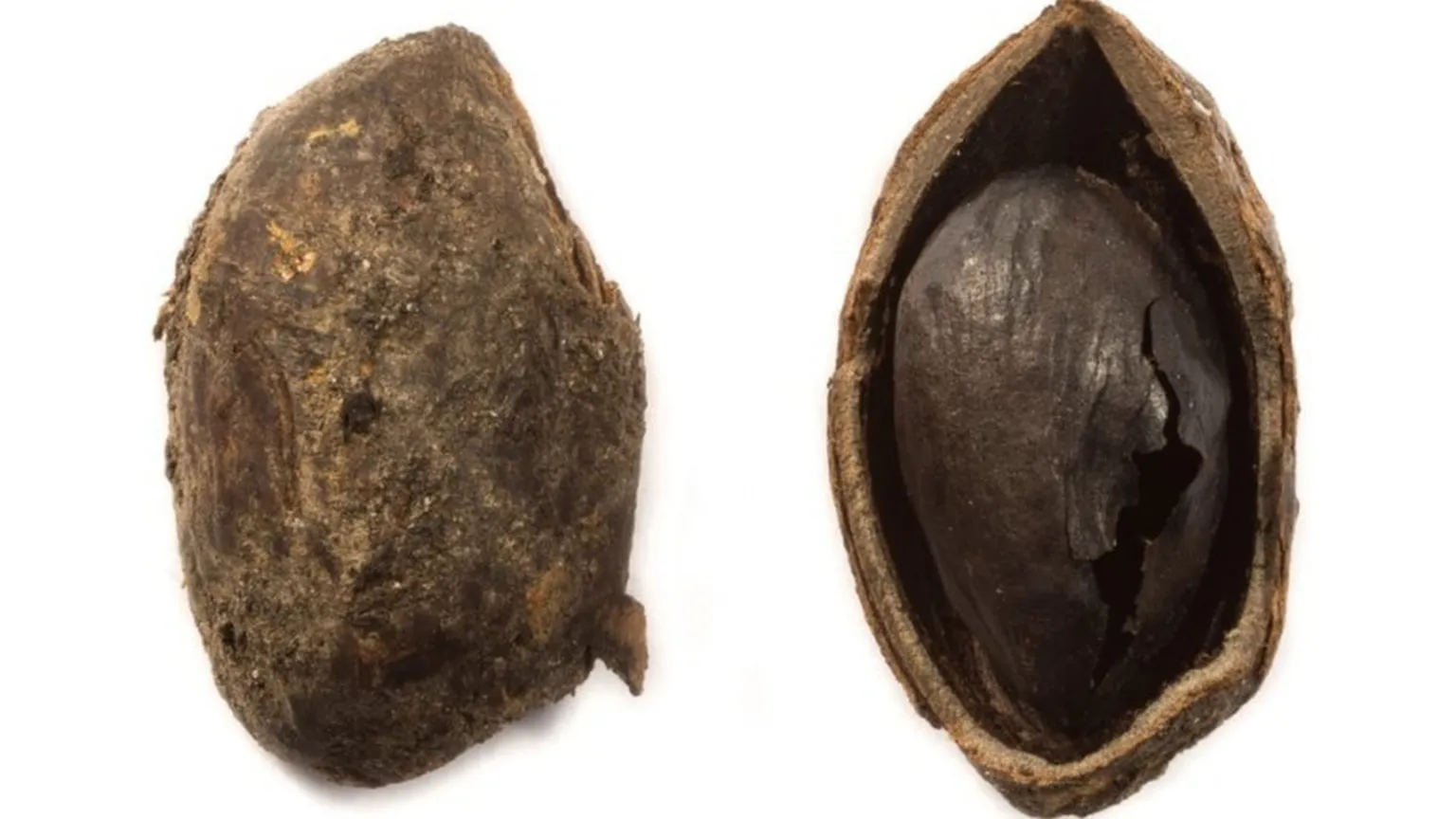
A single charred pistachio recovered from a Roman well in Yorkshire has revealed an unexpected taste for exotic foods on the northern frontier of the Roman Empire. Alongside Spanish mackerel and imported olive oil, the nearly 2,000-year-old nut offers a glimpse into a world where Mediterranean delicacies reached even the distant military settlements of Britain.
The pistachio emerged from a waterlogged well at Cataractonium, the Roman settlement beneath modern Catterick in North Yorkshire. Archaeologists from Cura Terrae identified it as the earliest known evidence of pistachios in Britain, an extraordinary find for a food that originated far beyond the Roman province.
Radiocarbon dating places the nut in the early Roman imperial period, approximately AD 24–128. Its presence in northern England is particularly intriguing because pistachios are thought to have reached Italy from the Middle East only a generation or two earlier.
For someone living in Roman Yorkshire, this small nut would have represented a food whose journey began thousands of kilometers away. Its survival also provides a rare physical trace of the tastes and trading connections of people living at the empire’s northern edge.
A Roman Well With an Unexpected Treasure
Cataractonium occupied an important position along Dere Street, the Roman road connecting military and civilian settlements across northern Britain. The town developed around a strategic crossing of the River Swale and became closely associated with the Roman army.
Archaeologists recovered the pistachio during investigations connected to improvements along the modern A1 road, which follows part of the ancient route.
The nut was charred but survived within the waterlogged deposits of a Roman well. Although researchers cannot establish who ate pistachios there or how this particular specimen entered the well, its presence points to a surprisingly extensive food supply network.
The excavation also produced another unexpected ingredient: bones identified as Spanish mackerel. This Mediterranean and eastern Atlantic fish would have reached northern Britain after preservation, probably as salted fish.
The find is considered one of the northernmost occurrences of Spanish mackerel recorded in Roman Britain. Together with the pistachio, it suggests that imported foodstuffs were not confined to wealthy households in Rome or the empire’s Mediterranean cities.
Spanish Olive Oil Reached Northern England
A separate excavation near Stamford Bridge, east of York, supplied another piece of the story.
Working along the route of a Roman road near the settlement of Derventio, Cura Terrae archaeologists recovered the broken handle of a Dressel 20 amphora, a large ceramic container widely used to transport olive oil.
The handle carried a manufacturer’s stamp reading VITAL(IS). Researchers traced the stamp to pottery workshops in the Guadalquivir Valley of southern Spain, a major olive-oil-producing region in the Roman province of Baetica.
Such amphorae carried oil across the empire, supplying military garrisons, towns, and civilian communities. Other ceramic fragments from the excavations belonged to containers associated with the transport of wine.
The finds demonstrate how familiar Mediterranean products could travel enormous distances before reaching consumers in northern Britain, sometimes covering journeys of more than 2,000 miles.
A Mediterranean Menu on Rome’s Northern Frontier
Roman soldiers played an important role in developing these trade networks. Military units stationed in Britain included men recruited from different parts of the empire, creating demand for foods, ingredients, and other goods familiar from their homelands.
Yet the imported products also reached civilian settlements that developed around military installations and major roads.
Stuart Ross, Senior Post-Excavation Manager at Cura Terrae, emphasized that the pistachio, fish remains, and stamped amphora reveal the remarkable reach of Roman supply networks.
The finds show that Roman Yorkshire was far from an isolated frontier. Its inhabitants participated in a commercial world extending from the Middle East to the Mediterranean and Atlantic coasts.
Perhaps the most striking evidence is also the smallest. A single pistachio, preserved for nearly two millennia in a Yorkshire well, offers an unexpected reminder that ancient Romans could enjoy foods brought from the other side of their vast empire.