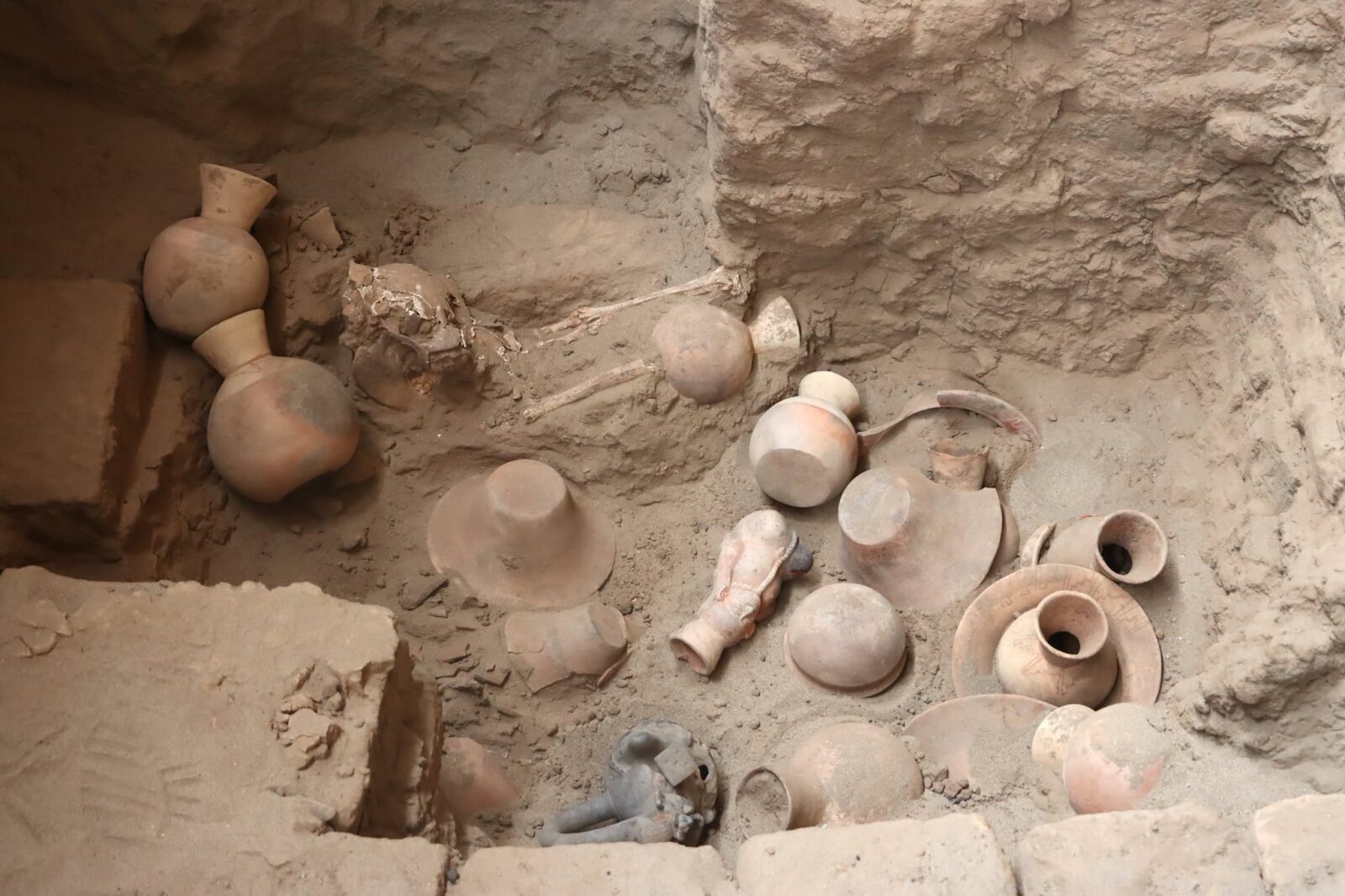
Archaeologists in Peru have uncovered an unusual Moche tomb containing 32 funerary offerings, among them ceramic figures of a bird-like deity and a prisoner with a rope around his neck. The grave’s small size suggests it belonged to a child, yet the rich collection of objects and its position near an important ancient temple raise the possibility that the young person held a privileged place in Moche society.
The discovery was made at Huacas de Moche, an archaeological complex on Peru’s northern coast and one of the most significant ceremonial centers of the Moche civilization. The Universidad Nacional de Trujillo (UNT) announced the findings after work directed by archaeologist Carlos Rengifo Chunga, who leads the Huacas de Moche Archaeological Project.
A Small Tomb With Signs of High Status
The burial belongs to the final period of the Moche civilization, which flourished along Peru’s northern coast roughly between the first and eighth centuries AD. Although archaeologists have not confirmed the age or identity of the deceased, the dimensions of the grave point to an infant or young child.
The real interest lies in the contrast between the tomb’s modest size and the 32 objects placed inside it. Its location close to Huaca de la Luna, a major Moche ceremonial complex, adds further weight to the find.
Researchers think these details may indicate that the deceased came from a privileged social group. The university has not yet established whether the child belonged to a ruling family or held any particular hereditary status.
A Bird-Like Deity and a Bound Prisoner
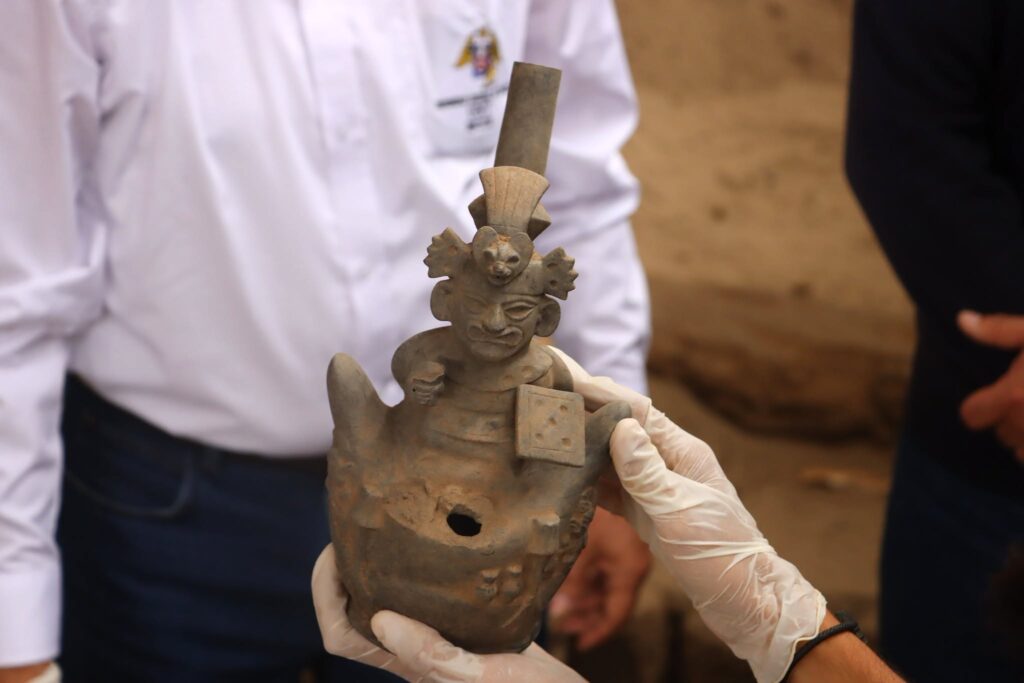
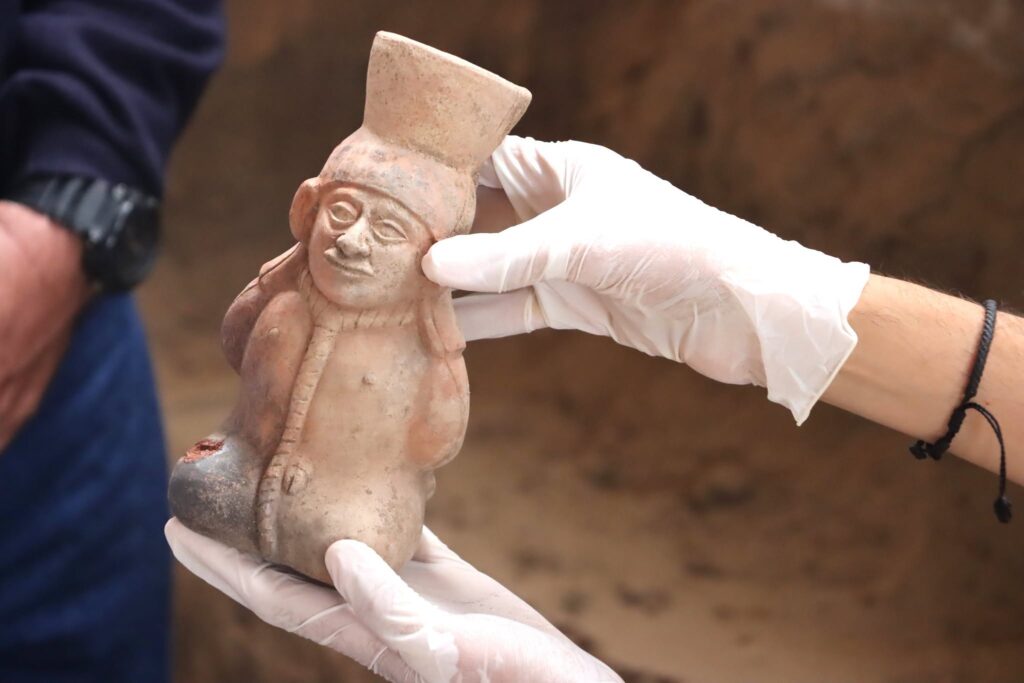
Two ceramic objects stand out among the offerings for their imagery. One shows a supernatural figure combining human and bird features; the other depicts a prisoner with a rope around his neck.
Such scenes were familiar in Moche art. Ceramics and monumental works frequently portrayed gods, warriors, captives, and elaborate ceremonies. The artistic tradition provides important evidence of a society in which religious belief and political power were closely linked.
Images of bound prisoners hold particular significance in Moche iconography. Captive figures often appear in scenes of warfare and ritual violence, though their exact meaning can change with context.
Finding these images in a possible child’s burial poses an interesting question for archaeologists. They may reflect religious ideas, social identity, or the symbolic role of the offerings themselves, but researchers have not yet determined why these particular objects were chosen.
What the Burial Reveals About Moche Society
The Moche built a complex civilization on Peru’s dry northern coast, constructing monumental ceremonial centers and producing some of the most distinctive ceramic art of the ancient Americas.
At Huacas de Moche, two large adobe complexes — Huaca del Sol and Huaca de la Luna — dominated the landscape. Huaca de la Luna was especially important for religious ceremonies, and its painted walls still preserve powerful images of supernatural beings and ritual scenes.
Burial practices offer another route into Moche society. The objects placed with the dead can reveal social distinctions, religious practices, and the ways communities expressed identity through funerary rites.
In this case, the combination of the grave’s size, its location, and the number of offerings may help researchers examine whether social privilege could extend to children, rather than depending solely on achievements in adult life.
Questions From the Final Days of a Civilization
The tomb also dates to an important phase in Moche history. In the later centuries of the civilization, political and ceremonial traditions underwent significant change, though the pace and nature of those changes varied from valley to valley along the northern coast.
The newly found burial may help illuminate how communities maintained their beliefs and social distinctions during this period. For the moment, the 32 offerings give researchers a rare chance to study the treatment of a possibly young individual whose identity remains unknown.
The importance of the grave does not rest on any confirmed royal connection. It lies instead in what its unusual contents may eventually reveal about childhood, privilege, and death in ancient Moche society.