A shepherd crossing the Uybat steppe in southern Siberia noticed something unusual after heavy rain had cut into the ground. An iron object was protruding from the side of a ravine, where it had apparently remained buried for centuries.
He pulled it free, damaging part of the outer edging in the process and probably losing some fragments. What looked at first like a corroded piece of metal turned out to be an exceptionally rare medieval shield dating to the Mongol era.
The shield eventually entered the collection of the Khakass National Museum of Local Lore. Researchers Alexander Poselyanin of Katanov Khakass State University and Oleg Mitko of Novosibirsk State University have now published a detailed study of the object, which was discovered in 2019, in Archaeology, Ethnology and Anthropology of Eurasia.
Their analysis suggests that the shield was not simply an unusual piece of military equipment. It may also preserve evidence of the long-distance political, military and commercial connections that stretched across medieval Eurasia.
Built from 14 iron plates
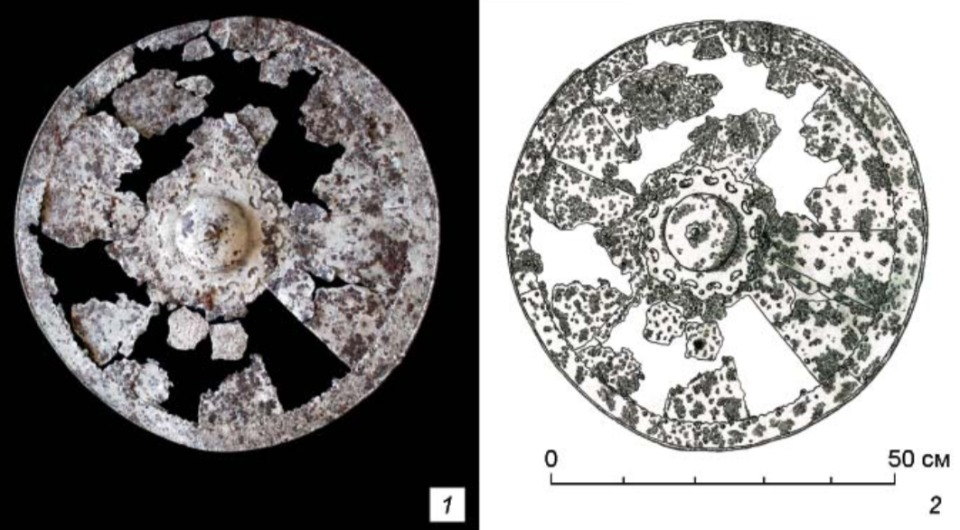
The shield is circular and roughly 65 centimeters across. Instead of being made from wood or hide reinforced with metal, its body consists of 14 matching segment-shaped iron plates joined together with rivets.
Only about 2.8 kilograms survive today, but the researchers estimate that the complete shield originally weighed more than four kilograms. Its outer edge carried an iron binding decorated with fine serrations, suggesting that the maker paid attention to appearance as well as protection.
At the center is a large two-piece iron boss about 20 centimeters in diameter. Its front surface was decorated with rectangular cutouts and openwork crescent-shaped motifs, while a narrow fitting on the inside probably formed part of the carrying or gripping system.
The surviving components were detailed enough for the researchers to reconstruct both sides of the shield and consider how a warrior may have handled it in battle or carried it while travelling.
A shield with an unexpected origin
The most intriguing part of the study is the shield’s apparent origin.
Researchers do not regard it as a typical product of Mongol military equipment. Instead, they argue that it was made in a Near Eastern weapons workshop. That conclusion gives the object a much wider significance, because it places a Near Eastern-style defensive weapon deep in southern Siberia during a period of intense political movement and warfare.
Such shields are also remarkably rare. The authors identify only one exact parallel.
That comparable example was found decades ago at the medieval settlement of Beshtam-Kala near the Aral Sea. Mongol forces destroyed the settlement during the conquest of the northeastern frontier of Khorezm in the early 13th century, and archaeologists found the shield near the defensive wall.
Russian science outlet N+1, which reported the new study, also highlighted the unusual connection between the Siberian find and this distant parallel.
Who carried it?
The missing archaeological context makes it impossible to tie the Uybat shield to a specific battle. Even so, Poselyanin and Mitko place it within the wider unrest that followed the fragmentation of the Mongol world, when conflicts among the successors of Genghis Khan also affected the peoples of the Sayan-Altai region.
They suggest that the shield’s owner may have been either a Kyrgyz or a Mongol warrior serving in the army of General Tutuha. In 1293, his forces conquered the “Five Tribes” of the Yenisei Kyrgyz during a campaign connected with Yuan expansion into southern Siberia.
That link remains a historical interpretation rather than a proven identification, but the combination of date, geography and military context makes it plausible.
More than anything, the shield shows how difficult it is to draw clean cultural boundaries around medieval weapons. An object apparently made in the Near East may have travelled thousands of kilometers before ending up in the hands of a warrior in southern Siberia.
For the researchers, the Uybat shield is therefore more than a rare survivor of medieval warfare. It is also a reminder of how connected the Mongol-era world had become.
Poselyanin, A. I., & Mitko, O. A. (2026). A Mongolian age iron shield from the Khakass-Minusinsk region. Archaeology, Ethnology and Anthropology of Eurasia, 54(3), 67–76. https://doi.org/10.17746/1563-0102.2026.54.3.067-076