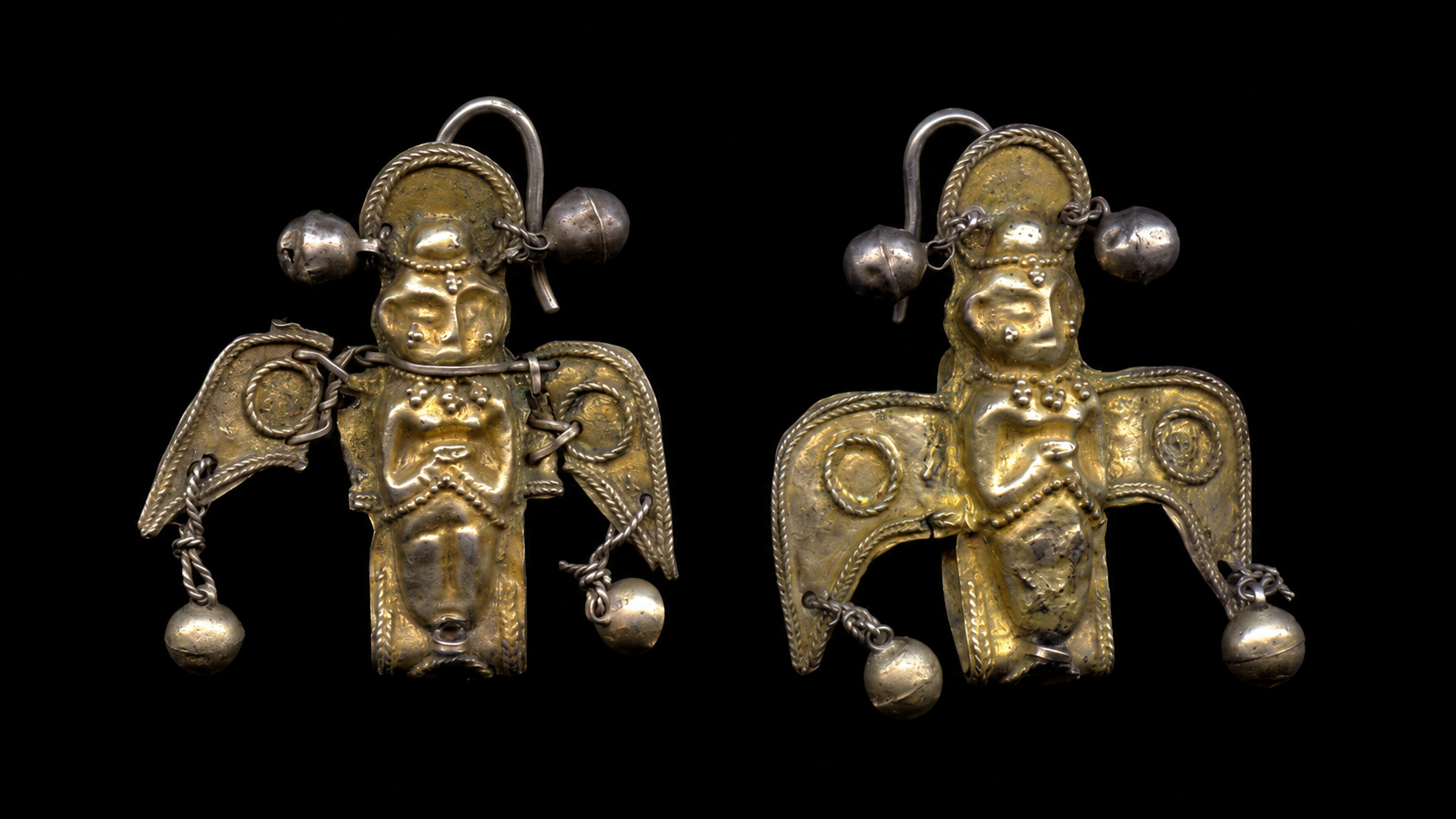
A pair of extraordinary silver earrings from southern Siberia may preserve a rare image associated with Umay, the ancient Turkic goddess linked to women, children, and protection.
Archaeologists discovered the ornaments in 1985 at the Koibaly cemetery in Khakassia, on the right bank of the Abakan River. Each piece shows a winged human figure holding a vessel beneath a halo-like element, surrounded by suspended silver ornaments.
Researchers have associated the figure with Umay for more than three decades. Now, a new technological study has revealed that the jewelry has an even more complicated history: the objects did not begin as earrings at all.
Scientists from the Institute of Archaeology and Ethnography of the Siberian Branch of the Russian Academy of Sciences and Novosibirsk State University reconstructed how several craftsmen transformed, used and repaired the pieces over time. Their results appear in Archaeology, Ethnology & Anthropology of Eurasia.
The findings suggest that the ornaments may have survived for generations as prestigious heirlooms, valued not only for their silver and craftsmanship but also for the meaning carried by the mysterious female figure at their center.
A Possible Image of Umay
The earrings came from Kurgan 7 at Koibaly, where archaeologists found them hidden in a small cache inside the grave wall.
Their imagery immediately stands out.
Each ornament features a frontal anthropomorphic figure with feminine forms, a high hairstyle or headdress, and a halo-like element around the head. The figure holds a vessel with both hands in front of the body, while broad wings extend to the sides.
Seven hollow spherical pendants attached to twisted wires add movement to the composition.
Archaeologist Sergei Skobelev first explored the religious meaning of the objects in detail in 1990. He proposed that the central figure could represent Umay, an important female being in early Turkic belief.
Turkic traditions associated Umay particularly with motherhood, fertility, women and the protection of children. Early Turkic sources also place her within a sacred world that included Tengri and Yer-Su, the sacred “Earth-Water.”
Researchers have also noted parallels between the Koibaly figure and Turkic stone sculptures. Both often show static frontal figures holding vessels with two hands.
No exact parallel for the Koibaly jewelry has yet emerged, however, so scholars continue to treat the Umay identification as an interpretation rather than a final conclusion.
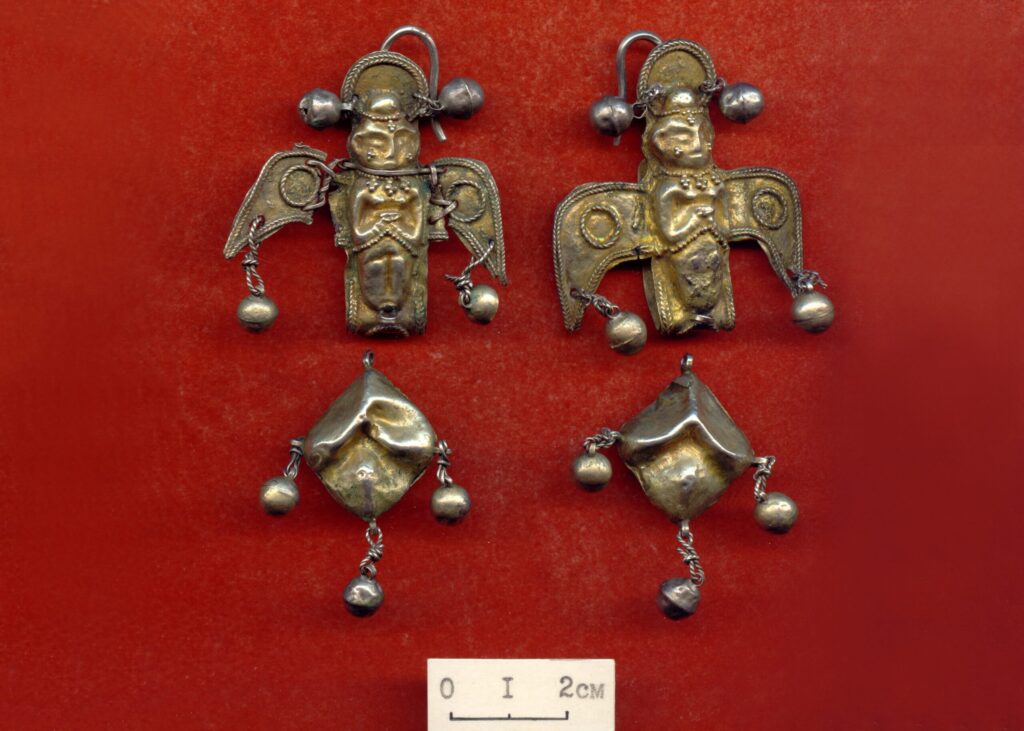
They Were Not Originally Earrings
The new study shifts attention from iconography to craftsmanship.
Oleg Mitko of Novosibirsk State University and Pavel Volkov of the Institute of Archaeology and Ethnography identified several distinct stages in the life of the objects.
A highly skilled jeweler first created two almost identical silver figures using an alloy with roughly 1–2 percent copper.
At that stage, the objects apparently served another purpose.
The craftsman decorated the surfaces with twisted metal thread and fine filigree, creating an elaborate bird-like form with a human figure at its center.
Later, another artisan converted the pieces into earrings.
He attached additional spherical pendants with silver wire and added curved ear hooks resembling question marks. Researchers note that people have used this type of suspension system since the Bronze Age.
The conversion, however, lacked the finesse of the original work. Dents and burrs left on the surface suggest that the second craftsman had less experience.
Even so, someone continued wearing the earrings for a long period.
Repaired Instead of Replaced
Eventually, one earring suffered damage when pressure cracked part of a wing.
A third craftsman repaired it with a much rougher method. Instead of soldering the broken section, he punched relatively large holes through the metal and tied the damaged part together with wire.
For the researchers, this poor-quality repair may reveal something important.
By then, the earrings may already have looked old-fashioned. Yet their owner chose to preserve them rather than replace them.
Mitko suggests that the jewelry may have functioned as a valuable family relic passed from one generation to another. The extensive wear, careful preservation, and repeated modification all point toward a long personal history.
If the figure carried associations with Umay, its symbolic value could have mattered even more than its appearance.
A High-Status Woman?
The burial had suffered ancient looting, and most of the human skeleton was missing. Archaeologists therefore cannot determine the individual’s biological sex directly.
The grave goods, however, led them to suggest that a woman most likely occupied the burial.
Excavators found horse remains, two stirrups and iron fittings from riding equipment, but none of the objects that more strongly mark male warrior burials, such as arrowheads, bow fittings or elements of a warrior belt set.
This combination may point to a woman of elevated status whose identity included both prestigious jewelry and horse-related funerary traditions.
Researchers still cannot assign the burial or the earrings to a precise cultural group. The wider region connected the worlds of the Uyghurs, Yenisei Kyrgyz and other Turkic populations, while the jewelry itself may reflect artistic influences reaching much farther across Eurasia.
Future comparisons with metalwork from China, Central Asia, Western Asia and the Middle East may help clarify those connections.
For now, the Koibaly earrings remain remarkable for another reason.
They were created, transformed, worn, damaged, repaired and finally buried. Across all those stages, the winged female figure remained at the center.
That persistence may explain why the possible connection with Umay continues to attract attention: the most important part of these ornaments may never have been the silver itself, but the meaning carried by the woman they depicted.
Volkov, P. V., & Mitko, O. A. “Technological Analysis of Earrings from a Burial with a Horse Hide at the Koibaly Cemetery in Khakassia,” Archaeology, Ethnology & Anthropology of Eurasia, pp. 83–90.