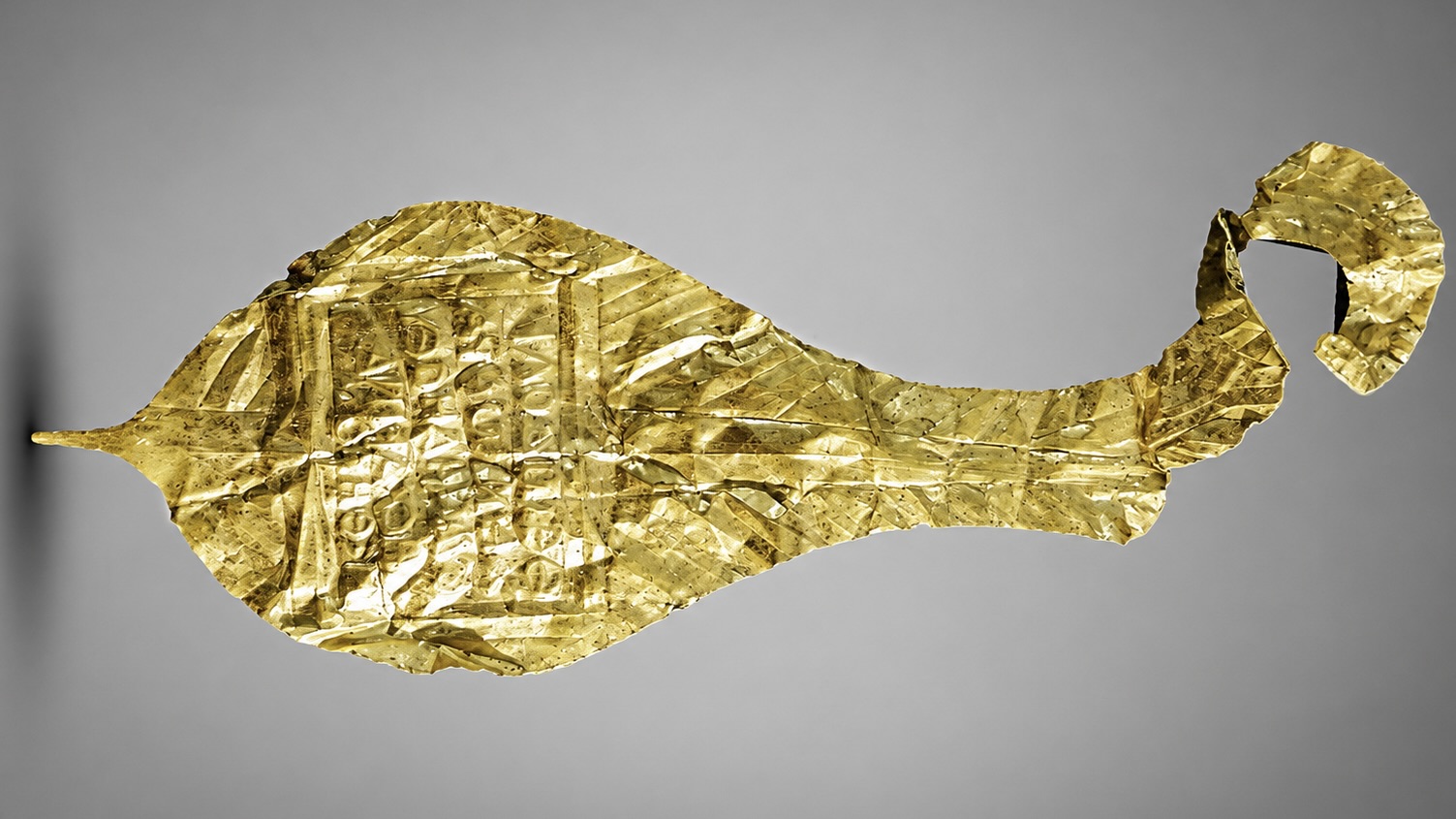
A gold plaque discovered at a Roman fortress in Georgia may have belonged to a wealthy merchant from Crimea who supplied Roman legions nearly 2,000 years ago.
A wealthy merchant from Crimea may have followed Roman soldiers across the Black Sea nearly 2,000 years ago, supplying their garrisons and expanding his business along the empire’s eastern frontier. His possible identity has emerged from an unexpected source: a small gold plaque discovered at the Roman fortress of Apsaros in Georgia. Inscribed with the name Thrasymedes, the object has prompted archaeologists to investigate whether its owner was a prominent trader already known from ancient records.
The plaque was discovered at Gonio, near Batumi, during excavations by a Polish-Georgian archaeological team. Researchers led by Radosław Karasiewicz-Szczypiorski of the University of Warsaw examined its Greek inscription and published their findings in Zeitschrift für Papyrologie und Epigraphik. What initially appeared to be a religious offering may also preserve evidence of a merchant’s connections with the Roman military.
A Merchant With Valuable Privileges
The name Thrasymedes immediately attracted attention because it was relatively uncommon around the Black Sea. Ancient inscriptions from Chersonesus, a Greek city in Crimea, mention a wealthy merchant with the same name. The city’s authorities had granted him an especially valuable privilege: permission to conduct maritime trade without paying customs duties.
Such an exemption could provide an enormous advantage in a region where merchants moved goods between distant ports. Karasiewicz-Szczypiorski believes this Thrasymedes may have supplied Roman soldiers, particularly those belonging to the Fifth Macedonian Legion. If the identification is correct, the merchant’s commercial activities extended far beyond Crimea.
The theory has an intriguing military connection. Detachments of Legio V Macedonica served in both Chersonesus and Apsaros, while stamped roof tiles discovered at the Georgian fortress document the legion’s presence during the AD 130s. A merchant supplying these troops could have followed their movements, transporting goods across the Black Sea.
Business and Religion on Rome’s Frontier
The gold plaque reveals another dimension of Thrasymedes’ life. Its Greek inscription records an offering to Jupiter Dolichenus, a deity originating in southeastern Anatolia whose worship became particularly popular among Roman soldiers. The god was typically depicted as an armed figure standing on a bull, combining eastern religious traditions with characteristics of the Roman Jupiter.
For someone conducting business with military personnel, worshipping a deity favored by soldiers might have offered a way to strengthen social connections. Yet the inscription does not explain why Thrasymedes made the dedication. Whether he adopted the cult through his commercial relationships or followed it for personal reasons remains unknown.
Apsaros itself was more than a military stronghold. Excavations have revealed evidence of amphora production and wine-making, highlighting the economic activities that supported Roman settlements along the coast. Although nothing directly connects Thrasymedes to these industries, they illustrate the commercial opportunities available to merchants operating around military garrisons.
A Sanctuary Still Waiting to Be Found
The gold plaque may also help archaeologists locate a lost religious sanctuary. Near the find, researchers discovered a bronze figurine showing an eagle on a bull, both animals associated with Jupiter Dolichenus. Together, the objects suggest that a place of worship dedicated to the deity once existed at the fortress.
The discoveries may belong to an early period in the cult’s expansion, before Jupiter Dolichenus became widely worshipped across Roman military communities. His followers eventually carried the religion to distant frontier regions, including Britain.
The identity of the plaque’s donor, however, remains uncertain. Thrasymedes could have been a soldier, a civilian associated with the garrison, or the wealthy Crimean merchant who enjoyed exceptional trading privileges. For archaeologists, the possibility that one man connected these distant Black Sea communities offers a compelling direction for further investigation.