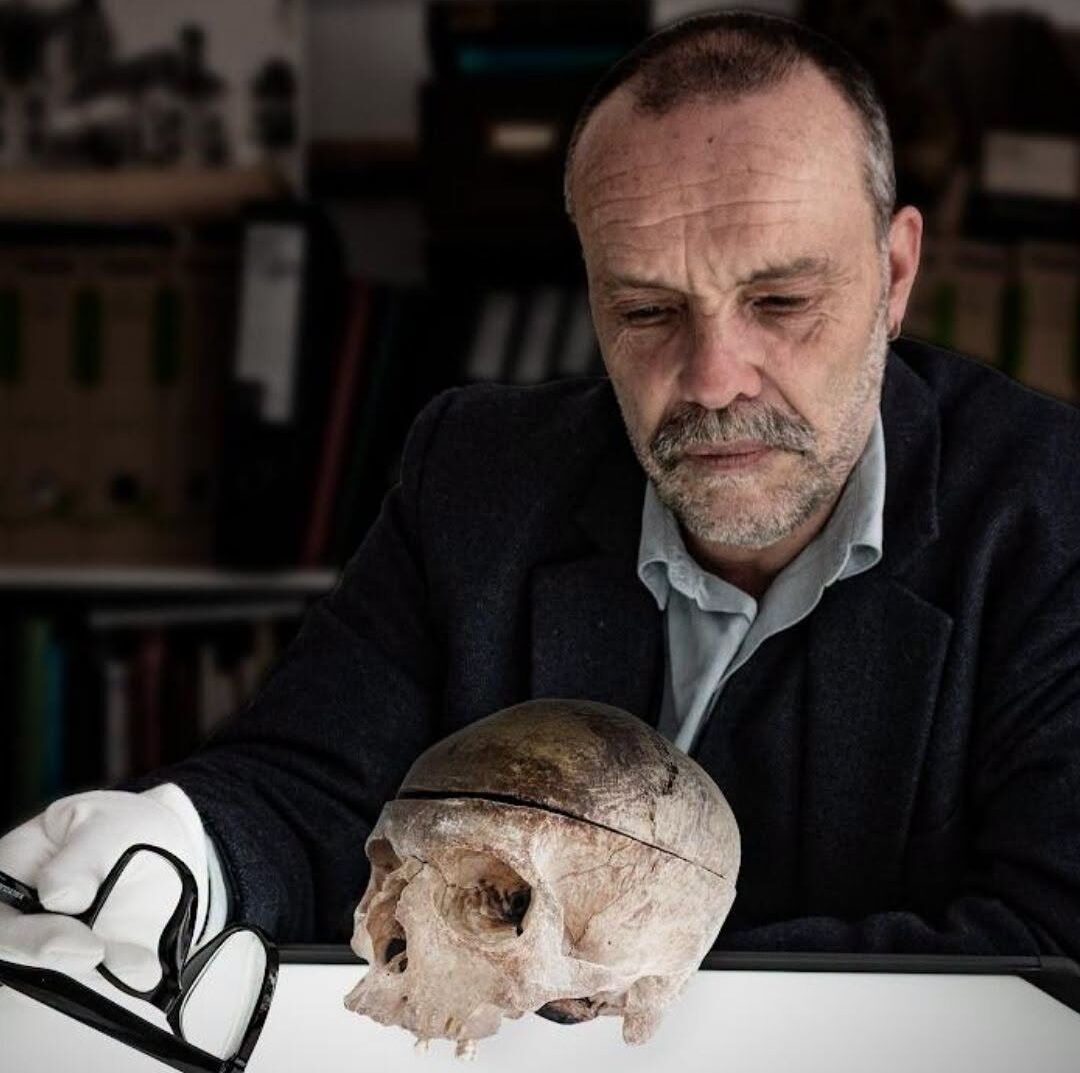
A human skull kept by a Scottish clan for generations was believed to belong to a medieval chieftain whose death inspired a centuries-old curse. But a forensic investigation has overturned the story’s central claim, revealing that the remains are hundreds of years younger than the legend.
For generations, a human skull kept by Scotland’s Clan Grant carried a chilling warning: if it ever left the family’s possession, the clan would lose its power and standing. The relic was said to belong to a medieval chieftain killed during a violent struggle for control of the Scottish Highlands. Now, modern science has delivered an unexpected twist. The skull is not medieval at all.
The discovery emerged from an investigation led by Grantown Museum, which brought the mysterious remains to forensic specialists at the University of Edinburgh and Surgeons’ Hall Museums. Radiocarbon dating ruled out a 13th-century origin, suggesting instead that the skull most likely belonged to someone who lived during the 19th or early 20th century.
A Skull, a Curse and a Family Secret
The skull had remained in the Grant family’s possession for more than 160 years, accompanied by a letter written in 1857. The document recounted a dramatic story of forbidden love, feuding clans and a violent encounter involving the Grants, MacGregors and Comyns.
According to the legend, a young Grant clansman eloped with the daughter of a MacGregor chieftain. Their flight eventually led to a confrontation in Strathspey, where deception, bloodshed and shifting loyalties helped establish the Grants’ influence over the region.
The tale also described the killing of a Comyn chieftain whose skull supposedly became a prized possession of the Grants. Tradition maintained that the relic had to remain with the family, warning of misfortune if it were ever removed.
The skull eventually disappeared from public view until Lord Reidhaven, a descendant of the Grant chiefs, found it in a family storeroom. Remarkably, it had been kept in a Harrods box alongside the old letter.
Early in 2026, Lord Reidhaven approached Grantown Museum curator Dan Cottam with a question: could the skull really belong to the chieftain described in the family legend?
The Scientific Test That Changed the Story
The skull immediately presented an unusual feature. Someone had cut across its upper portion and attached a metal hinge and fastening, allowing part of it to open. Such modifications raised suspicions that the object might have served a different purpose long after the medieval period.
Initial examination indicated that the remains belonged to an adult male, probably in his twenties or thirties. Researchers found no clear skeletal evidence revealing how he died.
The decisive breakthrough came when University of Edinburgh archaeologist Dr Sam Leggett examined the results of radiocarbon dating.
The analysis produced a broad possible date range of 1685–1941, with the greatest probability falling between 1800 and 1941. The findings ruled out the skull’s proposed medieval origin and raised the possibility that it had once formed part of an anatomical teaching skeleton.
CT scans revealed evidence of fittings that may originally have connected a movable lower jaw. Leggett suggested that the skull could have been acquired during the Victorian period, when anatomical specimens attracted interest among medical practitioners, collectors and wealthy enthusiasts.
Researchers also questioned the brown staining on the bone. It may have been applied to make the skull appear older, although museum investigators acknowledged that varnish used for preservation could offer another explanation. Neither possibility has been established.
The Mystery That Science Could Not Solve
The findings disappointed Lord Reidhaven, but they did not necessarily disprove every element of the old Highland legend. The story could have circulated long before the surviving skull became associated with it, and the original relic, if one existed, may have been lost or confused with another object.
Grantown Museum presented the investigation through a four-part podcast, The Legend of the Highland Skull, alongside an exhibition and animated film. The final episode, released on September 25, revealed the scientific results and explored how the family’s story had survived through generations.
Although further DNA and isotope testing might reveal more about the individual, researchers raised ethical concerns about additional destructive sampling. Without knowing the skull’s original provenance or descendant community, the University of Edinburgh did not consider further destructive analysis justified.
The investigation has therefore answered one question while leaving another unresolved. The skull cannot be the medieval chieftain described in the legend, but the identity of the man whose remains became part of the family’s history remains unknown.