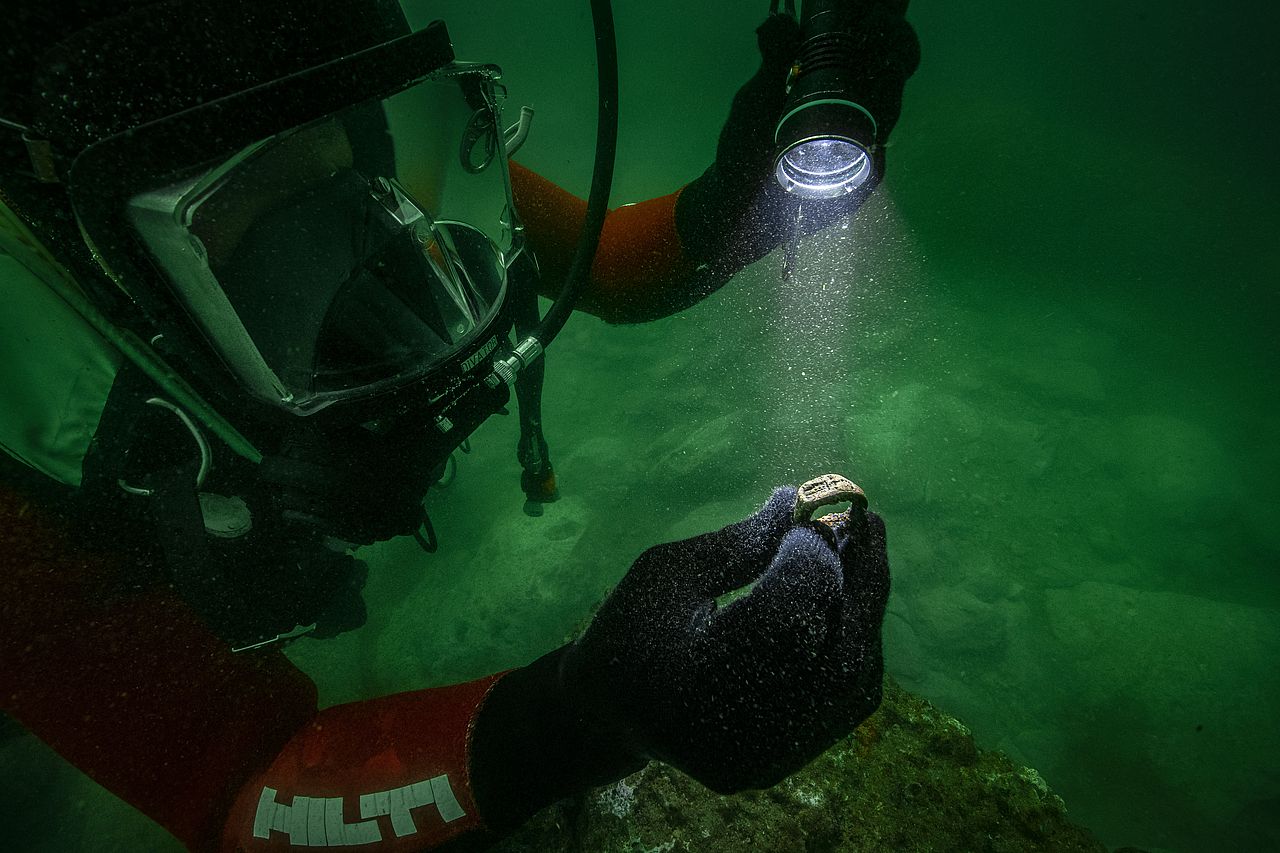
Underwater archaeologists exploring the submerged royal quarter of Alexandria have discovered a bronze signet ring depicting the city’s legendary lighthouse. Found among the ruins of a palace associated with Cleopatra’s dynasty, the object may reveal how one of the Seven Wonders of the Ancient World was administered nearly 2,000 years ago.
Deep beneath the waters of Alexandria’s ancient harbor, archaeologists have recovered a small bronze ring bearing the image of a monument that disappeared centuries ago. The engraving depicts the Lighthouse of Alexandria, one of the Seven Wonders of the Ancient World, and represents the first known signet ring featuring the famous structure. Yet the location of the discovery may be just as remarkable as the object itself: the ruins of a royal palace on an island once associated with Egypt’s most powerful rulers.
The ring emerged during underwater excavations on Antirhodos, a submerged island that formed part of Alexandria’s ancient royal quarter. Franck Goddio and his team from the European Institute for Underwater Archaeology (IEASM) discovered it while investigating the remains of the palace complex in the city’s former Great Harbor, known in antiquity as Portus Magnus.
A Lost Wonder Engraved on a Ring
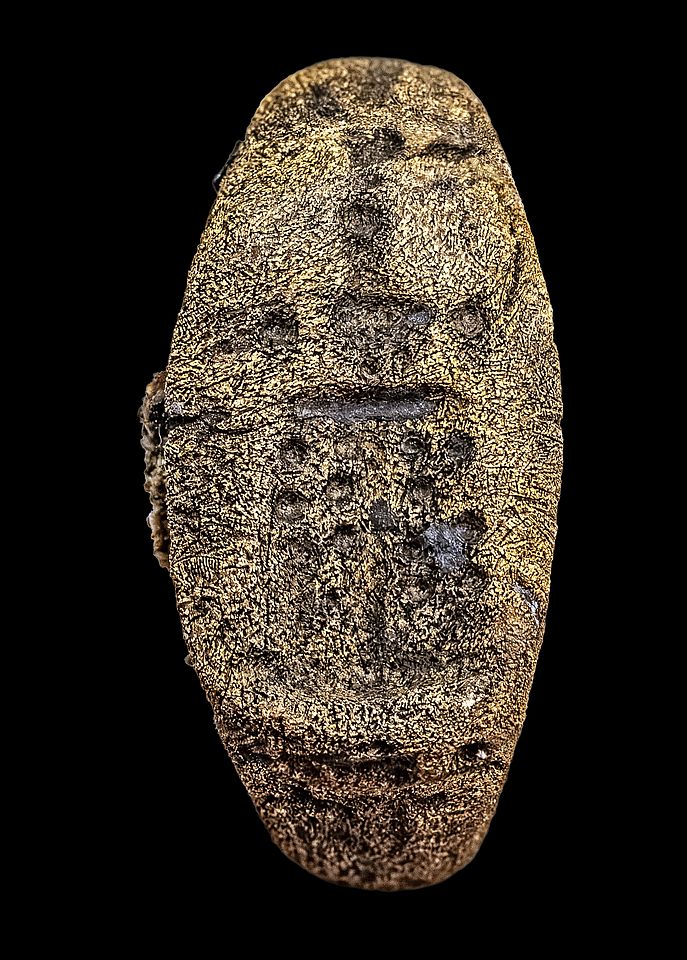
The bronze ring bears a relief image of the Pharos, the enormous lighthouse that once guided ships from the Mediterranean into Alexandria. Although the engraving has suffered considerable wear, its design closely resembles depictions preserved on Roman coins from the second century AD.
Such images are particularly valuable because the lighthouse no longer survives above ground. Ancient writers described its impressive height and appearance, while coins, engraved gemstones, lamps, and other objects preserve representations of its architecture. Scholars have long compared these sources to understand how the monument looked before its destruction.
Unlike a decorative ring, however, a signet could serve a practical purpose. Its engraved surface allowed an owner to stamp a recognizable image into a sealing material, potentially authenticating documents or identifying official property. The ring also has a small perforated projection opposite its engraved face, indicating that someone could have suspended it from a cord and worn it around the neck.
Goddio believes the object may have belonged to an individual connected with the lighthouse’s administration. If that interpretation proves correct, the ring would preserve more than a miniature representation of an architectural wonder: it could offer a rare glimpse into the officials responsible for its operation.
A Discovery in the Palace of Alexandria’s Rulers
The ring’s archaeological setting provides an important clue to its possible function. Divers recovered it within the palace complex on Antirhodos, an island that once stood at the center of Alexandria’s royal district during the Ptolemaic period.
The island belonged to the world of the Ptolemies, the Macedonian dynasty that ruled Egypt after the death of Alexander the Great. Their final ruler, Cleopatra VII, transformed Alexandria into the stage for some of antiquity’s most consequential political alliances, including her relationships with Julius Caesar and Mark Antony.
Today, the remains of this royal landscape lie beneath the Mediterranean. Goddio’s underwater investigations have revealed extensive architectural structures across several thousand square meters, gradually exposing a district that once accommodated the political and ceremonial life of the ancient capital.
The bronze ring suggests that the palace may have acquired a different function after Egypt became part of the Roman Empire in 30 BC. Rather than remaining exclusively a royal residence, parts of the complex could have housed administrative offices responsible for managing facilities within the harbor.
Researchers found the ring in close association with intact pottery dating to the second century AD. Although the object itself could be older, this context indicates that it remained in use during the Roman period. Goddio interprets the combination of the findspot and imagery as possible evidence that an official responsible for the lighthouse worked within the former palace.
The Lighthouse That Dominated the Ancient Harbor
The Lighthouse of Alexandria rose on the island of Pharos during the reigns of Egypt’s early Ptolemaic rulers in the third century BC. Ancient sources and modern reconstructions suggest that the monument stood more than 100 meters tall, making it one of the tallest structures of the ancient world.
Its architecture probably consisted of several distinct stages, with a broad square base supporting narrower upper sections. A light or fire at its summit helped mariners navigate the dangerous approaches to Alexandria, where shallow waters and hidden obstacles threatened ships arriving from across the Mediterranean.
The Greek geographer Strabo, who visited Egypt during the first century BC, described the lighthouse as an essential landmark for vessels approaching the harbor. By then, the tower had already become one of Alexandria’s defining monuments, combining a practical maritime function with an imposing architectural presence.
The Pharos survived the disappearance of the Ptolemaic dynasty and continued serving Alexandria for many centuries. A series of earthquakes eventually damaged and destroyed the structure, particularly during the medieval period. In the fifteenth century, builders erected the Qaitbay Citadel in the area traditionally associated with its location.
The ring offers another opportunity to examine the lighthouse’s appearance through an image created while the monument still stood. Its resemblance to Roman coin designs may also help specialists compare how Alexandria represented its most recognizable landmark across different objects and periods.