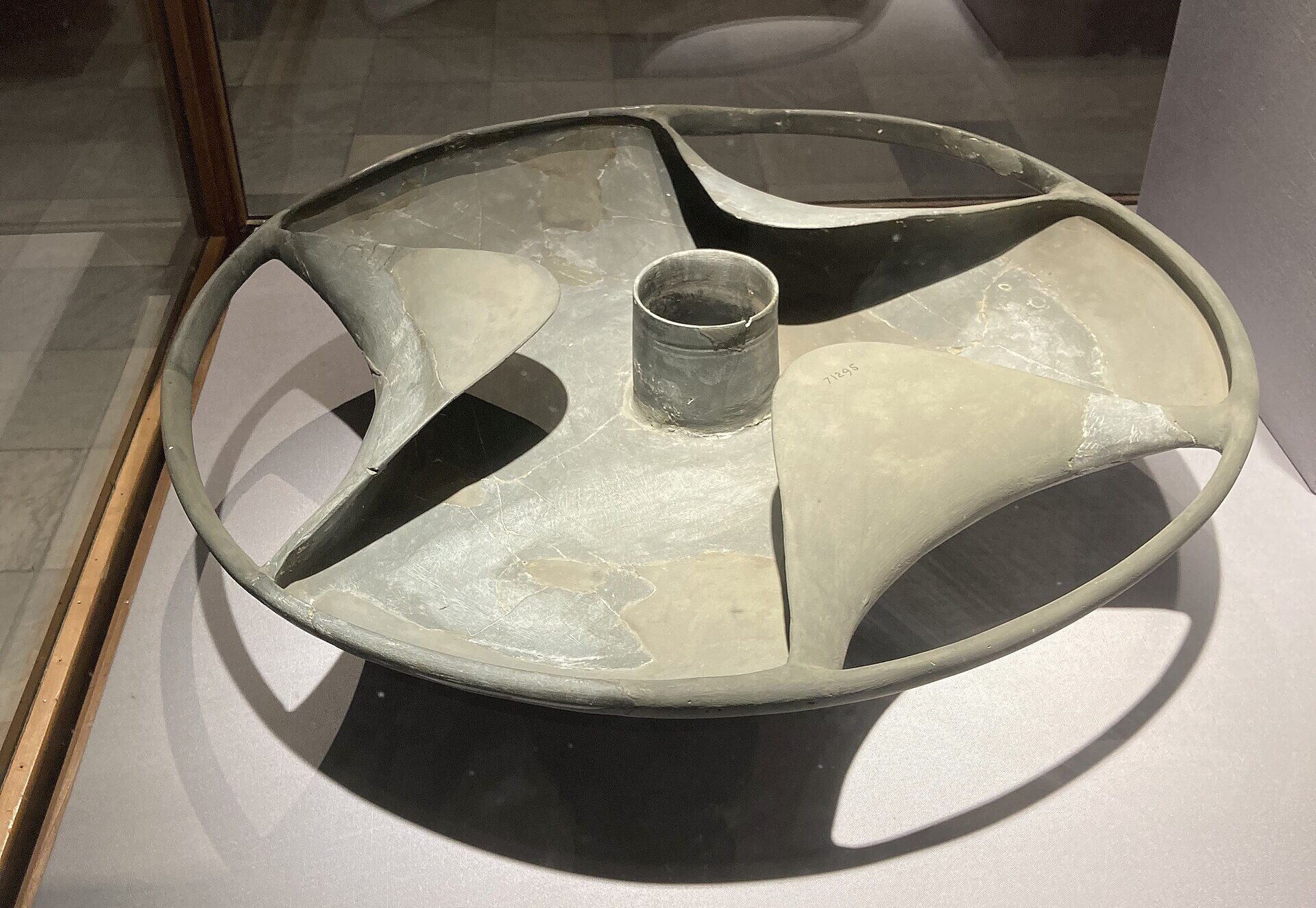
Discovered in 1936 at Saqqara, Egypt’s 5,000-year-old Sabu Disk still puzzles researchers with its strange, machine-like three-lobed stone design.
With three curved lobes, a raised central opening, and a shape that has been compared to a propeller, turbine, and even a modern car hubcap, the 5,000-year-old Sabu Disk appears strangely out of place among the familiar statues, jars, and carved vessels of ancient Egypt.
Yet the object is not modern. It was discovered inside one of Egypt’s earliest elite tombs—and nearly a century later, its original purpose remains unknown.
British Egyptologist Walter Bryan Emery uncovered the disk in 1936 while excavating Mastaba S3111 at Saqqara. The mud-brick tomb belonged to Sabu, a high-ranking official who lived during Egypt’s First Dynasty, more than 5,000 years ago.
This was the period when the newly unified Egyptian state was still taking shape. Royal authority, administration, monumental burial traditions and the artistic language later associated with pharaonic Egypt were only beginning to develop.
Among the objects placed inside Sabu’s tomb was a vessel unlike almost anything else known from the ancient world.
A Shape That Still Looks Modern
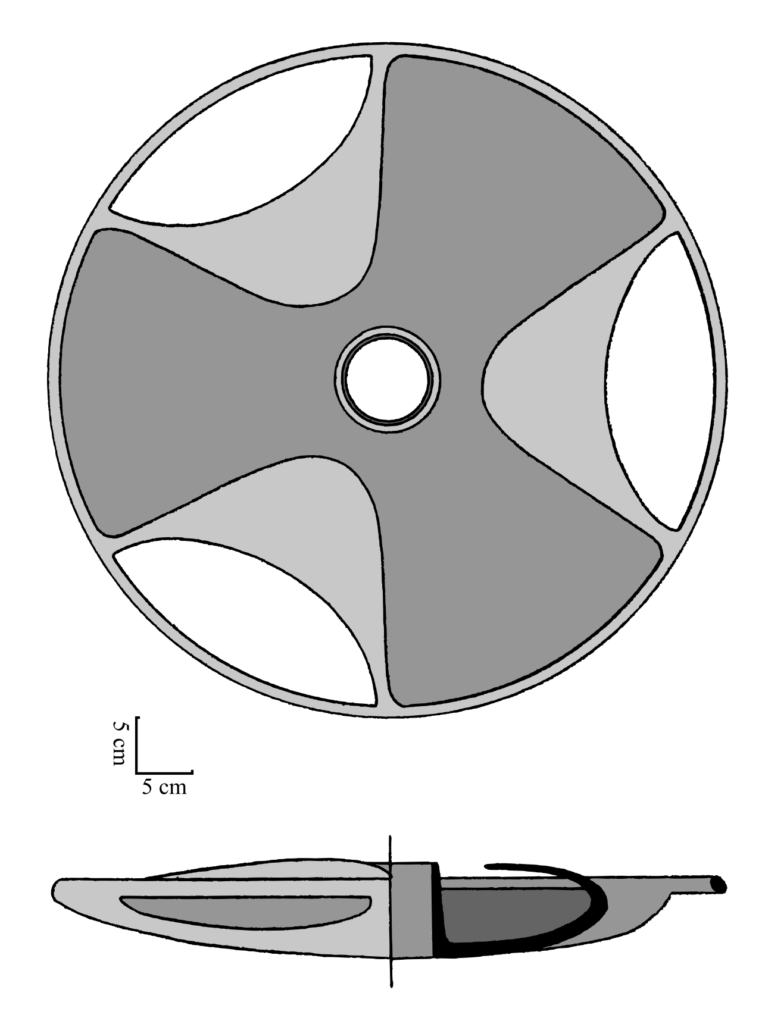
The Sabu Disk measures about 61 centimeters across and slightly more than 10 centimeters high. It was carved from metasiltstone, a fragile material often described in older publications as schist.
Its shallow circular body surrounds a central raised socket. Three thin, sweeping lobes curve inward, creating a form that seems mechanical even to modern eyes.
That appearance has become the source of its fame.
Stone vessels were common in early Egypt, and ancient craftspeople were capable of producing bowls, jars, and containers from extremely difficult materials. But the Sabu Disk stands apart. No widely accepted parallel has been found for its distinctive three-lobed design.
The object was discovered broken and later reconstructed. Even in its restored form, however, it remains difficult to classify.
Is it a bowl? A lamp? A ceremonial container? Or something entirely different?
A Vessel for the Afterlife?
The simplest explanation is that the disk was an elaborate funerary vessel.
Because it was recovered from a tomb, it may have contained food, oil or another offering intended to accompany Sabu into the afterlife. Its delicate stone and thin projecting sections would have made it unsuitable for rough daily use, suggesting that it may have been symbolic, ceremonial or specially produced for burial.
Another possibility is that the stone disk copied an object originally made from metal.
Ancient Egyptian craftspeople sometimes translated forms from one material into another. If the original design was intended for copper or another metal, its narrow curves and unusual geometry may have been easier to produce and more practical than they appear in stone.
No metal version, however, has been found.
From Beer Making to Water Pumps
Over the decades, researchers and enthusiasts have proposed a long list of possible functions.
The disk has been interpreted as a large oil lamp, a ceremonial incense burner, and a vessel connected with food or drink preparation. One proposal suggested that it may have formed part of a rotating device used during beer production, mixing grain and hot water.
Others have argued that the object could have moved water.
Modern replicas have shown that similarly shaped devices can create movement in liquid when rotated. This has encouraged claims that the disk was part of an ancient pump or hydraulic system.
But a working replica does not prove an ancient function.
No shaft, casing, mechanical frame or related installation was found in Sabu’s tomb. The material is also too fragile for many of the high-speed or high-pressure uses sometimes proposed for it.
The Ancient Technology Claims
The disk’s machine-like appearance has made it a favorite object in alternative-history theories.
It is regularly described online as an ancient turbine, propeller or evidence of lost Egyptian technology. More extreme versions claim that it proves the existence of an advanced forgotten civilization—or even contact with extraterrestrials.
There is no archaeological evidence for such claims.
The Sabu Disk was found in a funerary context alongside objects belonging to early dynastic Egypt. Nothing from the tomb suggests that it formed part of a machine.
Its resemblance to modern engineering may be striking, but resemblance is not proof.
A Mystery Carved in Stone
What makes the Sabu Disk so compelling is not that it proves the existence of lost technology. It is that an object created at the beginning of Egyptian civilization can still look so unfamiliar.
Its makers knew exactly what it was for. The people who placed it inside Sabu’s tomb probably understood its meaning immediately.
That knowledge has disappeared.
Today, the reconstructed disk is held by the Egyptian Museum in Cairo. Its dimensions can be measured, its material analyzed and its shape reproduced, but its original purpose remains uncertain.
Nearly 90 years after its discovery, Egypt’s ancient “hubcap” continues to invite explanations—and reject every final answer.
Emery, W. B. (1949). Great Tombs of the First Dynasty: Excavations at Saqqara (Vol. 1). Cairo: Government Press.