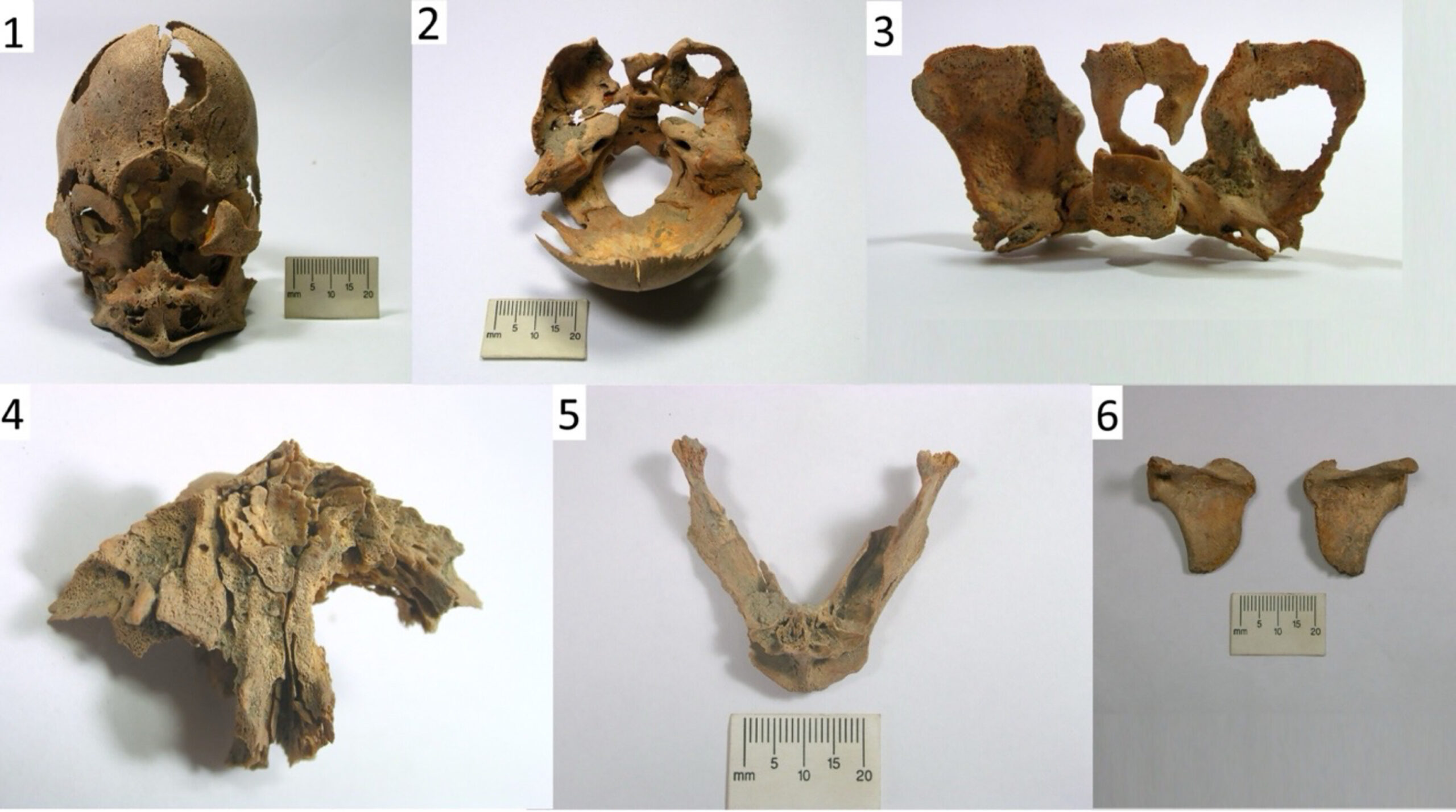
In a cemetery in southern Peru, archaeologists discovered two baby girls buried together inside a ceramic urn. One had an extraordinary condition: her skull contained a single eye socket in the center of her face. The other showed no comparable skeletal abnormalities. More than 1,600 years later, ancient DNA has revealed the genetic explanation for the unusual remains, while raising another question: why were the two infants buried together?
The discovery comes from Jauranga, an archaeological site in Peru’s Palpa Valley, a region associated with the Nasca civilization and its monumental desert geoglyphs. The findings, published in the journal Proceedings of the National Academy of Sciences (PNAS), document an exceptionally uncommon congenital condition in the archaeological record and provide evidence of how one ancient community treated a child born with severe physical differences.
Two Infants, One Burial Urn
The burial dates to the Middle Nasca period, approximately AD 325–440, when communities living along Peru’s southern coast maintained elaborate funerary traditions. Archaeologists excavating Jauranga uncovered dozens of graves, including the ceramic vessel containing the remains of the two infants.
The first child, identified as JA13A, lay at the bottom of the urn. A second infant, JA13B, had been placed above her. Both were identified genetically as female, but the circumstances surrounding their shared burial were unusual.
Burial in ceramic vessels was a recognized practice for Nasca children. Finding two infants together in one container, however, was less common. Researchers believe the remains were placed in the vessel during a single burial event, although the exact circumstances cannot be reconstructed.
The difference between the two skeletons was striking. While the upper infant showed no comparable developmental abnormalities, the child beneath her had an unusually small skull and a single central eye socket, together with other alterations in the bones of her face.
A Genetic Mystery Finally Explained
The unusual anatomy pointed to cyclopia, an exceptionally uncommon developmental condition associated with severe disruption of early brain formation. During normal embryonic development, the front portion of the brain separates into two hemispheres. In cases of cyclopia, this process fails, affecting the formation of the eyes and central facial structures.
The condition occurs in approximately one in every 100,000 births and is generally fatal before or shortly after birth.
To investigate its cause, researchers led by Elsa Tomasto-Cagigao of the Pontifical Catholic University of Peru examined the infant’s skeletal remains and analyzed ancient DNA. The results revealed an extra copy of chromosome 13, establishing that the child had trisomy 13, also known as Patau syndrome.
Trisomy 13 is a serious chromosomal disorder associated with multiple congenital abnormalities. Cyclopia is one of its most severe possible manifestations, although most individuals with trisomy 13 do not develop the condition.
The study published in PNAS provides a genetic explanation for the infant’s unusual skeletal anatomy. The researchers describe the case as an important example of how ancient DNA can help identify developmental disorders that would otherwise remain difficult to interpret from skeletal evidence alone.
Two Babies Who Did Not Share the Same Mother
The genetic investigation produced another significant finding. Although the infants had been buried together, their mitochondrial DNA indicated that they did not share the same maternal lineage.
This distinction complicates the interpretation of the grave. Were the children members of the same household? Did they die around the same time? Or did their families share circumstances that led to a joint burial?
The archaeological evidence does not provide definitive answers. Researchers have not established whether the infants were related through their fathers, and the shared burial cannot by itself reveal their social relationship.
Nevertheless, their placement within the same ceramic vessel suggests that their deaths were treated as part of a single funerary event. The child with cyclopia was not buried separately or accompanied by an unusual collection of grave goods.
Those details are particularly important because they allow archaeologists to examine how the community responded to a severe congenital condition, rather than considering the skeleton solely as a medical specimen.
How Did the Nasca Treat a Child Born Different?
The burial presents a question that genetics alone cannot answer: how was the infant perceived by the people who cared for her?
Researchers cannot establish exactly how long the child lived. Although the skeletal evidence may be compatible with survival beyond birth, determining whether she lived for days, weeks, or longer remains difficult.
The infant’s burial resembled those of other Nasca children. She was interred in an ordinary cemetery, in a familiar type of burial container, without distinctive offerings that would clearly indicate exceptional treatment.
This does not establish how she was treated during life. Nor does it mean that all children with disabilities occupied the same social position in Nasca society. A single burial cannot support such broad conclusions.
It does show that a child born with a profound congenital difference received a funerary treatment consistent with established local traditions.
An Ancient Life Beyond the Medical Diagnosis
For archaeologists, the significance of the Jauranga burial extends beyond the identification of trisomy 13. The discovery brings together skeletal analysis, genetics, and burial archaeology to investigate a child whose brief life would otherwise remain almost entirely unknown.
It also demonstrates the limits of modern scientific techniques. DNA can identify the chromosomal abnormality associated with her condition, but it cannot recover her name, explain the circumstances of her death, or reveal why another infant was placed in the same vessel.
The study adds an unusual case to the history of congenital conditions in ancient populations while contributing to a broader discussion about childhood, disability, and death in pre-Columbian societies.
More than sixteen centuries after the burial, the two infants remain together in the archaeological record. Science has now explained one child’s extraordinary anatomy, but the human circumstances behind their shared grave remain unresolved.
E. Tomasto-Cagigao,M. Reindel, J.I. Cuadrado,M. Lund Valle, K. Kassadjikova, K. Harkins, & L. Fehren-Schmitz, A Nasca-period perinatal burial reveals cyclopia associated with trisomy 13 in southern Peru, Proc. Natl. Acad. Sci. U.S.A. 123 (46) e2625042123, https://doi.org/10.1073/pnas.2625042123 (2026).