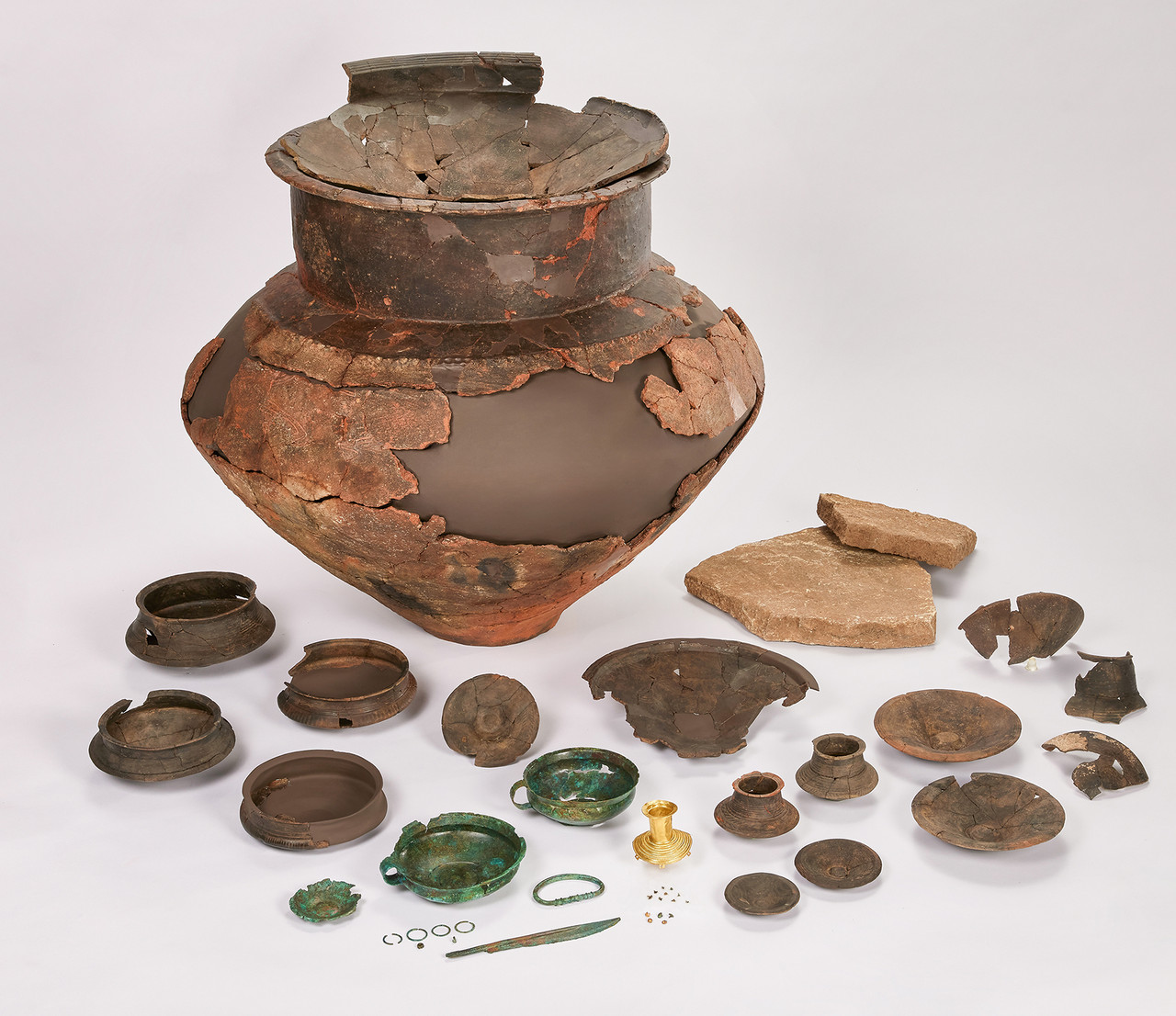
Archaeologists examining an extraordinary Bronze Age burial in Germany have discovered that a mysterious gold artifact may be something entirely different from what they first imagined. Tiny nails, traces of glue and the remains of a vanished material are now helping researchers piece together its forgotten history.
Someone in Bronze Age Germany was buried with an extraordinary collection of possessions: at least 24 ceramic vessels, valuable bronze objects and a curious piece of gold tucked beneath a bronze bowl. More than 3,000 years later, archaeologists have a better understanding of how that gold object was made. But they still cannot say what it was used for.
The burial, discovered near Albisheim in Germany’s Rhineland-Palatinate state, has become the focus of a fascinating archaeological investigation. New restoration findings announced by the General Directorate for Cultural Heritage of Rhineland-Palatinate (GDKE) on September 29 have overturned an early interpretation of the object, revealing clues that were almost invisible to the naked eye.
A Piece of Gold That Wasn’t What It Seemed
At first, the artifact’s unusual shape led specialists to suspect that someone had cut it from a larger gold vessel, possibly a bottle. That seemed one possible explanation for a piece whose original purpose was far from obvious.
But as conservators examined the object more closely, a different picture began to emerge. The gold had apparently been made in precisely the form in which it survives today. It was not simply a fragment salvaged from an older vessel.
Its decoration added another piece to the puzzle. Researchers believe a Bronze Age craftsperson worked the design into the thin gold sheet from the inside, suggesting a deliberate and carefully planned manufacturing process.
Then came the smallest, and perhaps most intriguing, clues. Specialists identified tiny nails, traces of adhesive and structures resembling cords. Together, they suggest that the gold was once attached to an organic material that has disappeared over the centuries.
The surviving artifact, in other words, may be only one part of something larger. Without the missing material, archaeologists cannot yet reconstruct its complete appearance or determine what purpose it served.
An Exceptional Grave Hidden Beneath a Building Site
The story began not with a search for ancient treasure but with preparations for a modern housing development in the Alzey hill country.
Between 2023 and 2025, archaeologists from the GDKE’s Speyer office investigated the land before construction began. Across the site, they documented more than 850 archaeological features dating to different periods, evidence of the area’s long history of human activity.
Among the discoveries was an exceptionally rich cremation burial from the 12th or 11th century BCE, near the end of the Bronze Age. The grave contained at least 24 ceramic vessels alongside unusual bronze and precious-metal objects, a collection that immediately distinguished it from more modest burials.
Such an elaborate arrangement raises questions about the person buried there. The quantity and quality of the offerings suggest that considerable care and resources went into the funeral, although researchers have not established the individual’s identity or exact position within society.
One detail remains particularly intriguing: the mysterious gold object lay beneath a bronze bowl. Whether the two items originally belonged together or were placed in that arrangement for a funerary reason is still unclear.
The Clues That Survived When Everything Else Disappeared
The Albisheim investigation highlights an unusual difficulty archaeologists face when studying ancient luxury objects. Gold may endure for thousands of years, while materials once used alongside it can decay almost completely.
That difference can leave researchers with a misleading picture of an artifact’s original form. A surviving gold component might look like a complete object even though the people who made it intended it to function as part of something more elaborate.
At Albisheim, the adhesive, nails and cord-like traces provide rare evidence of that lost construction. GDKE specialists now plan further scientific examinations of these remains, hoping to identify the missing materials and understand how the different components fitted together.
Dr. Ulrich Himmelmann, acting head of the GDKE’s State Archaeology Directorate, has emphasized the importance of studying minute traces rather than relying only on an artifact’s visible shape. Small tool marks and material residues, he explained, can reveal crucial details about how objects were manufactured.
The next stage of research will also involve comparisons with similar archaeological discoveries. Those investigations may eventually help specialists identify the gold artifact’s original function, a question that remains unanswered despite the progress already made.
For now, the most revealing evidence from this remarkable Bronze Age grave is not the gold’s value or elaborate decoration. It is the tiny traces of materials that disappeared long ago, preserving clues to an object whose original appearance has yet to be reconstructed.
General Directorate for Cultural Heritage of Rhineland-Palatinate (GDKE)