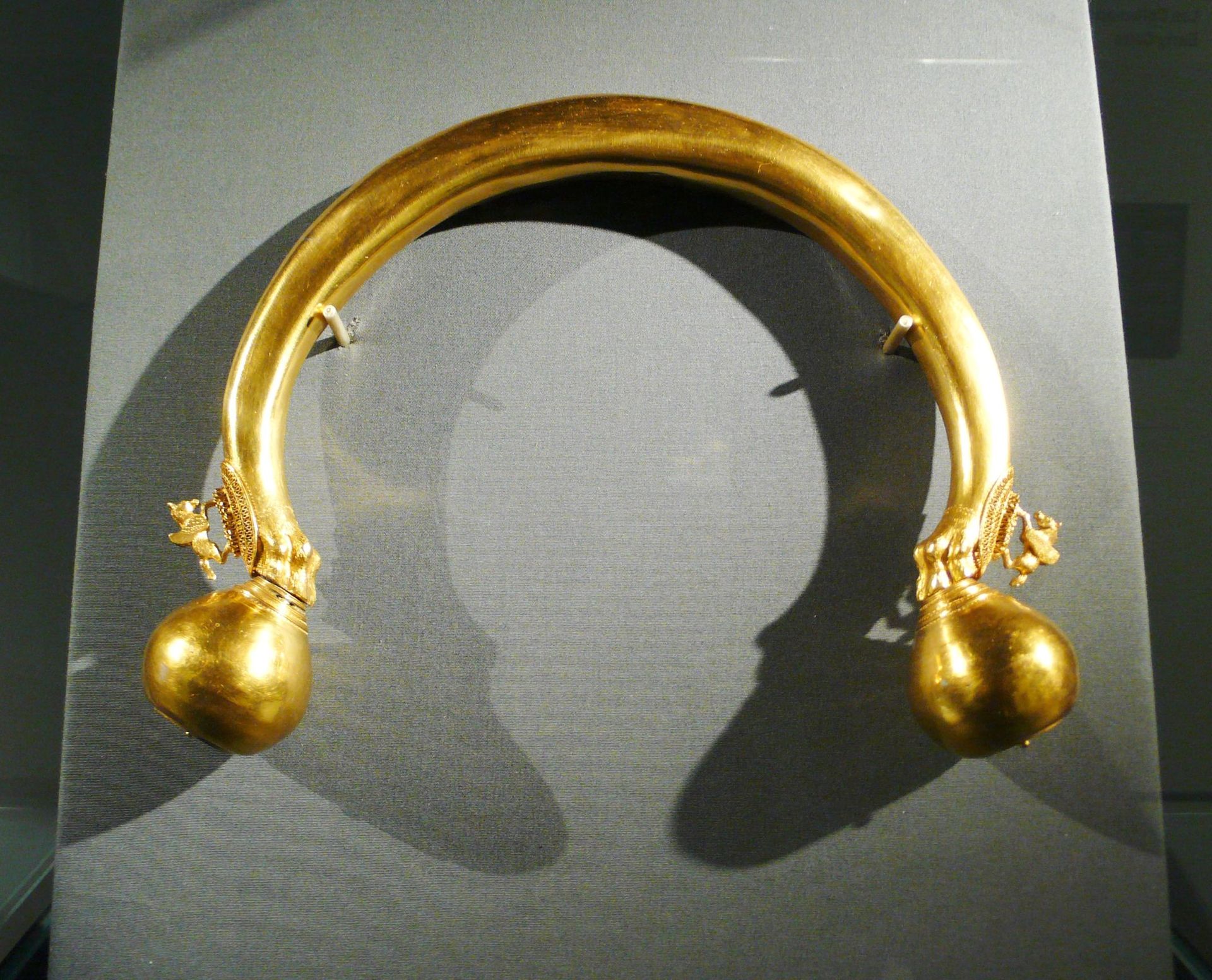
A 2,500-year-old gold torc from the celebrated Vix Treasure has been stolen in a daylight raid on a museum in eastern France, adding to a disturbing sequence of robberies targeting some of Europe’s most important cultural objects.
The theft occurred on July 24, 2026, shortly after the Musée du Pays Châtillonnais in Châtillon-sur-Seine opened to visitors. Created around 500 BC, the solid-gold ornament is regarded as a masterpiece of Early Iron Age metalworking and one of the defining objects of Celtic archaeology.
A Four-Minute Daylight Raid
According to France’s National Gendarmerie, two people dressed in black entered the museum wearing wigs, hats and glasses. They passed the reception area, went directly to the Vix Treasure gallery and used a sledgehammer and hammer to smash the torc’s secured display case.
The thieves escaped less than four minutes after entering the museum. One suspect, a man in his twenties, has since been arrested and placed in pre-trial detention. Investigators are still searching for the second thief, possible accomplices, and the missing torc.
Weighing almost half a kilogram, the torc was discovered in January 1953 inside the grave of the “Lady of Vix,” an elite woman buried on a chariot. The burial also contained the monumental bronze Vix Krater, one of the most remarkable surviving works of ancient Greek metalwork.
Why the Loss Is Greater Than the Gold
The Vix torc is not valuable simply because it is made from gold. Its form, construction and elaborate terminals preserve evidence about ancient craftsmanship, political authority and cultural connections between Celtic communities and the Mediterranean world.
Once an archaeological object enters a criminal network, that evidence is placed at risk. The artifact can no longer be studied directly, displayed to the public or examined using new scientific methods. If it is dismantled or melted down, a unique historical document is reduced to anonymous raw material.
UNESCO has warned that the theft and trafficking of cultural property erase scientific, historical and emotional knowledge. When objects disappear, communities lose part of their identity and future generations lose access to physical evidence of the past.
No insurance valuation or gold price can measure that damage.

A Pattern Repeated Across Europe
The Vix robbery is not an isolated incident.
In November 2022, thieves broke into the Celtic-Roman Museum in Manching, Germany, after cutting local telecommunications cables. They removed 483 Celtic gold coins and a gold ingot in approximately nine minutes.
Several offenders were later convicted, but Bavarian police reported in May 2026 that most of the treasure—including 411 coins and the ingot—remained missing. Only around 500 grams of the stolen gold had been recovered, while investigators suspected that part of the collection had been melted into gold lumps.
In January 2025, criminals used explosives to enter the Drents Museum in the Netherlands. They stole the 2,500-year-old Coțofenești Helmet and three Dacian gold bracelets that had been loaned by Romania for an exhibition.
The helmet and two bracelets were eventually recovered and returned to Romania in 2026, but one bracelet remains missing. The case demonstrated how quickly internationally important archaeological objects can be removed from a public collection.
France faced another major shock in October 2025, when thieves targeted two high-security display cases in the Louvre’s Galerie d’Apollon and stole eight historic jewels of incalculable cultural value.
The answer cannot simply be to replace original artifacts with replicas or remove important discoveries from public view. Museums exist to preserve authentic objects and make them accessible. But the Vix theft shows that glass cases, alarms and surveillance systems alone may no longer be sufficient against rapid, targeted attacks.
The stolen torc is gold, but it is also something far harder to replace: surviving evidence of a woman, a society and a European world that existed 2,500 years ago. Every day it remains missing, part of that history remains beyond public reach.
Cover Image Credit: A unique 24-carat Celtic torc/diadem, whose ends are adorned with winged horses on intricate filigree pedestals and lion paws, inspired by Etruscan, Scythian or Middle Eastern bestiary. Public Domain