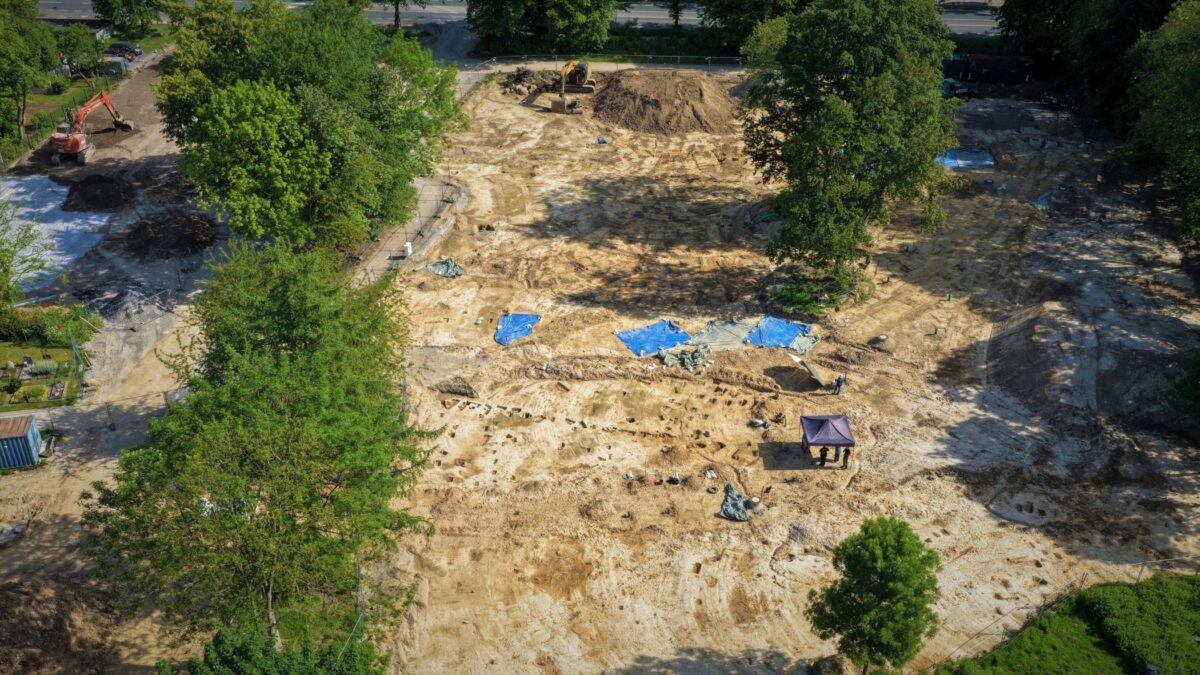
Archaeologists in western Germany have completed excavations at an unusually large Germanic settlement containing at least 30 longhouses, revealing what may have been one of the most important regional centers north of the Roman frontier between the second and fifth centuries AD.
The settlement was uncovered at Bielefeld-Sieker in North Rhine-Westphalia. According to the Landschaftsverband Westfalen-Lippe (LWL), some of its timber buildings measured up to 30 meters long and eight meters wide, alongside numerous outbuildings and smaller sunken-featured structures.
At a time when most communities in eastern Westphalia consisted of isolated farms or small hamlets, the scale and density of the Sieker settlement were exceptional.
LWL archaeologist Dr. Sven Spiong described the site as “an important center for the region at that time.”
Longhouses Rebuilt for Generations
Excavations revealed rows of closely spaced longhouses, several of which had been rebuilt two or three times on almost exactly the same plots.
This repeated construction suggests that individual farmsteads remained in use for as long as 200 years, indicating a level of settlement continuity rarely documented in the region.
Although detailed dating work has only begun, the pottery recovered so far indicates that the settlement reached its greatest intensity during the second and third centuries AD.
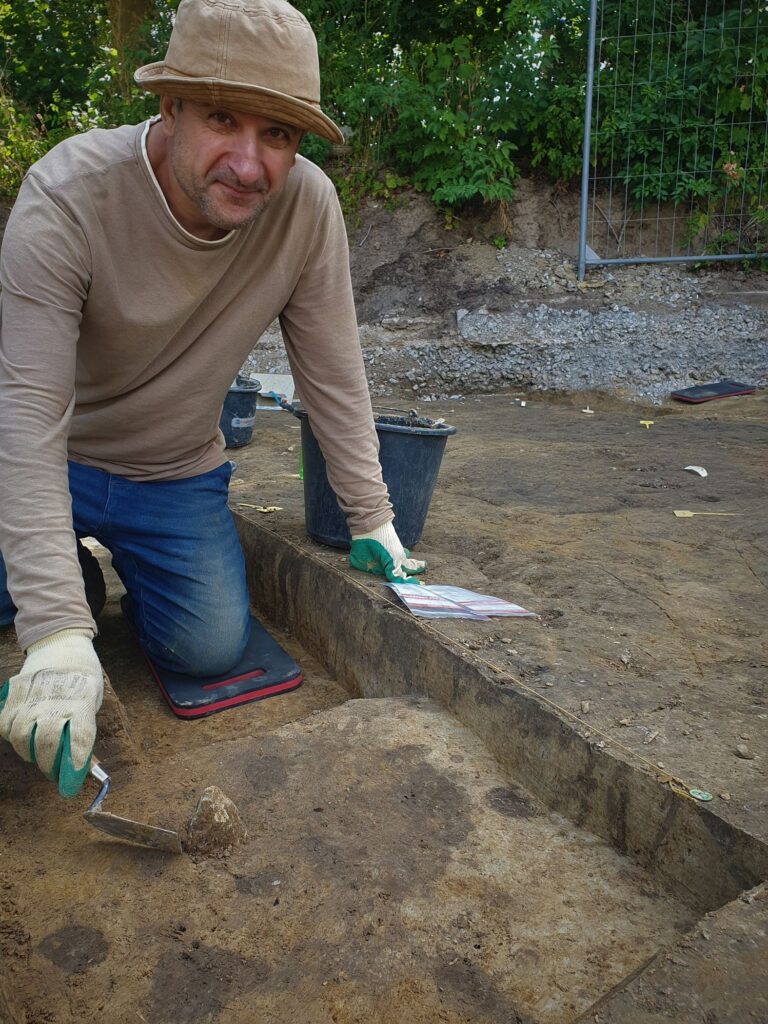
One of the most valuable discoveries was a small Roman coin dating to the second century. The coin was recovered from the fill of a posthole that once held part of a building’s timber framework.
“It provides a precise date for the post-built house,” excavation director Dr. Eva Manz explained.
Because the coin was found within a specific architectural feature, researchers can use it to date the building more accurately and trace changes in Germanic house construction, including shifts in room layouts and the organization of domestic space.
A Settlement Beside an Ancient Route
The community occupied a carefully chosen location on the northern edge of the Teutoburg Forest.
Fertile loess soils offered favorable conditions for agriculture, while the Mühlenbach stream, which once flowed directly through the settlement, provided a reliable supply of fresh water throughout the year.
Its proximity to an ancient pass through the Bielefeld hills may have been equally important.
During Rome’s military campaigns east of the Rhine, troops and supplies traveled along the Lippe River toward Anreppen and Paderborn before continuing through the Senne region toward the Weser.
Evidence of this Roman military network has been found nearby. A marching camp was previously identified in Sennestadt, while a Roman watchtower on the Sparrenberger Egge appears to have monitored movement through the approximately 2.5-kilometer-long Bielefeld Pass.
The route did not disappear when Roman armies withdrew from the region. Archaeologists believe it remained active for centuries and gradually developed into a trade corridor connecting local Germanic communities with the Roman world west of the Rhine.
Numerous Roman imports discovered in the settlement’s nearby cemetery, together with Roman coins found along the route, indicate that exchange continued into the fifth century.
Roman Imports and Agricultural Wealth
The settlement’s fertile land may have allowed its inhabitants to produce more food than they required for their own survival.
Researchers suggest that surplus grain, livestock or other agricultural products could have been sold or exchanged with merchants traveling along the route. In return, Roman objects and other imported goods may have reached Sieker.
Not every Roman artifact necessarily arrived through peaceful trade. Some objects may have been taken as plunder or brought home by Germanic men who had served in the Roman military.
Determining how these imported items reached the settlement will be one of the central questions examined during the next phase of research.
Did the Community Find Safety in Numbers?
Despite its wealth and strategic position, the settlement appears to have had no defensive wall. No contemporary hillfort has been identified nearby.
This raises another question: did the unusually dense arrangement of houses provide a form of collective security?
Germanic farmsteads in the region were normally separated by considerable distances. At Sieker, however, families lived much closer together.
Spiong suggests that the settlement’s inhabitants may have chosen this compact arrangement partly to protect themselves from travelers attracted by the community’s prosperity. The same road that brought traders and imported goods may also have exposed the settlement to raiders.
The End of a Regional Center
The settlement survived until the fifth century, when the Western Roman Empire and many of its established communication networks were breaking down.
According to Spiong, Sieker’s rise was probably closely connected to its location beside routes that had developed during the Roman period. When those traditional systems of movement and exchange collapsed, the settlement may have lost the economic foundation that had sustained it for generations.
Scientific analysis of the finds will now continue through the long-term research project “Westgermanien im Wandel”—“Western Germania in Transition”—recently accepted into the research program of Germany’s national academies.
The project is expected to clarify how the settlement developed, how its inhabitants interacted with the Roman world, and why this unusually large community eventually disappeared.