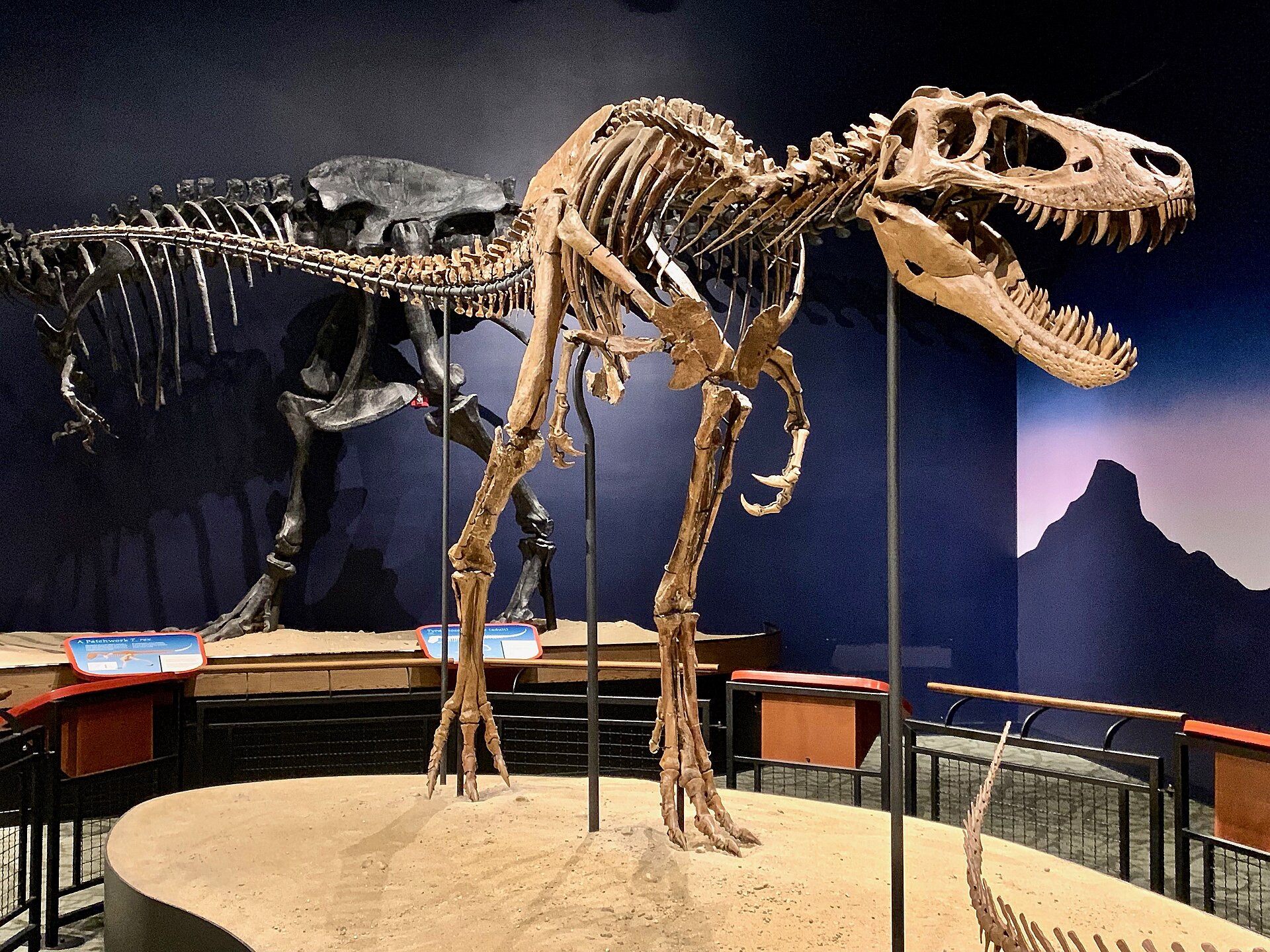
A 67-million-year-old dinosaur skeleton once believed to belong to a young Tyrannosaurus rex has sold for $47.3 million at a New York auction. Nicknamed Jodi, the fossil belongs to a recently validated dinosaur genus whose identity sparked decades of scientific debate.
For years, paleontologists argued over whether the smaller predator known as Nanotyrannus was a distinct dinosaur or simply a young Tyrannosaurus rex. Now, one of its rarest skeletons has become the center of another extraordinary story. A fossil nicknamed Jodi sold for $47.3 million at Sotheby’s in New York on October 27, 2026, making it the second-most expensive dinosaur skeleton ever sold at auction.
The price stunned even the auction house, which had estimated the specimen would fetch between $6 million and $9 million. Six bidders competed for approximately 12 minutes before an anonymous buyer secured the 67-million-year-old fossil, whose scientific identity had been the subject of a long-running paleontological dispute.
A Dinosaur That Changed Its Identity
Jodi’s story began in Montana in 2019, when rancher Jodi Pierson discovered fossilized bones on her property near the town of Jordan, within the famous Hell Creek Formation. Commercial paleontologist Clayton Phipps and his team excavated the remains that year, recovering an unusually complete skeleton of a small tyrannosaur-like predator.
The fossil eventually entered a private collection and appeared at London’s Frieze Masters exhibition in 2023. At the time, sellers presented it as a juvenile T. rex under the name Chomper, with an asking price of approximately $20 million.
That identification would later change dramatically.
For decades, scientists had disagreed about Nanotyrannus, a relatively small carnivorous dinosaur whose skull and teeth resembled those of Tyrannosaurus. Some researchers considered it a separate predator, while others argued that the known specimens represented younger T. rex individuals that had not yet reached their enormous adult size.
In October 2025, paleontologists Lindsay Zanno and James Napoli published a study in Nature that provided strong evidence supporting Nanotyrannus as a distinct genus. Their analysis of a different, exceptionally preserved skeleton found anatomical characteristics and growth patterns inconsistent with the idea that these animals were simply immature T. rex.
The researchers also identified two Nanotyrannus species, suggesting that the ecosystems of Late Cretaceous North America supported a more diverse group of large predators than previously recognized.
What Makes Jodi Worth Millions?
The skeleton offered at Sotheby’s measures approximately 6 meters (19.6 feet) long and stands about 2.9 meters (9.5 feet) high on its exhibition mount. It consists of roughly 191 fossil bones, including a remarkably complete skull preserving 53 bones and around 50 teeth.
According to the auction catalogue, the specimen also retains important parts of its forelimbs, pelvic girdle and vertebral column. These features are particularly valuable because they allow researchers to compare the animal’s anatomy with other tyrannosaur specimens.
Sotheby’s describes Jodi as one of only three substantial Nanotyrannus skeletons known to science. Its rarity, preservation and connection to a major paleontological debate made it an unusual offering in the rapidly expanding market for dinosaur fossils.
The final price far exceeded expectations. At $47.3 million, including auction fees, Jodi fell just short of the record $50.1 million paid for a T. rex skeleton named Gus in July 2026.
A Scientific Treasure Behind Closed Doors?
The spectacular sale also revives a familiar controversy within paleontology: what happens when scientifically important fossils enter private collections?
Unlike specimens held by public museums, privately owned dinosaur skeletons may become difficult for researchers to access. Owners can decide whether to permit examinations, lend material to institutions or display their purchases publicly.
That concern carries particular weight for Nanotyrannus. Scientists have only a small number of substantial specimens available for comparison, and discoveries involving their growth and anatomy could influence how researchers reconstruct the final ecosystems of the dinosaur age.
Jodi’s new owner has not been publicly identified, leaving questions about the skeleton’s future accessibility. Although the sale demonstrates the extraordinary commercial value collectors now place on rare fossils, it offers no guarantee that the specimen will remain available for scientific investigation.