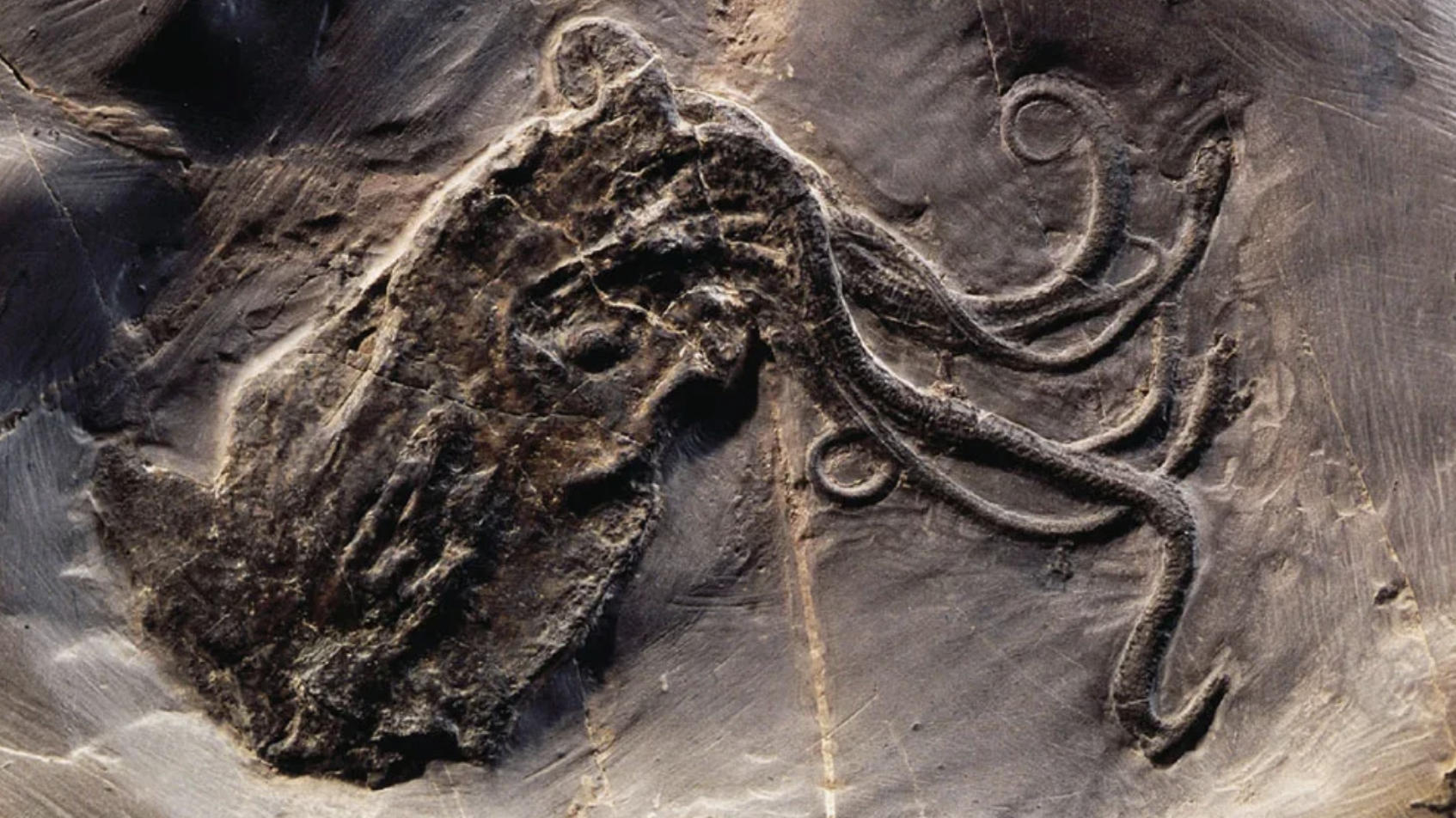
A fossil that spent decades carrying the title of the world’s oldest known octopus has lost its place in the cephalopod family tree. New scans show that the roughly 310-million-year-old animal was not an octopus at all, but a badly decomposed relative of the modern nautilus.
The specimen, known as Pohlsepia mazonensis, was found at the Mazon Creek fossil site in Illinois and formally described in 2000. Its sac-shaped body, apparent fins and arm-like structures led researchers to identify it as an early octopus. That interpretation pushed the known history of octopuses back by around 150 million years and eventually earned the fossil recognition from Guinness World Records.
A study published in Proceedings of the Royal Society B has now overturned that identification. Researchers used advanced imaging methods to examine structures hidden beneath the surface of the fossil and discovered a feeding organ that could not have belonged to an octopus.
Hidden Teeth Revealed the Fossil’s Identity
The crucial evidence was a radula, a ribbon-like organ covered with rows of microscopic teeth that molluscs use to process food.
Because the structure was concealed within the surrounding rock, it could not be seen during the original examination. The new team applied scanning electron microscopy, micro-CT scanning and synchrotron imaging, which uses intense X-rays to map features that remain invisible under ordinary light.
At least 11 tooth-like elements could be identified in each preserved row. Octopus radulae normally contain seven or nine elements per row, while nautiloids possess a larger arrangement, typically containing 13.
The number, shape and position of the fossil’s teeth therefore ruled out an octopus identity. Instead, the radula closely resembled that of Paleocadmus pohli, a fossil nautiloid already known from Mazon Creek. The researchers concluded that Pohlsepia mazonensis should be reassigned to Paleocadmus, most probably as the same species.
“The world’s most famous octopus fossil was never an octopus at all,” said lead author Thomas Clements, a lecturer in invertebrate zoology at the University of Reading.
According to Clements, the animal had already been decomposing for weeks before it was buried. The deterioration distorted its body, creating folds and appendage-like shapes that later appeared remarkably similar to the arms and fins of a soft-bodied octopus.
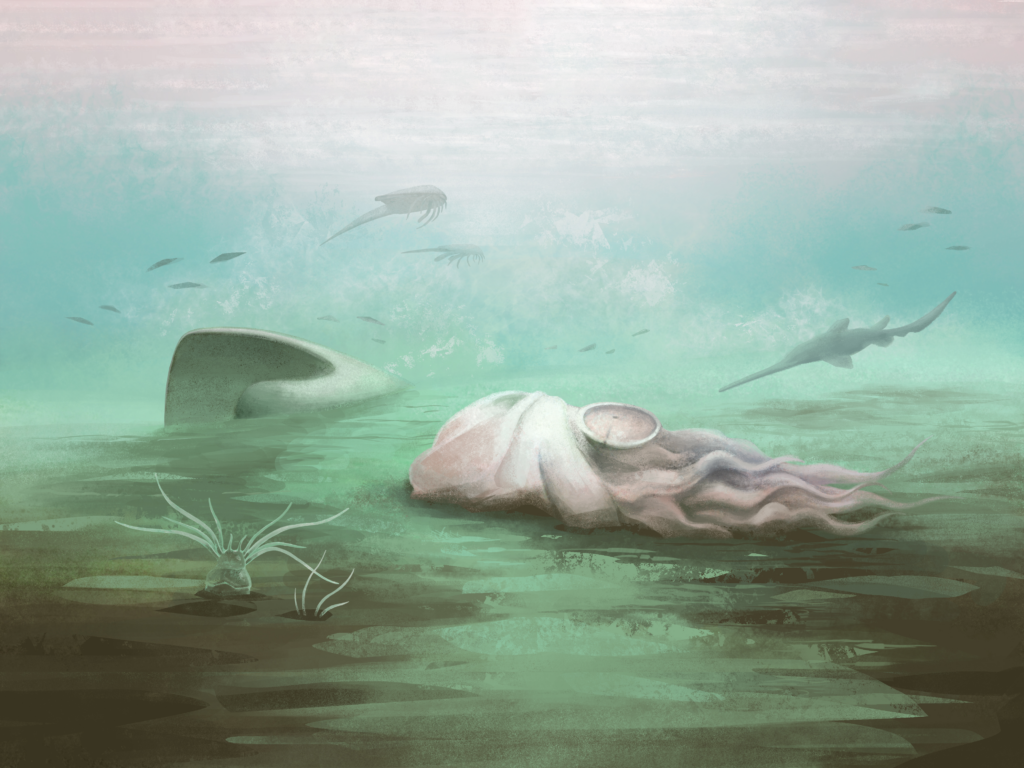
Decay Created a Convincing Octopus Shape
Fossilization at Mazon Creek often occurred inside iron-rich siderite concretions. These mineral deposits can preserve outlines and traces of soft tissues that normally disappear before fossilization.
Such preservation is scientifically valuable, but it can also be misleading. Decay causes tissues to collapse, separate and change position. In the case of Pohlsepia, structures originally interpreted as eight arms, fins, eyes and a fused head-and-body region could not be confirmed by the new scans.
Researchers found no clear siphon and no distinct crown of octopus arms. The newly detected radula provided a much more reliable anatomical marker than the fossil’s distorted external outline.
This explains why the specimen remained controversial for so long. Its apparent anatomy resembled a cirrate octopus—one of the deep-sea forms that includes the so-called dumbo octopuses—but it lacked several diagnostic features expected even in an early member of that group.
Technology eventually made it possible to look through the mineral matrix rather than rely solely on the visible surface.
What the Discovery Means for Octopus Evolution
Removing Pohlsepia from the octopus lineage closes a major gap in the evolutionary record.
Its original identification appeared to place advanced octopus-like animals in the Late Carboniferous, between approximately 311 million and 306 million years ago. That date conflicted with other fossil and molecular evidence indicating that the principal lineages of modern octopuses and their ten-armed relatives, including squid and cuttlefish, separated much later.
Without Pohlsepia as evidence, there is no longer a convincing fossil basis for placing crown-group octobrachians in the Palaeozoic Era. The revised interpretation is more consistent with an origin and diversification during the Mesozoic, probably around the Jurassic Period.
The fossil has not, however, become less important. Its new identity gives it a different record.
The preserved remains now represent the oldest unequivocal soft-tissue evidence of a nautiloid, extending the known record of such preservation by around 220 million years. Most fossil nautiloids are represented only by their hard shells, making preserved feeding structures and body tissues extremely rare.
The study also shows how established fossil identifications can change when new analytical tools reveal anatomical evidence hidden inside the rock.
A row of microscopic teeth, unseen for 300 million years, was enough to remove the world’s oldest “octopus” from the record books—and replace it with an equally exceptional glimpse of an ancient nautiloid.
Thomas Clements, Imran Alexander Rahman, Alan R. T. Spencer, Christian Klug, Dirk Fuchs, Isabelle Rouget, Isabelle Kruta, Sebastian Schöder, Jack Wittry, Orla G. Bath Enright, Pierre Gueriau; Synchrotron data reveal nautiloid characters in Pohlsepia mazonensis, refuting a Palaeozoic origin for octobrachians. Proc. R. Soc. B 1 April 2026; 293 (2068): 20252369. https://doi.org/10.1098/rspb.2025.2369