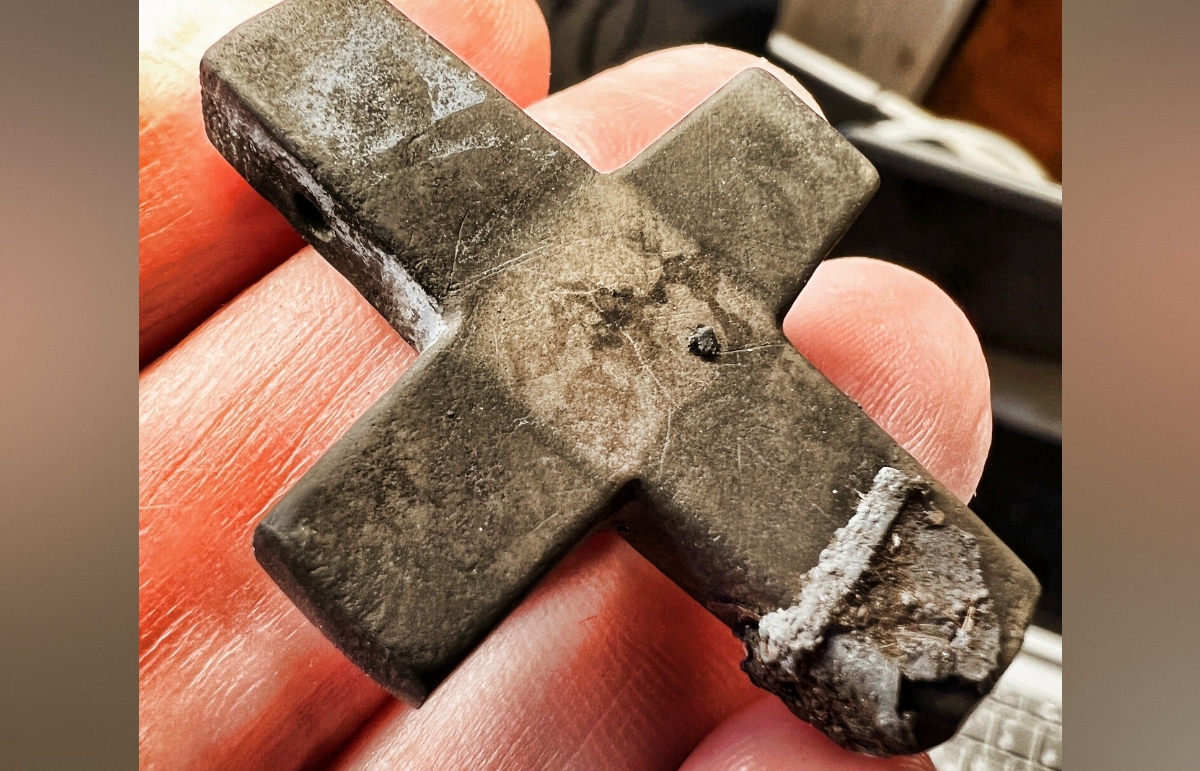
Archaeologists working in the historic Russian town of Torzhok have uncovered a stone Christian cross decorated with silver appliqués in an archaeological layer dating to the early 13th century.
The discovery was announced by archaeologist Natalya Sarafanova, a researcher affiliated with the Institute of Archaeology of the Russian Academy of Sciences and the Russian Historical and Ethnographic Museum. The cross was found during excavations conducted in Torzhok in 2025.
The object is fragmentary, and only a small portion of its precious-metal decoration has survived. Nevertheless, the combination of stone and silver makes it an important piece of material evidence for Christian life and religious craftsmanship in medieval Russia.
Specialists are now completing the cross’s conservation and post-excavation treatment. Once this work is finished, the artifact is expected to enter the collection of the Torzhok Museum-Reserve, where it will be preserved alongside other objects illustrating the town’s long history.
A Christian Town with Deep Medieval Roots
Torzhok is among the oldest towns in Russia. Its medieval cultural layers preserve evidence of houses, workshops, trade and religious life stretching back hundreds of years.
Official reports from the Institute of Archaeology show that parts of Torzhok’s left bank were already occupied by the middle of the 12th century. By the middle of the 13th century, residential estates and houses had begun to reshape sections of the settlement. Even where later construction damaged the archaeological deposits, excavations have continued to reveal medieval pits, structures and everyday objects.
Christianity was already firmly embedded in Torzhok’s landscape when the newly discovered cross was deposited or lost. The town’s most prominent religious institution is the Borisoglebsky Monastery, traditionally dated to 1038 and dedicated to the canonized princes Boris and Gleb.
Archaeological research at the monastery has recovered 12th-century plinth bricks and fragments of frescoes from the beginning of the 13th century—the same broad period as the stone cross. These remains indicate that Torzhok possessed substantial ecclesiastical buildings decorated with painted interiors during the High Middle Ages.
The town’s later skyline would become dominated by churches, bell towers and monastic buildings. Torzhok’s historic centre, including its extensive religious architecture, was submitted to UNESCO’s World Heritage Tentative List in 2023.
Although only part of the medieval cross has survived, its silver decoration sets it apart from more ordinary finds. It offers a small but tangible connection to the people who worshipped in Torzhok roughly 800 years ago, at a time when the town was developing as an important religious and urban centre.