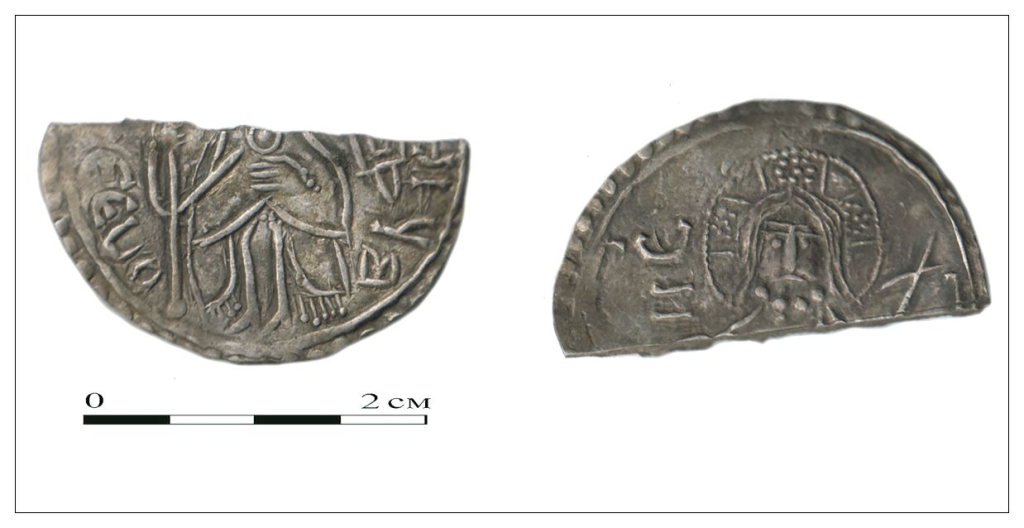
Archaeologists excavating in the historic center of Veliky Novgorod have discovered half of a rare silver coin issued by Prince Vladimir Sviatoslavich, the ruler associated with the Christianization of Kyivan Rus.
The coin, known as a srebrenik, was found on July 24 during rescue excavations conducted by the Institute of Archaeology of the Russian Academy of Sciences. It is only the third coin of Prince Vladimir ever discovered in Veliky Novgorod, making it an important addition to the city’s early archaeological record.
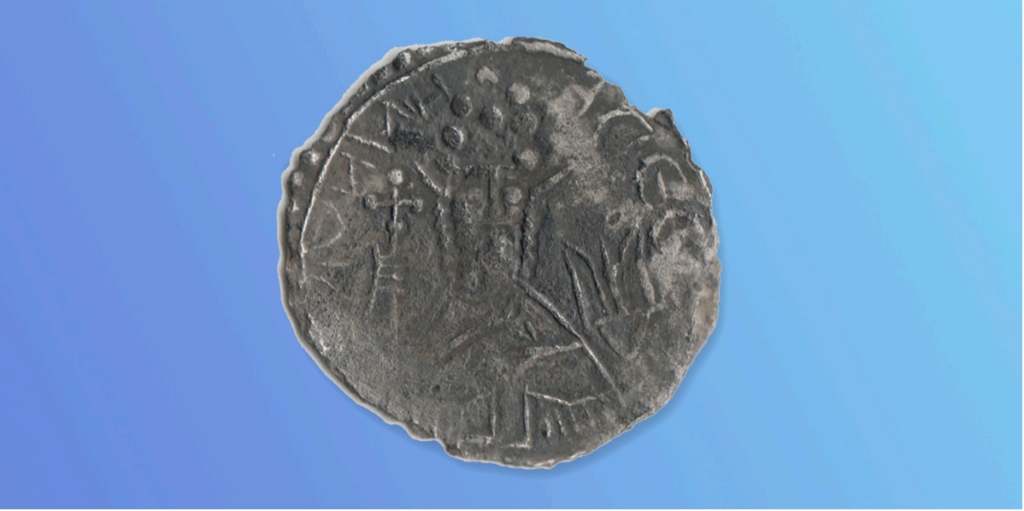
One side of the coin depicts Prince Vladimir seated and wearing a cloak fastened across his chest. He holds a cross mounted on a long staff in his right hand, while his left hand rests against his chest. Beside his shoulder appears the prince’s dynastic symbol, the trident.
Parts of an inscription identifying the ruler and the coin as his silver can also be seen around the figure.
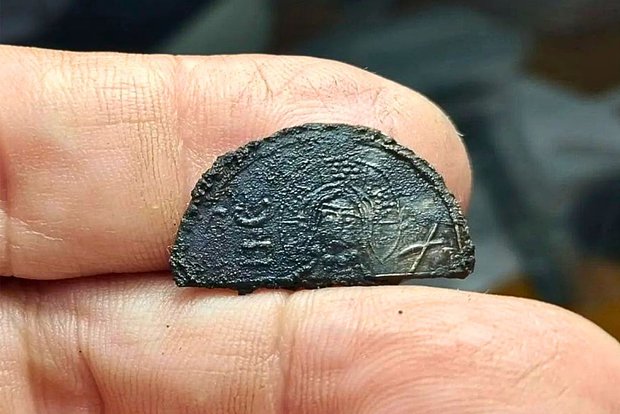
The reverse carries a bust of Jesus Christ holding the Gospel, accompanied by an abbreviated inscription identifying Christ. The coin was produced from high-quality silver but was deliberately cut in half during antiquity. The surviving fragment weighs 1.90 grams.
Only the Third Vladimir Coin Found in Novgorod
The discovery is exceptionally rare for northwestern Russia. The first srebrenik of Prince Vladimir found in Veliky Novgorod was uncovered in 2010, while the second was discovered in 2023.
“This discovery expands the known distribution of early Rus coins, points to early contacts between Novgorod and Kyiv, and provides new information about the first decades of Novgorod’s history, which are only sparsely documented in written sources,” said Pyotr Gaidukov, an adviser to the director of the Institute of Archaeology.
The coin was found in the southeastern part of medieval Novgorod’s Lyudin district, where archaeologists were working ahead of the construction of a hotel. The excavation lies close to the route of Proboynaya Street, one of the city’s medieval thoroughfares.
Evidence from the site suggests that the area was first occupied in the late 10th century. Archaeologists believe that a large estate once stood there, with residential and service buildings remaining in use between the 11th and 15th centuries.
More than 600 individual objects have been recovered from the excavation, including items made from iron, non-ferrous metals, bone, amber, glass, stone and clay. Pottery fragments, leather offcuts and animal bones were also found throughout the cultural layers.
The earliest deposits contained postholes, storage pits and traces left by ploughing. Pottery and silver dirhams issued by the Arab Caliphate helped date these layers to the late 10th and early 11th centuries—the same period in which Prince Vladimir’s silver coins were produced.
A Coin Linked to the Christianization of Rus
Around 800 srebreniks attributed to Prince Vladimir are currently known. Scholars divide them into four principal types, with Type I generally considered the earliest.
The coin discovered in Veliky Novgorod belongs to this first group. Its design was influenced by Byzantine silver coins, which commonly placed the ruler on one side and a Christian sacred figure on the other.
Researchers believe Vladimir’s coinage was closely connected with the adoption of Christianity as the official religion of Rus at the end of the 10th century. The image of the prince holding a cross, paired with the portrait of Christ, communicated both political authority and the new religious identity of the state.
The newly discovered fragment is particularly valuable because of its good preservation. Specialists have already identified other coins struck using the same dies, including examples from a hoard discovered near Peremyshl in Russia’s Kaluga region and another coin found in the Chernihiv region.
Most srebreniks are thought to have been minted in Kyiv and are usually found in the southern territories of medieval Rus. Their presence in Veliky Novgorod is therefore unusual and offers rare archaeological evidence of connections between the northern city and the political center in Kyiv around the beginning of the 11th century.
Although the minting of silver coins by Vladimir and his successors lasted no more than three decades, the surviving srebreniks remain among the most distinctive artifacts associated with the formation of the early Rus state and its conversion to Christianity.