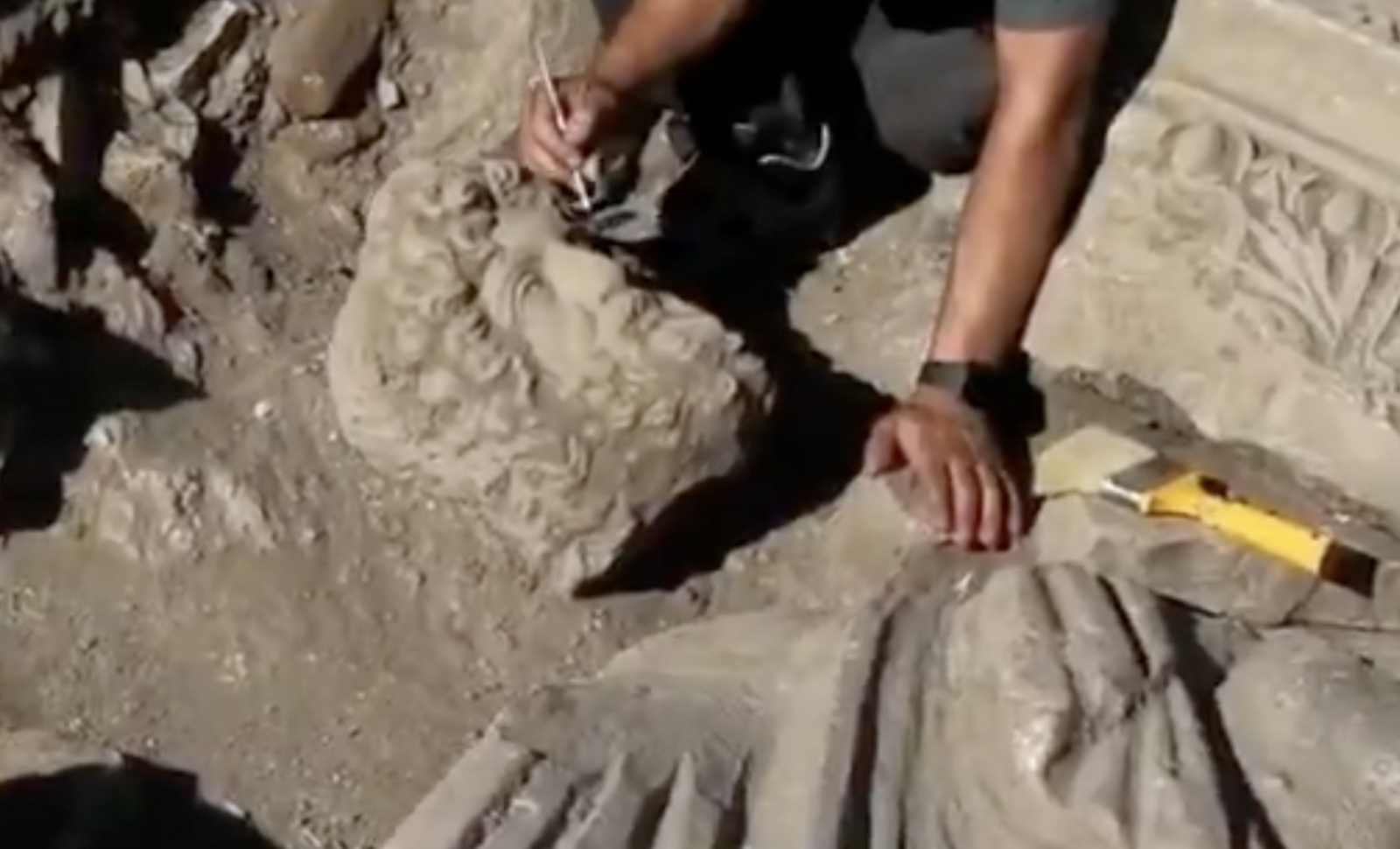
For centuries, visitors have come to Aspendos for its spectacular Roman theatre. Now the ancient city has produced a new leading figure: a marble Asklepios statue at Aspendos, discovered with the small, hooded figure of Telesphoros standing beside him.
The 2.20-meter-tall statue was found during excavations carried out under Türkiye’s Legacy to the Future Project. Archaeologists uncovered it among collapsed architectural blocks belonging to the northern wing of a monumental gateway on the western side of the East Square, along Theatre Street. The discovery was announced by Culture and Tourism Minister Mehmet Nuri Ersoy on August 6.
Dated to the final quarter of the second century AD, the work belongs to the Roman Imperial period. Its considerable size suggests that it was never intended to disappear into a private corner. This was a statue created to command attention in one of the city’s most visible spaces.
A Roman God With Leading-Man Presence
Asklepios appears as a mature, bearded man with long, thick hair and a calm but commanding stance. His weight rests on his left leg, while the right leg bends slightly and extends forward. Much of his upper body is exposed, but a himation falls from his left shoulder and wraps around his waist and legs in deeply carved folds.
The face, hair and beard received particularly careful treatment. According to Türkiye’s Ministry of Culture and Tourism, these details, together with the arrangement of the drapery, reflect the sculptural style of the late second century AD.
Even after nearly 1,800 years beneath fallen architectural blocks, the figure retains the visual authority expected of one of antiquity’s most recognizable healing deities. Across the Greek and Roman worlds, Asklepios was associated with medicine, treatment and the protection of health.
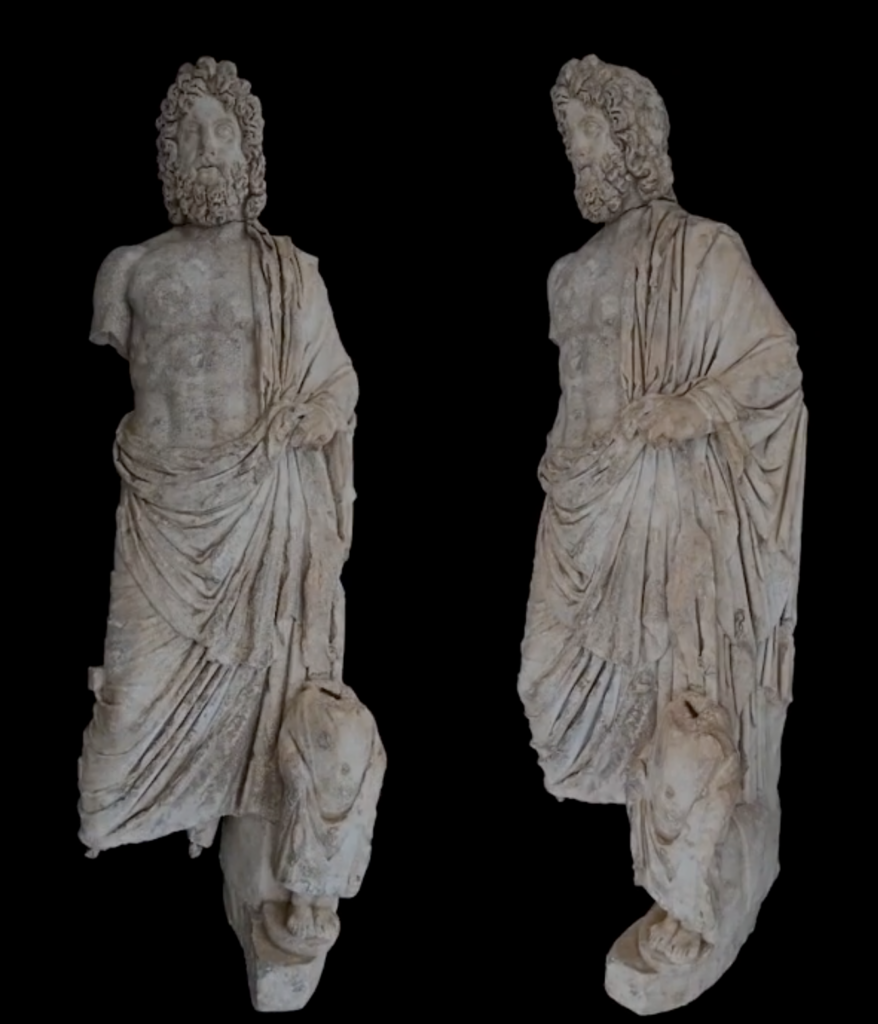
A 2.20-meter marble statue of Asklepios and Telesphoros, unearthed at Aspendos Ancient City, Antalya. Credit: Türkiye’s Minister of Culture and Tourism, Mehmet Nuri Ersoy, via X
The Smaller Figure Who Completes the Story
At Asklepios’ left foot stands Telesphoros, represented at a dramatically smaller scale. The childlike figure is almost completely concealed beneath a long, hooded garment. With most anatomical details hidden, his narrow body takes on an almost column-like appearance.
The contrast between the two figures is striking. Asklepios is open, detailed and physically imposing; Telesphoros is enclosed, compact and mysterious. Yet the smaller figure is essential to the meaning of the composition.
While Asklepios represented medical care and treatment, Telesphoros symbolized the completion of that process: recovery, convalescence and the gradual return to health. Together, the pair created a visual narrative that began with illness and ended with healing.
Aspendos Finds a New Star
The setting of the discovery gives the statue additional importance. It was recovered near a monumental gateway connected with the East Square, rather than from an isolated domestic area. Its location indicates that the sculpture probably stood in a prominent public or ceremonial section of the city.
That makes the find more than an impressive example of Roman sculpture. It provides fresh evidence for the place of healing beliefs in the public life of Aspendos. The god of medicine and the figure representing recovery were apparently displayed as part of the city’s monumental image.
Ersoy said the discovery offers new information about the healing cults, religious beliefs and social life of Roman Aspendos. Further conservation and study may help researchers determine more precisely where the sculpture originally stood and how residents encountered it within the ancient city.
Aspendos may still be famous for its theatre, but this newly uncovered marble duo has introduced a different kind of spectacle. After 1,800 years among fallen stones, the ancient city’s symbol of treatment and recovery has returned to public view.
Türkiye’s Minister of Culture and Tourism, Mehmet Nuri Ersoy, via X