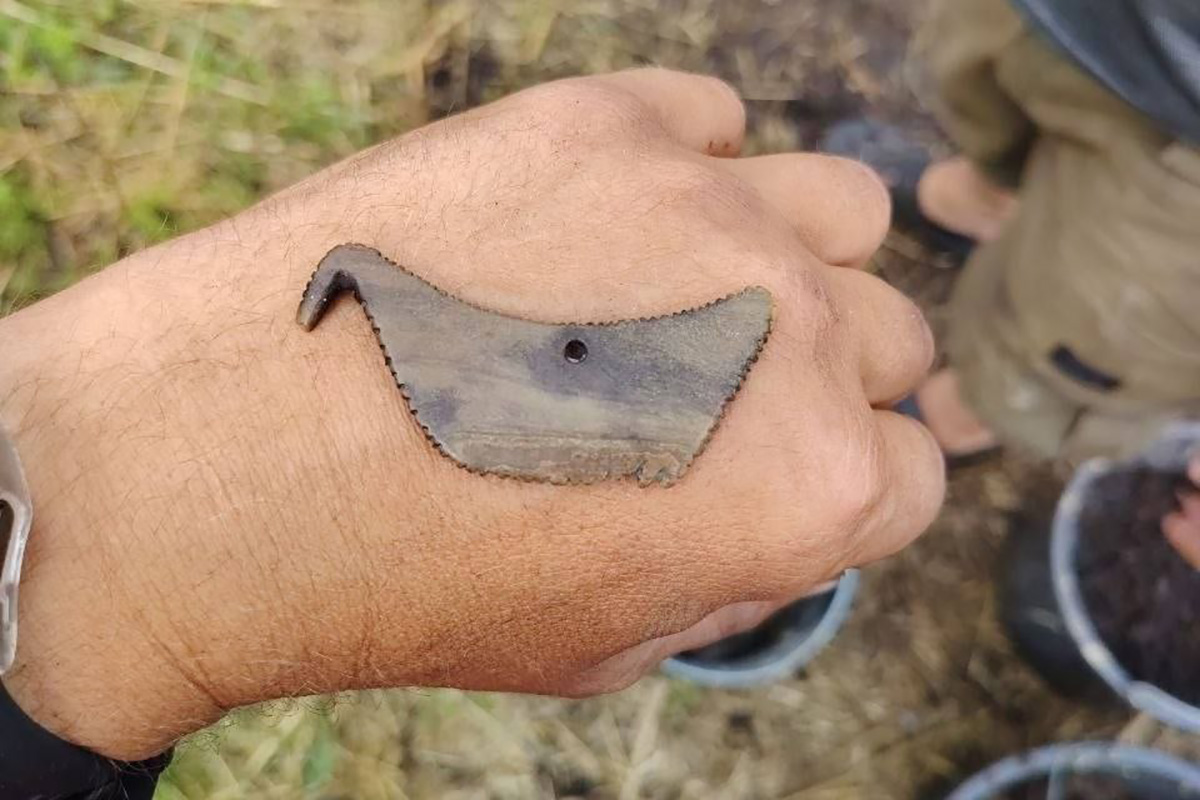
Archaeologists in northern Belarus have pulled a small piece of Stone Age artistry out of the ground — a bone amulet carved in the shape of a duck, dating back roughly 4,500 years to the middle of the 3rd millennium BC.
A Find From the Final Days of the Dig
The discovery was made on August 7 by a team from the Institute of History of the National Academy of Sciences of Belarus, led by Maxim Chernyavsky, head of the Department of Primitive Society Archaeology. The find came just as the expedition — which has been excavating the Neolithic and Early Bronze Age settlement of Osovets-2 — was wrapping up for the season.
The amulet turned up during “cleaning of the material,” the process archaeologists use to level and expose the original ground surface beneath later soil layers, where the oldest and most fragile artifacts tend to survive. According to the Institute’s Telegram channel, the zoomorphic pendant belongs to the North Belarusian culture, a Stone Age tradition that once flourished across this part of the Western Dvina river basin.
Why a Bone Duck Matters
Carved from bone and shaped to resemble a waterfowl, the amulet is a rare example of Neolithic portable art in the region. Objects like this weren’t just decorative — for hunter-gatherer and early farming communities living along rivers and lakes, ducks and other waterbirds carried strong symbolic weight, tied to water, migration, and the changing seasons. Finding one intact after roughly four and a half millennia underground is uncommon, which is what makes this piece stand out even among a productive excavation season.
More Than Just the Amulet
The duck pendant wasn’t the only thing to come out of Osovets-2 this year. The team also recovered a substantial haul of North Belarusian culture material, including:
- Fragments of pottery
- Bone, antler, and flint tools
- Hunting implements
- Fishing gear
- Personal ornaments
Together, the assemblage paints a picture of a community that hunted, fished, and crafted tools and jewelry from the natural materials around them — a snapshot of daily life on the shores of the Western Dvina thousands of years before recorded history.
The Setting: Beshenkovichi District
Osovets-2 sits in the Beshenkovichi district of Vitebsk region, in north-eastern Belarus. The wider region has a deep well of history behind it — Vitebsk Oblast is often called the birthplace of Belarusian statehood, home to the ancient Principality of Polotsk founded in the 9th century, and later associated with famous natives such as artist Marc Chagall. The Beshenkovichi area itself, centered on the town of Beshenkovichi on the Western Dvina, is first mentioned in historical records from the 15th century and later became linked to figures like Napoleon, whose army staff was headquartered there in 1812. Long before any of that, though, the same riverside landscape was already home to Neolithic communities — the people who left behind the little bone duck now being studied by archaeologists.
What Comes Next
With the field season at Osovets-2 concluding, researchers will now turn to detailed analysis of this year’s finds. The duck amulet, in particular, is expected to become a key reference piece for understanding the symbolic and artistic world of the North Belarusian Neolithic culture.
Institute of History of the National Academy of Sciences of Belarus