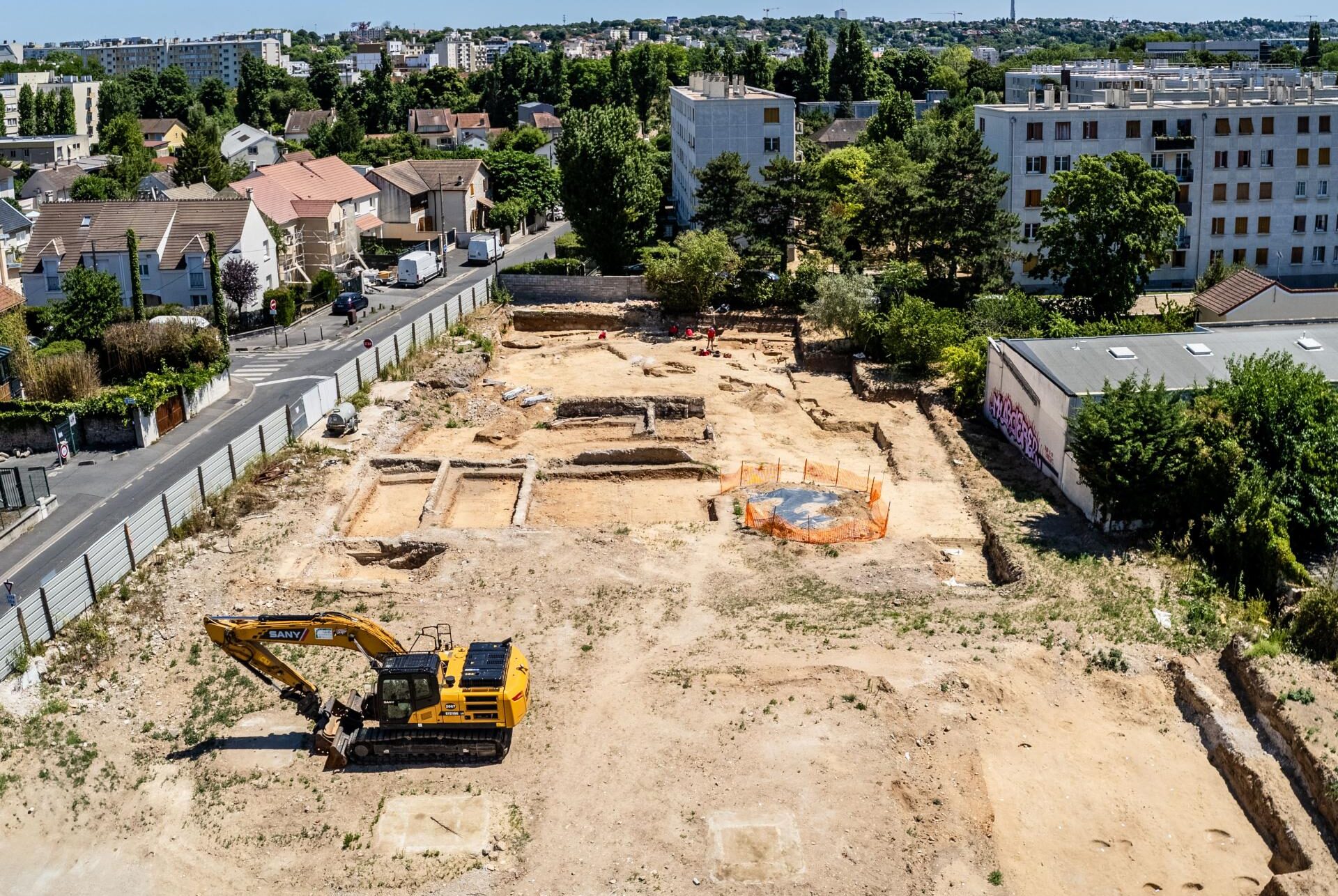
A construction project near Paris has led archaeologists to an extraordinary Neolithic cemetery containing 11 graves, dozens of massive stone blocks, and a nearly 10-ton standing stone shaped to resemble a human figure. The discovery also reveals something unexpected about the people who built the site around 6,500 years ago: they were using a primitive form of cement to construct their monuments.
The French National Institute for Preventive Archaeological Research (Inrap) uncovered the burial complex at Champigny-sur-Marne, southeast of Paris, ahead of a planned property development. Dating from approximately 4750 to 4300 BCE, the site is particularly unusual for the Île-de-France region, where burials from this period are generally found in isolation rather than grouped into elaborate funerary complexes.
A Giant Stone with Human Features
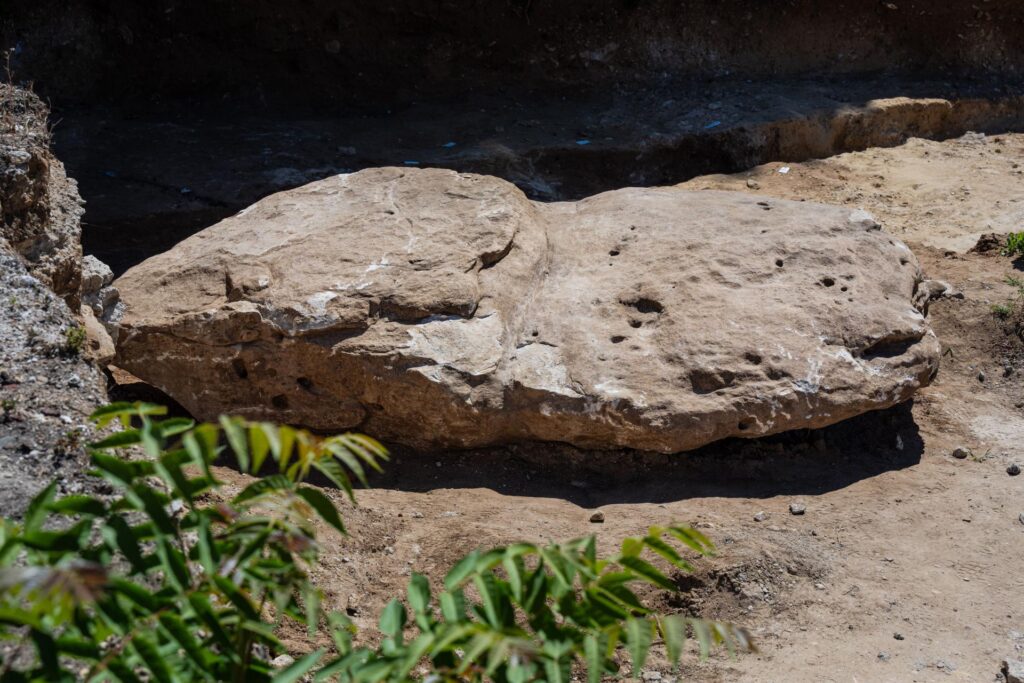
Among the 30 megalithic stone blocks discovered at the site, one immediately stands out. Measuring three meters long and weighing an estimated 9.7 tonnes, the massive sandstone monument belongs to a category known as a statue-menhir, a standing stone bearing human-like features.
Its surface carries an engraved belt, a series of small circular depressions known as cupules, and possible traces of black and white pigments. These details suggest that the stone was deliberately shaped and decorated, although its precise symbolic meaning remains unknown.
Archaeologists found the monument lying flat inside a clearly identifiable setting pit. They believe its position preserves evidence of the moment the standing stone collapsed and was subsequently abandoned.
Two smaller sandstone monuments stood nearby. One appears to have been a small stele, while the other may have served as a marker identifying the burial area.
Eleven Graves and an Unusual Seated Burial
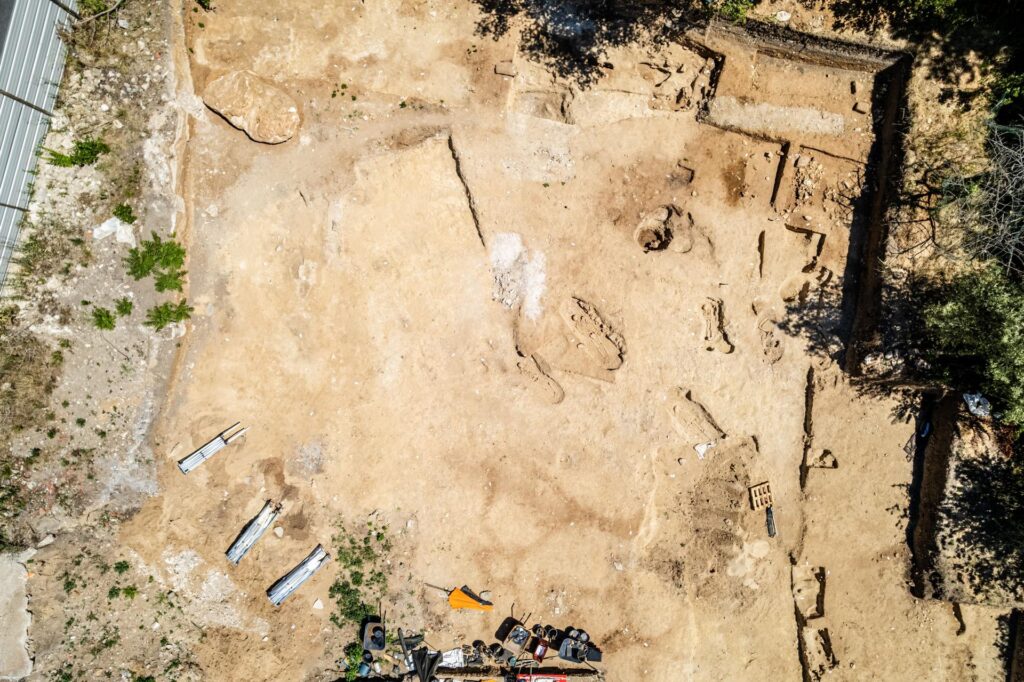
The cemetery was arranged across a terrace overlooking the Marne River. Eight graves occupied an area of approximately 60 square meters south of an unusual earthen structure, while three others lay farther north near the statue-menhir and two additional megalithic blocks.
Two graves examined during the preliminary investigation contained women buried on their backs, aligned east to west. Further excavation revealed nine more burials, most of them placed in large pits. Postholes near the heads of several individuals suggest that wooden markers may once have identified their resting places.
The dead were buried with objects including stone blades, projectile points, a locally made sandstone axe, and other stone implements. Two graves also contained worked bone objects.
One burial was particularly striking. Inside a narrow circular pit resembling a well, archaeologists discovered an adult buried in a seated position. The individual’s lower legs and feet had become completely encased in calcite, preserving an unusual detail of the burial environment.
The arrangement of these graves suggests that the cemetery was carefully planned, although researchers have yet to determine how the people buried there were related or whether differences in burial practices reflected social distinctions.
A Mysterious Monument That Covered No Grave
Another unusual feature lay in the southeastern part of the excavation.
Here, archaeologists identified a mound-like structure made from brown silt, covering approximately 30 square meters. A small stele, broken into two pieces, stood above a complex arrangement of pits, palisaded ditches, stone blocks, and wooden posts.
At first glance, the structure might resemble a burial mound. Yet excavations revealed an important difference: it did not cover a grave.
Its purpose remains unexplained. Researchers are considering whether it served as a visible landmark or played another role within the funerary complex.
Neolithic Builders Used a Primitive Cement
One of the excavation’s most significant discoveries concerns the materials used to build and stabilize the cemetery’s structures.
Archaeologists identified a mixture of highly carbonate-rich sandy and silty sediments, gravel, and water. Once dry, the material hardened, functioning as a primitive cement.
The builders used it around grave edges, in pits supporting the standing stones, and within the mysterious mound-like structure. They combined this prepared mixture with untreated earth, sand, and wooden elements.
Similar carbonate-rich building materials have previously been identified at other Neolithic and later prehistoric sites in Western Europe, particularly around the Mediterranean. The Champigny-sur-Marne discovery provides valuable evidence of their use in a funerary and megalithic setting in the Paris region.
Ancient DNA Could Reveal Who Was Buried Here
Although excavation has ended, scientists still have important questions to answer.
Planned DNA and isotope analyses may reveal the buried individuals’ ages, biological sexes, health, diets, geographical origins, and mobility. The results could also help researchers understand the relationships between people buried within the same complex.
For a region where Middle Neolithic funerary sites are relatively rare, Champigny-sur-Marne offers an exceptional opportunity to investigate how prehistoric communities commemorated their dead, erected monumental stones, and organized ceremonial spaces thousands of years before modern Paris existed.