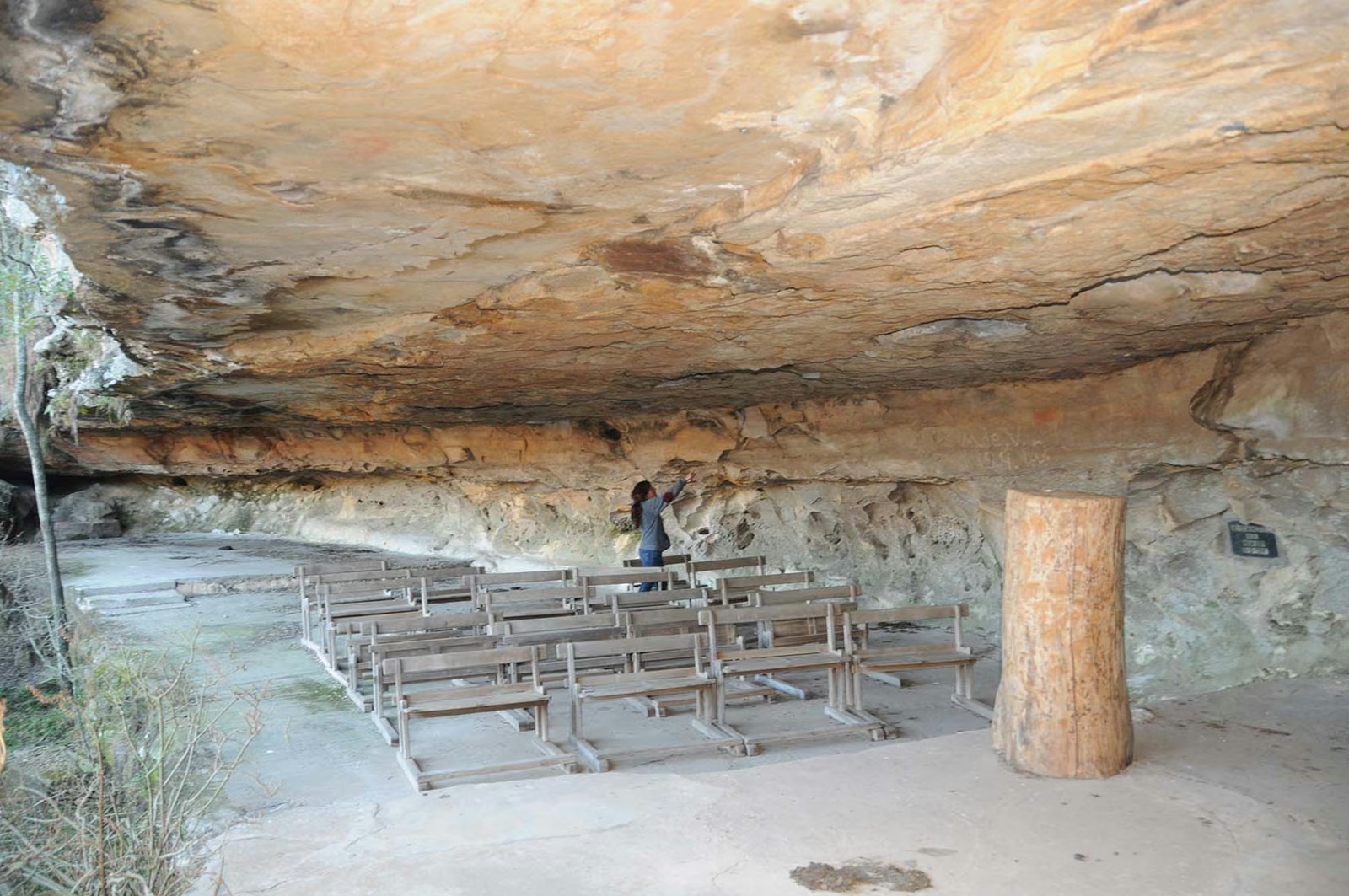
Two tiny human figures painted onto a South African rock shelter have revealed an artistic technique never previously documented in the region. Rather than painting the figures directly, their creator appears to have used handmade stencils and sprayed red pigment around them, leaving behind an unusual archaeological puzzle.
Two human figures, each measuring barely nine centimeters, have challenged what researchers thought they knew about the ancient rock art of southern Africa. At first glance, the faint reddish markings on a shelter wall seem unremarkable. Look more closely, however, and they reveal an unexpectedly sophisticated technique: someone appears to have created the figures using stencils.
The discovery comes from La Rochelle, a rock shelter in South Africa’s Mpumalanga province. Researchers David Pearce of the University of the Witwatersrand and Kiah Johnson of the University of Cambridge have identified the markings as the first documented stencil rock art in southern Africa, a region celebrated for its extraordinarily rich tradition of prehistoric painting.
Two Tiny Figures That Almost Escaped Notice
The La Rochelle shelter, also known as Klein Buffelspruit, lies near Carolina in the Mpumalanga Highlands. Its walls contain paintings of antelopes and unusual human-like beings, including figures that combine human and animal characteristics.
Researchers had examined the shelter before, including during surveys in 1995 and 2020. Yet the two small silhouettes attracted little attention, partly because their reddish outlines had faded into the surrounding rock.
Pearce initially struggled to recognize what he was seeing. Once the markings became clearer, their appearance suggested something different from the painted figures familiar across southern Africa.
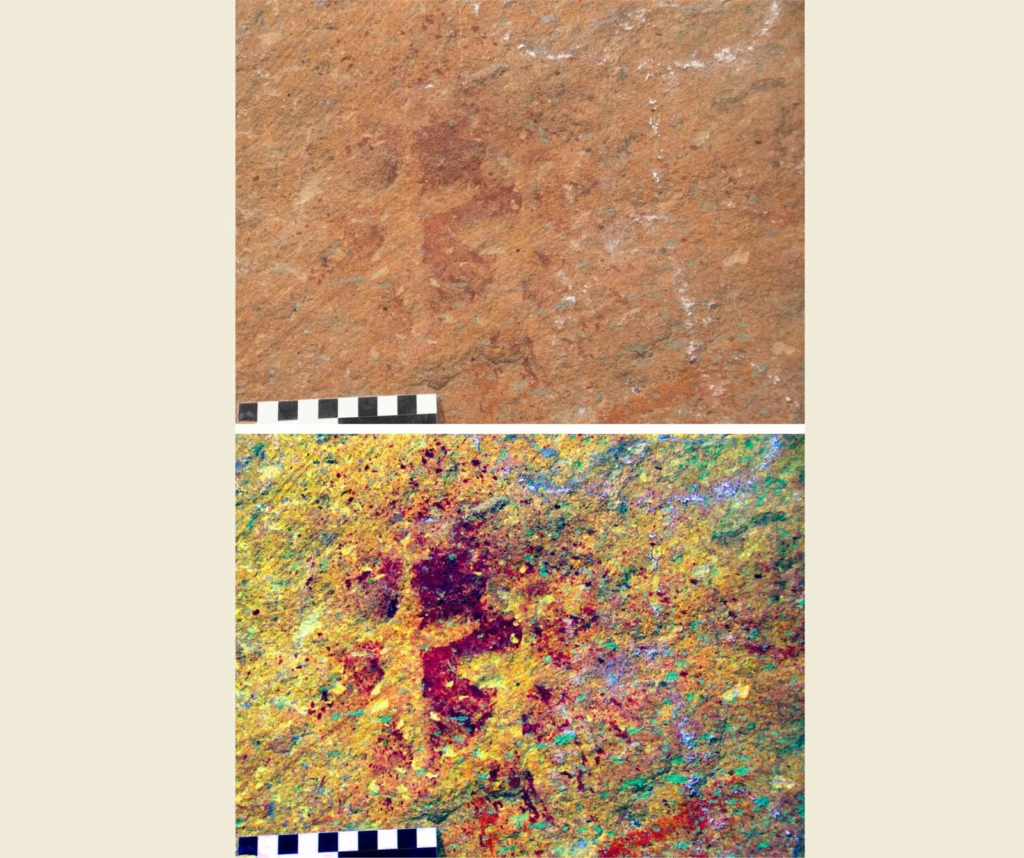
The researchers examined photographs using digital image enhancement, including DStretch software, which can make faint pigments more visible. Their analysis revealed two unpainted human-shaped silhouettes surrounded by red pigment, with fine droplets scattered around the denser patches of color.
These details provided the crucial clue. The figures did not appear to have been painted with a brush or traced with a finger. Instead, the pigment seemed to have been applied around objects placed against the rock.
An Ancient Artist Who Used a Stencil
The technique resembles a familiar form of stencil art. An artist places a hand or another object against a surface, sprays or splashes pigment around it, and removes the object to reveal an unpainted silhouette.
But the La Rochelle figures introduce an unusual variation.
Unlike hand stencils, which use an existing part of the body, these human-shaped images appear to have required specially prepared templates. Their creator may have fashioned miniature figures from beeswax, clay, wood, or another material before holding them against the rock.
No such templates have survived, and the researchers cannot identify the material used. Nevertheless, the shapes and pigment distribution suggest a deliberate process rather than accidental stains.
That distinction matters because stencil art is well documented elsewhere, including prehistoric sites in Europe, Australia and Asia. Southern Africa, by contrast, has an extensive record of figures painted with brushes or fingers, but no previously recognized tradition of stencil images.
The La Rochelle discovery therefore expands the known range of techniques used by the region’s early artists. It also demonstrates that artistic practices could be more varied than the surviving archaeological record suggests.
A Rock Shelter with an Unusual History
La Rochelle presents another intriguing contrast between its ancient paintings and its more recent history. The shelter contains wooden benches, a concrete floor and an improvised pulpit, reflecting its occasional use for Christian worship.
The two stencil figures have remained on the rock wall despite these later activities. Their survival is especially remarkable because the pigment is faint enough to escape casual observation.
Yet the setting offers few clues about their original meaning.
The researchers cannot establish when the figures were created, whether they belong to the same period as other paintings in the shelter, or which community made them. Although San hunter-gatherers produced much of southern Africa’s famous rock art, attributing these particular stencils to them would be premature.
Their small size also provides no reliable indication of age. Ancient painters across the region frequently depicted people and animals at scales far smaller than life-size.
An Artistic Tradition Still Full of Surprises
The discovery raises the possibility that stencil-making was more widespread than researchers currently recognize. Other examples may have faded beyond visibility, while some artists may have used the technique on materials that rarely survive archaeologically.
Pearce has suggested that people might also have created stencil images on bodies, clothing or other surfaces rather than restricting them to rock shelters. For now, however, the La Rochelle figures remain an isolated example rather than evidence of a widespread artistic tradition.
Their importance lies in the technique itself. Two nearly overlooked silhouettes have added an unexpected chapter to southern African rock art, demonstrating how much researchers can still learn by looking carefully at places that archaeologists have already studied.
Pearce, D. G., & Johnson, K. (2026). First report of stencilled rock art in Mpumalanga, South Africa. South African Archaeological Bulletin, 81(224), 20–26.