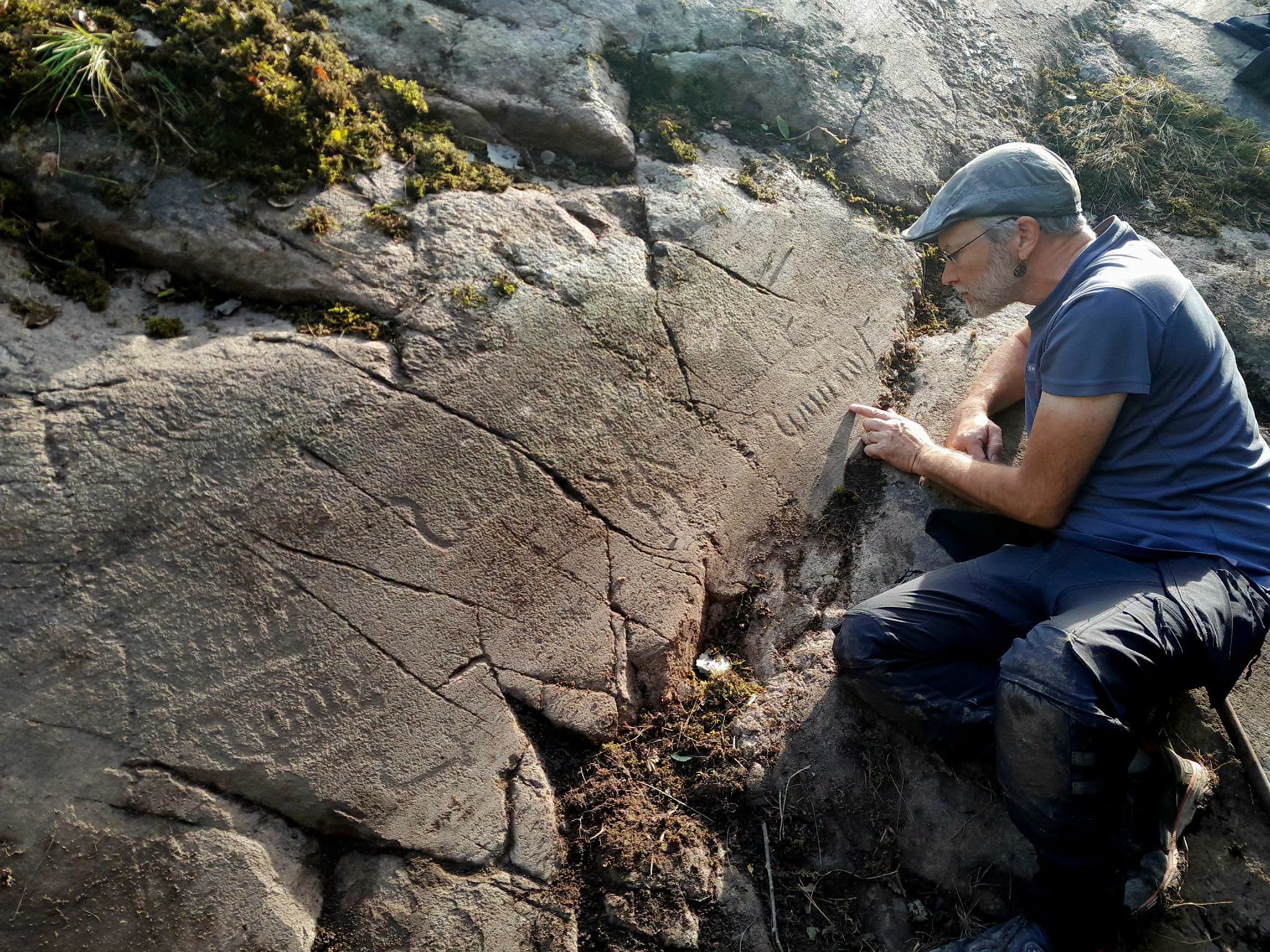
For thousands of years, ships and human figures lay almost invisible across the granite at Trättelanda in western Sweden. Now a new survey inside the Tanum World Heritage Site has brought them back into view — and archaeologists say the newly documented rock surface may be larger than they first realized.
Researchers from the Foundation for the Documentation of Bohuslän Rock Carvings, working with Vitlycke Museum, have identified 16 previously undocumented rock-art surfaces during an inventory at the southern end of the UNESCO-listed landscape. The most striking of them covers an area already measuring about 11 by 10 meters, although the team has yet to establish where the decorated surface ends.
Across the fine-grained granite, researchers can make out numerous ships and human figures. The carvings are unusually well preserved, and photographs from the site show long vessel motifs emerging from the rock alongside smaller figures that become clearer as the surface is carefully cleaned and examined.
The foundation described the discovery as exceptional and indicated that work at Trättelanda will continue. The find is especially notable because it comes at the very beginning of the new inventory.
A landscape that still holds surprises
Tanum is hardly an unknown archaeological landscape. The area, on Sweden’s west coast in northern Bohuslän, has attracted researchers for generations and contains one of the greatest concentrations of prehistoric rock art in northern Europe.
UNESCO added the Rock Carvings in Tanum to the World Heritage List in 1994. More than 600 known rock-art sites lie within the protected area, while northern Bohuslän as a whole contains at least 1,500 known carving sites.
Yet the Trättelanda discovery shows that even a landscape this intensively studied can still produce substantial new finds.
The new inventory began at the farm of Trättelanda, at the southern edge of the World Heritage area. Researchers soon identified one new surface after another, eventually reaching a total of 16. The final and largest surface proved far more extensive than the others, with carvings spread across a broad expanse of exposed granite.
Its full size remains unknown.
Ships carved into stone
Ships are among the defining images of Tanum’s rock art. They appear in many forms across Bohuslän, from simple outlines to long vessels filled with rows of human figures.
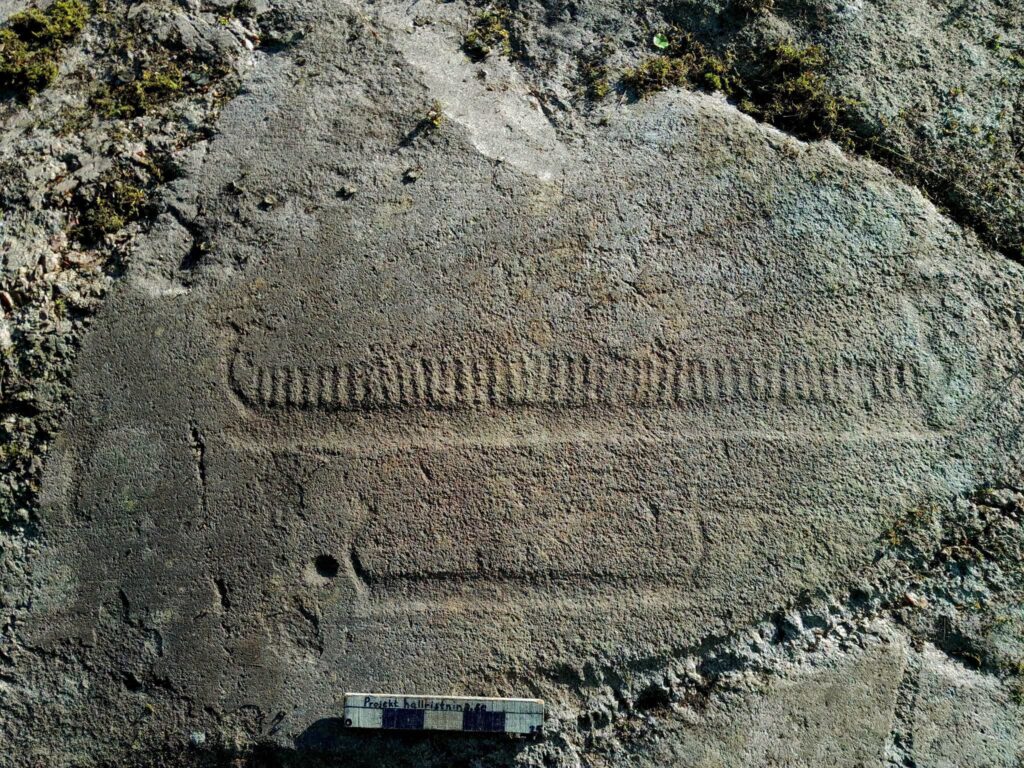
The Trättelanda carvings fit naturally into that visual world. One newly documented vessel stretches horizontally across the rock with a long line of vertical strokes rising from its hull, while other photographs reveal human forms and additional carved motifs scattered across the surface.
Researchers have not yet announced a specific date for the newly documented Trättelanda carvings, so assigning them a precise age would be premature. The wider Tanum landscape, however, is closely associated with the Nordic Bronze Age, and many of its best-known carvings date broadly between about 1700 and 500 BC.
At that time, the landscape looked very different from today. Sea levels stood higher, and places that now overlook fields and woodland often lay much closer to bays, waterways and the coast.
That changing geography helps explain why ships became such a persistent image in Bohuslän. They were not merely practical objects. In Tanum’s rock art, vessels often appear alongside people, animals, weapons and scenes that archaeologists have linked to travel, status, conflict, ritual and belief.
Images left across generations
The granite itself played a major role in preserving this prehistoric visual world. When the Scandinavian Ice Sheet retreated, it left behind broad, smooth rock surfaces that later communities used repeatedly as places for carving.
People created the images by pecking and grinding into the stone. At some sites, generations returned to the same panels, gradually filling them with overlapping scenes.
The famous Vitlycke panel offers one of the clearest examples. It contains hundreds of figures, including ships, humans, animals, and some of Tanum’s best-known scenes. Elsewhere, monumental human figures and heavily populated ship motifs show how varied the region’s rock art could become.
The Trättelanda discovery now adds another large surface to that record.
For archaeologists, the importance of the find lies not only in the individual carvings but also in what the first weeks of the inventory have already revealed. Sixteen previously undocumented surfaces have appeared in a World Heritage landscape that researchers have studied for decades.
And the largest one is not yet fully mapped.
As work continues across Trättelanda, the newly exposed ships and human figures may prove to be only the beginning of a much larger addition to Tanum’s prehistoric landscape.