High on a rocky mountainside in central Mexico, three faded red paintings are adding unexpected pieces to one of Mesoamerica’s enduring puzzles: how the people of Teotihuacan wrote.
For much of the twentieth century, scholars hesitated to describe Teotihuacan’s symbols as a true writing system. The ancient metropolis produced monumental pyramids, elaborate murals and a visual culture recognizable across Mesoamerica, yet it left behind nothing resembling the long inscriptions known from the Maya world.
That assumption has steadily weakened. Researchers have now identified nearly 120 signs associated with Teotihuacan writing, including symbols that appear to record names, places, titles and actions. A new study published in Antiquity brings three more unusual examples into the discussion—and they survive far from the great city itself.
The paintings appear inside Cave 19 at Chalcatzingo, an ancient ceremonial center about 90 kilometers southeast of Mexico City. Better known for much earlier Olmec-style monuments,
Chalcatzingo seems to have attracted new visitors centuries later, when Teotihuacan dominated much of central Mexico.
A Tiny Cave Almost Hidden in the Cliffs
Cave 19 occupies a difficult position on the western face of Cerro Delgado. Today, researchers reach it by climbing the mountain from the opposite side and descending the cliff by rope. Ancient visitors may have used scaffold-like ladders to approach from below.
The destination is surprisingly small. The rock shelter covers only about 7.4 square meters and reaches a maximum depth of 2.24 meters. Yet someone chose this cramped, inaccessible space for paintings and rituals.
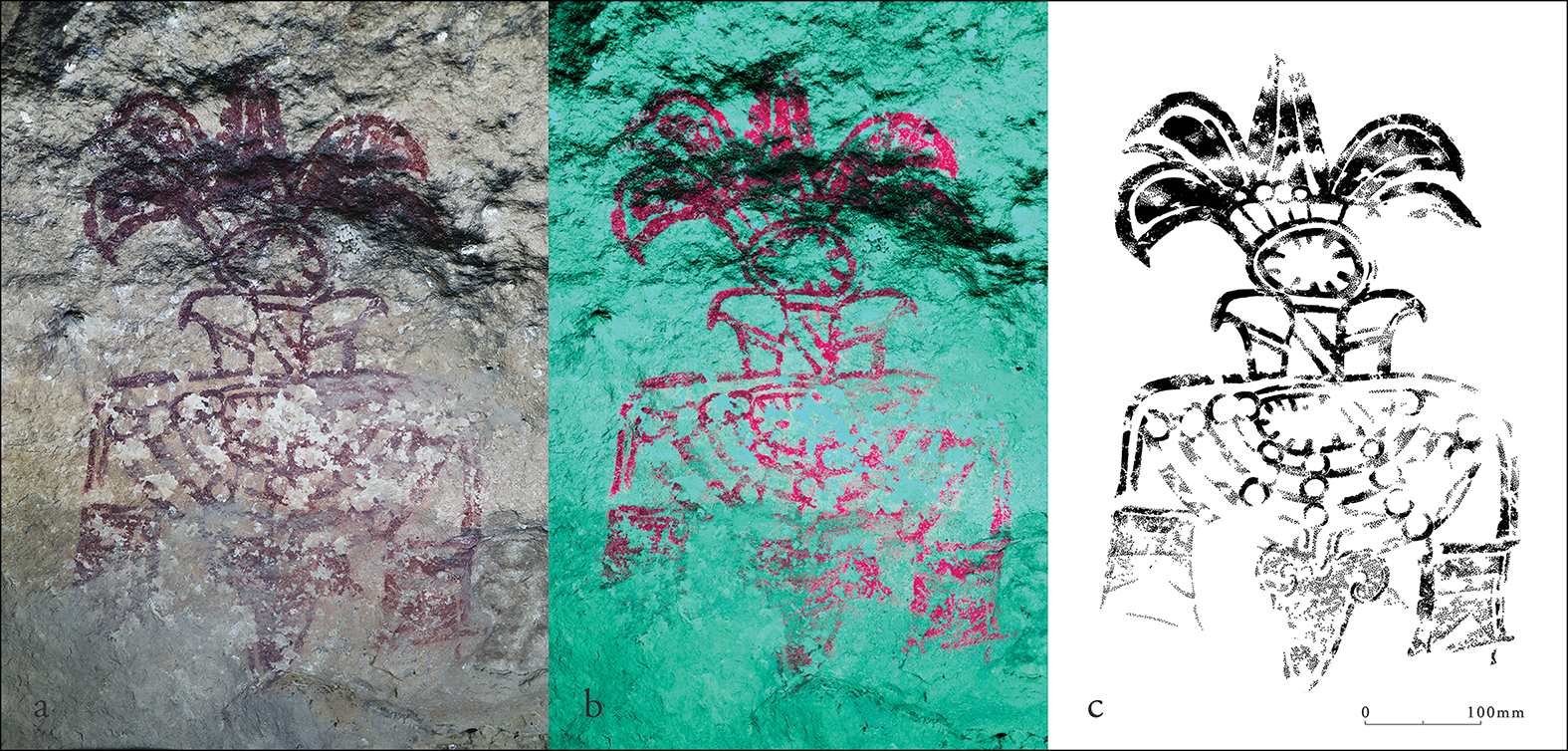
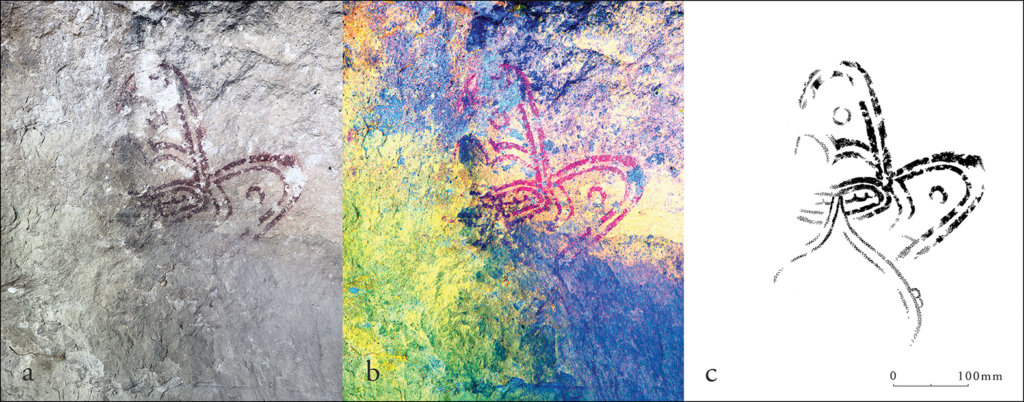
Researchers documented the cave in detail in 2022, using photography and digital enhancement to recover parts of the red pigment that are now difficult to see. Their analysis linked the three compositions to the graphic tradition of Teotihuacan.
One of them may even preserve the ancient name of the mountain.
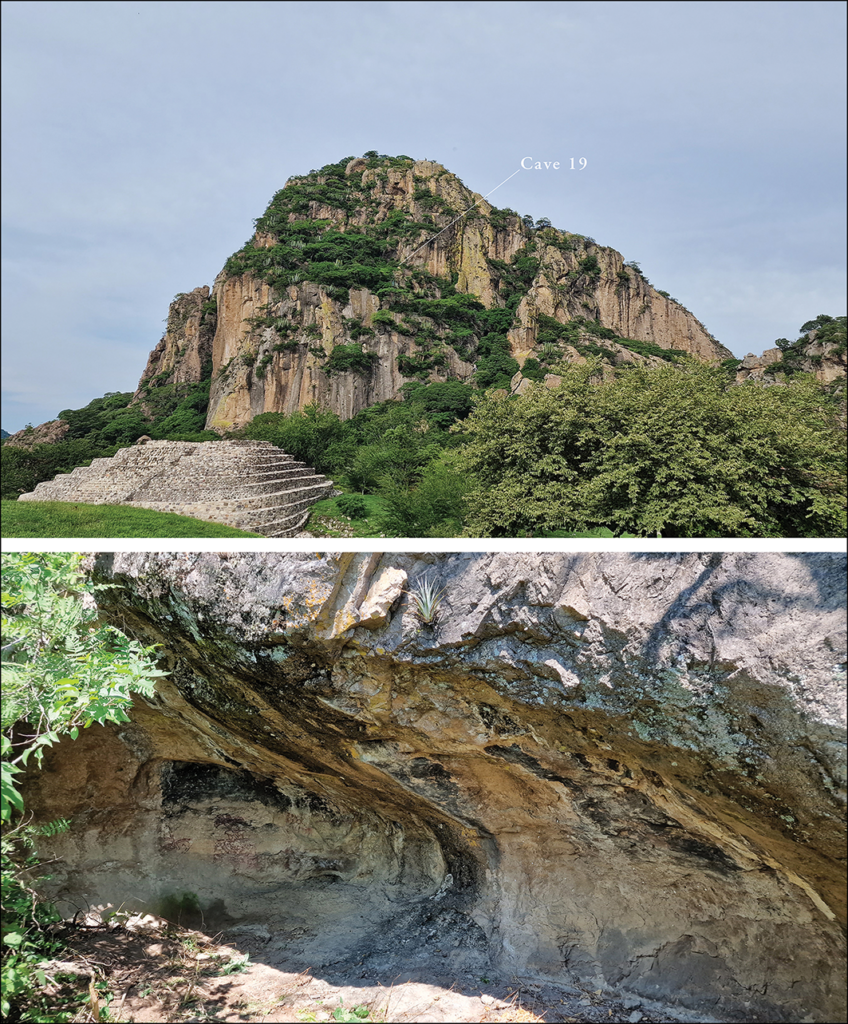
Cerro Delgado at Chalcatzingo, with the remote location of Cave 19 marked high on its western face (top). Inside the small rockshelter (below), red-painted glyphs survive beneath dark traces of ancient burning. Photos: Christophe Helmke. Source: Helmke et al., Antiquity (2026).
Was This the ‘Singing Mountain’?
The first glyph combines mountain imagery with scrolls associated with speech or song. Researchers interpret the compound as a place name meaning “Singing Mountain.”
That reading becomes more intriguing because a nearby hill was historically known by the Nahuatl name Cuicatepec, which carries essentially the same meaning. Teotihuacan murals at the Tetitla compound also contain a place-name glyph interpreted as “Singing Mountain.”
If those references point to the same location, people from Teotihuacan may have travelled to Chalcatzingo for ceremonies. The idea would transform Cave 19 from an isolated rock shelter into part of a ritual landscape known to people living around the great metropolis roughly 90 kilometers away.
The researchers remain cautious about that identification, but the possibility fits a broader picture. Chalcatzingo had been a sacred place long before Teotihuacan flourished, and its mountains and caves already carried deep ritual significance.
Another Glyph Points to a Warrior
A second composition offers a very different message. It combines a large beaded necklace, a cloth garment and an upright dart of the type launched with an atlatl, or spear-thrower.
These objects belonged to Teotihuacan’s visual vocabulary of warfare. The researchers therefore interpret the combination as a possible martial title, perhaps identifying a particular warrior rank or group.
Nearby evidence makes the interpretation more intriguing. A third painted composition frames a natural rock shelf with star-like motifs, while ancient burning has blackened the wall and ceiling above the shelf.
Similar imagery appears in Teotihuacan contexts associated with the commemoration of dead warriors. The researchers suggest that people may have burned incense here or performed ceremonies involving a deceased warrior. They even consider the possibility that a funerary bundle was cremated on the shelf, although no surviving evidence can confirm that scenario.
A Writing System Coming Back Into View
The three paintings matter because Teotihuacan writing remains only partially understood. Its inscriptions tend to be short, often containing individual compounds rather than extended texts. That made it difficult for generations of researchers to determine whether the signs represented language or functioned primarily as symbols.
The picture now looks different. Evidence for place names, personal names, titles, calendar information and verbal expressions increasingly supports the existence of a logo-phonetic writing system, in which signs could convey words or concepts while others carried phonetic information.
Researchers still cannot fully read it, and the language behind the script remains debated. Cave 19 does not solve that mystery.
But the tiny shelter shows that Teotihuacan writing travelled beyond the metropolis and entered places that may have held religious importance for centuries. Three fading red compositions on a Mexican mountainside have become part of a much larger effort to recover a written tradition that archaeology once struggled even to recognize.
Helmke, C., Nielsen, J., Meza Rodríguez, C., & Córdova Tello, M. (2026). Painted Teotihuacan glyphs of Cave 19, Chalcatzingo, Morelos, Mexico. Antiquity, 1–19. doi:10.15184/aqy.2026.10425