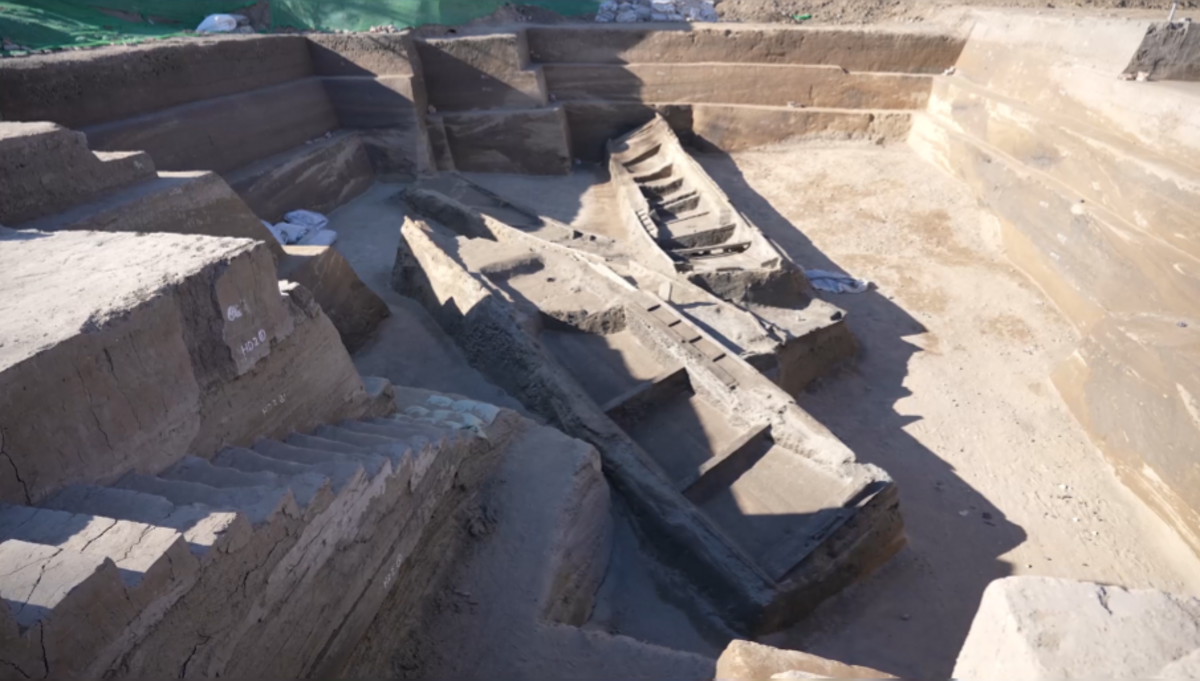
Beneath the modern streets and high-rise buildings of Beijing, archaeologists have discovered three wooden riverboats dating back approximately 1,800 years. Buried seven meters underground, the vessels are the largest known inland boats of their period found in northern China. One of them carries ten official markings, offering an unexpected connection to the transportation networks of ancient imperial China.
The discovery was made in Beijing’s Fengtai district, where archaeologists from the Beijing Municipal Institute of Archaeology excavated an abandoned channel of the Yongding River. The boats were uncovered in November and December 2025, with further details presented by archaeologist Ding Lina at the Beijing Public Archaeology Season closing ceremony on October 31, 2026.
A Forgotten Waterway Beneath Modern Beijing
Today, Fengtai is a densely developed part of China’s capital. Some 1,800 years ago, however, boats travelled through a river channel beneath what is now an urban landscape.
According to Ding Lina, the discovery indicates that the area once contained an important navigable waterway, potentially serving official transportation. The ancient Yongding River connected northern China with the Central Plains during the Han and Jin periods, when rivers carried people, grain, and other supplies.
Archaeologists named the vessels Yongding River No. 1, No. 2, and No. 3. All three were discovered near a bend in the former river channel, their bows pointing southwest.
The boats share a flat-bottomed design suited to inland navigation. Each measures more than ten meters long, while the largest, Yongding River No. 3, reaches 15 meters. The discovery provides the first direct physical evidence of ancient river shipping in the Beijing region.
Ten Mysterious Marks on a Wooden Boat
The best-preserved vessel, Yongding River No. 2, measures 14 meters long and contains nine internal compartments. But its most intriguing feature is not its size.
Archaeologists identified ten impressions of the Chinese character “官” (guān) on different wooden components. Meaning “official” or “government-related,” the character suggests that the boat had a connection to state authorities.
The markings raise an important historical distinction. Was the vessel built under government supervision, or did it transport goods as part of an officially managed fleet? Researchers have not yet established its precise role, but the inscriptions provide physical evidence for investigating state involvement in ancient river transport.
Ancient Shipbuilders and an Unexpected Comparison
The wooden vessels also preserve details of how boats were constructed nearly two millennia ago. Their builders joined floorboards using carefully fitted wooden connections reinforced with small wooden pegs, while some upper components were secured with iron nails.
Similar floorboard connections appear on Silk Road No. 1, an ancient boat discovered in Xi’an. The comparison allows researchers to examine how shipbuilding knowledge developed across different parts of China.
Some construction details also resemble methods used in Mediterranean shipbuilding during the Roman period. Whether these similarities reflect any exchange of knowledge remains uncertain, however, and there is currently no evidence of a direct technological connection between the two regions.
More Than Three Abandoned Boats
The surrounding sediments contained animal bones, including remains of horses, cattle, sheep, pigs, and dogs, as well as human remains. These finds may help archaeologists reconstruct activities along the former riverbank.
Wood analysis identified pine as the principal material used in the hulls, with mulberry wood employed in certain structural connections. Preliminary radiocarbon dating places the vessels between the late Eastern Han and Wei–Jin periods.
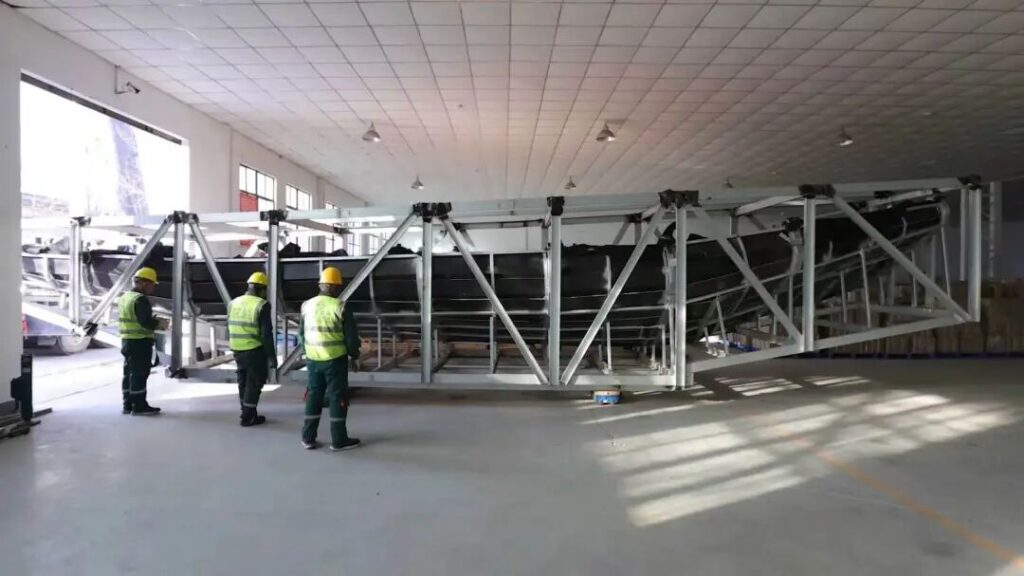
Following excavation, conservators reinforced the fragile wooden hulls with steel frameworks and removed them from the site for further treatment.
The next stage of research will examine the boats’ construction and official markings in greater detail.