A group of carved stone figures discovered beside a probable kurgan in eastern Türkiye may preserve traces of the mounted nomadic cultures that moved between Eurasia and Anatolia nearly 2,700 years ago, according to a study examining the monuments in detail.
The statues and roughly shaped standing stones were documented near Ormanlı village in the Şenkaya district of Erzurum. Researchers Yavuz Günaşdı, Ahmet Cüneydi Has and Burak Bingöl argue that the form, iconography and archaeological setting of the monuments closely resemble traditions known across Central Asia and the Eurasian steppe. Their study was published in Gazi Akademik Bakış in 2022.
The site lies about 500 meters northeast of Yanıkkale Castle, on elevated ground overlooking the surrounding landscape. It was identified during archaeological surveys in 2014. The researchers describe the location as a probable kurgan, or burial mound, accompanied by several satellite graves, anthropomorphic stone statues and balbals — more roughly worked upright stones associated with funerary and memorial traditions.
During the first surface examination, the team identified two clearly human-shaped statues and at least six balbals. A third stone monument remains difficult to classify and may represent either an unfinished anthropomorphic statue or a balbal.
A cup, dagger and belt
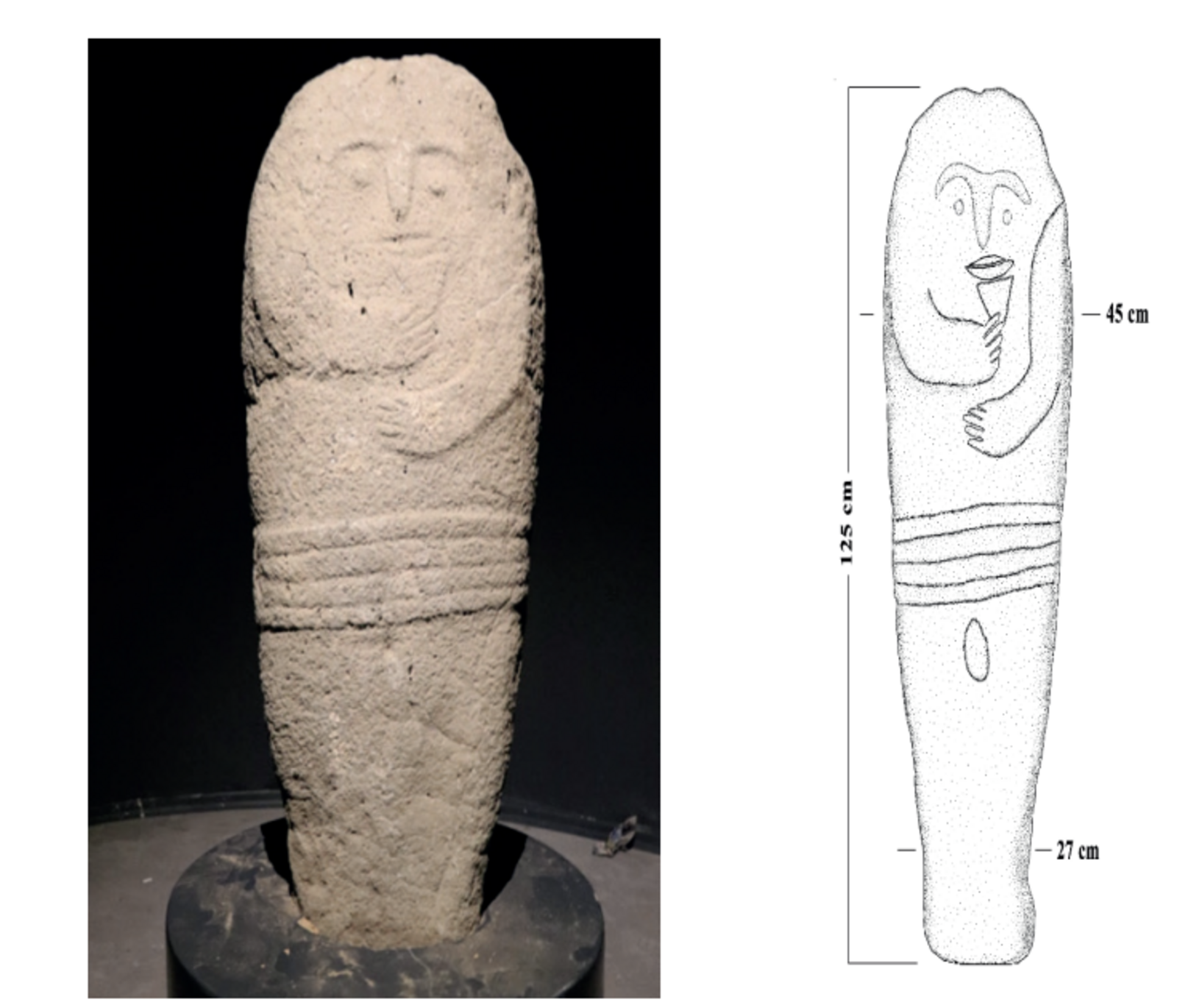
The most carefully carved figure stands about 1.25 meters high and was made from local stone. Its front was flattened and worked in relief, while the back was left relatively rough. The face has prominent crescent-shaped eyebrows, rounded eyes, and a long nose that together form a distinctive T-shaped arrangement.
Its most striking feature is the right arm. The figure bends its elbow and raises a cup or goblet toward its mouth. The left hand rests around the abdomen, while a grooved belt or sash encircles the waist.
The researchers note that cups held by stone figures appear repeatedly in the wider Eurasian tradition and have been interpreted in several ways. Some scholars have associated them with ritual drinking, agreements with a deity or ideas of immortality. The Ormanlı study does not claim a single definitive meaning, but treats the vessel as an important marker of status and ritual symbolism.
The second statue, about 1.23 meters tall, is more simply carved. Its head and eyes are rendered with unusual triangular forms, while its mouth and nose are absent. More importantly for comparison, the figure wears a belt with a dagger attached to it and appears to hold the weapon with its right hand. The authors suggest that this may indicate a warrior identity.
The third stone is 1.35 meters high but largely retains its natural shape. Only a three-grooved belt was carved onto it. Because of its limited workmanship, the researchers consider it more likely to be a balbal than a finished human-shaped statue.
A possible cult landscape
The arrangement of carved figures, balbals and a probable kurgan is central to the study’s interpretation. Across parts of Eurasia, rows of balbals found beside anthropomorphic stone monuments have been associated with funerary or commemorative cult areas. On that basis, the authors suggest that the Ormanlı complex may also have served as a ritual landscape connected with the dead.
The Şenkaya figures also show similarities to other stone monuments in Anatolia, including examples from Hakkari, Ahlat, Oltu and Horasan. Shared features include belts, weapons, hand positions and facial treatment. The first Ormanlı statue, in particular, resembles the Hakkari stelae in the treatment of the eyes, nose and eyebrows.
Drawing on these comparisons, the authors propose that the Ormanlı statues were created in the 8th or 7th century BCE by Cimmerian or Scythian groups, described in the study as mounted warrior-nomadic cultures. Importantly, this dating is based on stylistic and archaeological comparison rather than a direct scientific date, making future excavation especially important.
The researchers argue that archaeological excavation could clarify whether the mound is indeed a kurgan, refine the chronology of the complex and potentially reveal additional statues or balbals.
For now, the Ormanlı stones provide an unusual glimpse of how ideas about warriors, status, memory and death may have travelled across the Eurasian steppe and into eastern Anatolia during the early first millennium BCE.
Günaşdı, Y., Has, A. C., & Bingöl, B. (2022). Erzurum’un Şenkaya ilçesine bağlı Ormanlı Köyünde bulunan erken dönem Türk kültürüne ait insan biçimli taş heykeller ve balballar. Gazi Akademik Bakış, 16(31), 327–344.