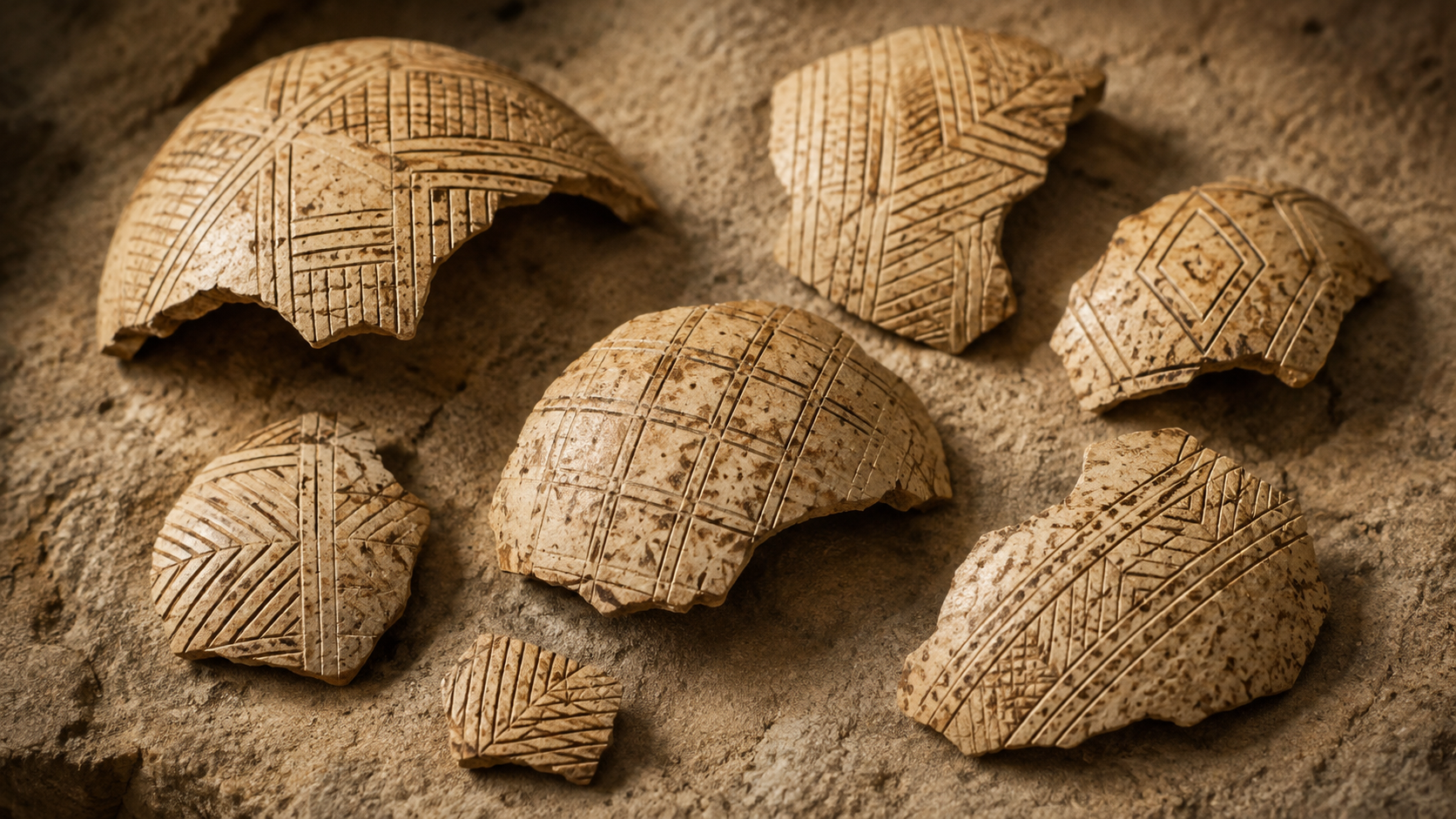
More than 60,000 years ago, people living in southern Africa scratched lines into ostrich eggshells. At first glance, the marks can look deceptively simple: parallel strokes, intersecting lines, grids and diamond-like shapes.
But a new analysis suggests they were anything but random.
Researchers studying engraved ostrich eggshells from the Middle Stone Age have found evidence of repeated geometric rules behind the designs. The patterns appear to have been planned and constructed according to an internal visual logic, offering a rare glimpse into how early Homo sapiens organized shapes in their minds tens of thousands of years before writing existed.
The study, published in PLOS ONE, examined material associated with the Howiesons Poort, a technological and cultural tradition that flourished in southern Africa roughly 65,000 to 60,000 years ago.
The fragments came from three important archaeological sites: Diepkloof and Klipdrift rock shelters in South Africa and Apollo 11 in Namibia.
Ancient Water Bottles Covered in Patterns
Ostrich eggs were valuable resources in prehistoric Africa. Beyond providing food, their thick but relatively light shells could be turned into portable water containers — an especially useful technology in dry landscapes.
Some of these containers were also decorated.
Archaeologists have recovered hundreds of eggshell fragments bearing deliberately incised designs. Researchers had long recognized recurring motifs, but determining whether these patterns represented genuine structured design rather than loose decoration remained difficult.
The new study approached the question mathematically.
Researchers assembled images of 112 engraved fragments and reconstructed the individual lines, examining their direction, intersections, angles and spatial relationships.
What emerged was remarkably consistent.
Parallel lines repeatedly appeared together, while many intersections approached right angles. More complicated compositions included grids, hatched bands and diamond-shaped patterns created through repeated movements and rotations of basic elements.
In some cases, the sequence of engraving was particularly revealing. The maker first established larger boundary lines and then inserted smaller repeated strokes within them.
That suggests someone was not simply scratching a surface as they went. They appear to have had an idea of the larger composition before completing it.
A ‘Geometric Grammar’ 60,000 Years Ago
The researchers describe the underlying system as a kind of “geometric grammar.”
The term does not mean that prehistoric people understood geometry in the modern mathematical sense. Instead, it refers to a recurring set of visual operations: repeating parallel lines, creating intersections, rotating elements, and embedding smaller patterns inside larger structures.
More than 80 percent of the analyzed designs showed strong evidence of orthogonality, line alignment or spatial regularity.
That consistency matters because it points toward visual planning and abstract organization rather than accidental scratches.
Some patterns also changed through time and between sites. Diamond-shaped motifs, for example, appear at Klipdrift, while particular hatched-band designs characterize phases at Diepkloof. Such differences hint that communities may have maintained their own visual traditions while sharing broader ways of organizing designs.
Were the Engravings Symbols?
That remains the harder question.
Researchers cannot determine what the patterns actually meant. They may have marked ownership, group identity, personal affiliation or something entirely different. Similar designs appearing repeatedly on practical objects nevertheless suggest they formed part of a recognizable visual tradition.
And these were not necessarily rare ceremonial objects hidden away for special occasions.
They were probably water containers used in everyday life.
That makes the engravings particularly intriguing. Structured graphic behavior may have been woven into ordinary activities rather than restricted to caves, rituals or explicitly symbolic objects.
The study does not claim that these designs were writing, nor can the engravings reveal the exact thoughts of the people who made them.
What they do preserve is something more fundamental: evidence that humans living in southern Africa more than 60,000 years ago could organize lines according to repeated visual rules, maintain complex spatial relationships and construct designs from an internal plan.
Long before alphabets, cities or agriculture, someone was already thinking in patterns.
Decembrini V, Ottaviano L, Cartolano M, Spinapolice EE, Ferrara S (2026) Earliest geometries: A cognitive investigation of Howiesons Poort engraved ostrich eggshells. PLoS One 21(2): e0338509. https://doi.org/10.1371/journal.pone.0338509