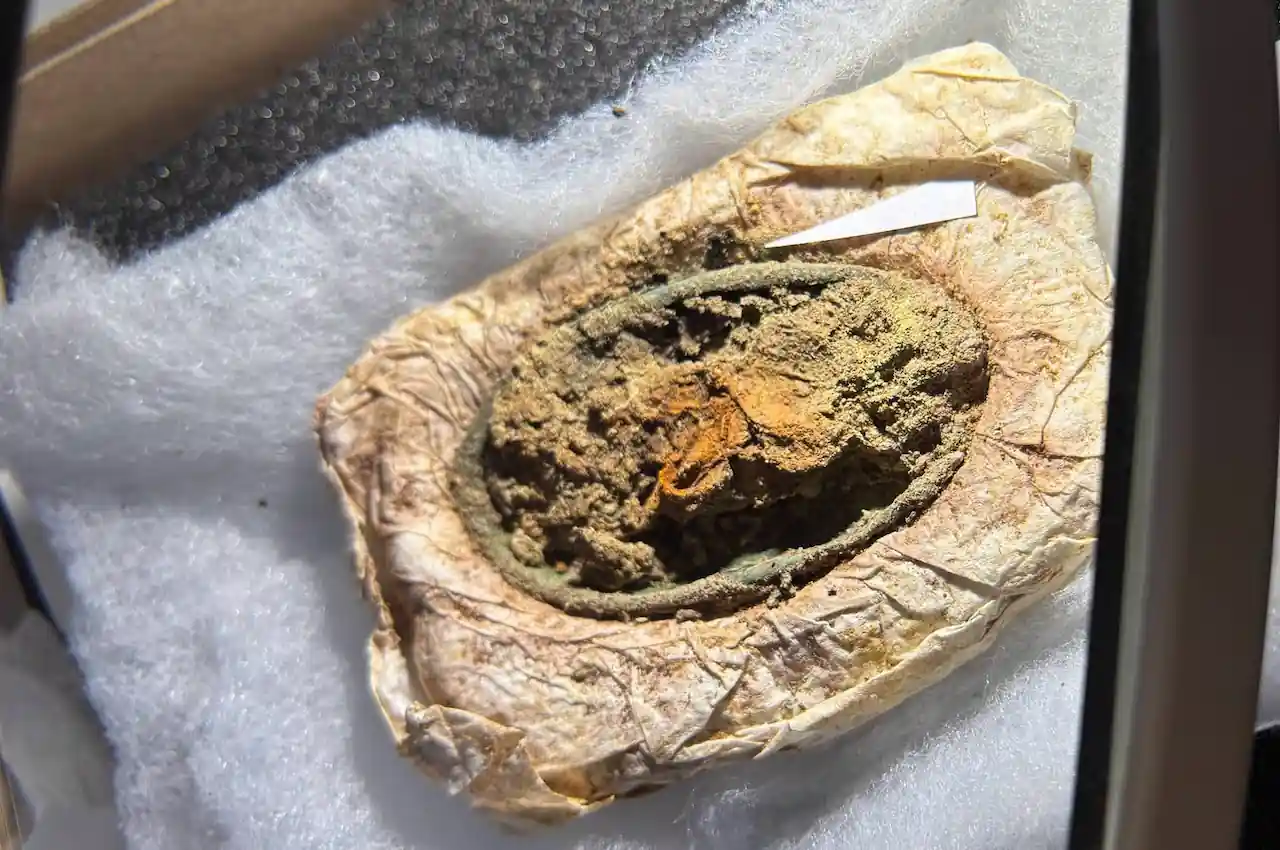
A rare Viking Age burial in western Denmark is giving archaeologists an unusually close look at how a young girl was dressed around 1,300 years ago.
The grave was found at Skonager, near Varde in West Jutland, where Viking Age burials are exceptionally uncommon. What makes this burial stand out is not only the pair of shell-shaped brooches found with the girl, but the textile fragments still clinging to them.
Fabric survives on both the upper and lower sides of the brooches. That may allow researchers to identify more than one layer of clothing — including what she wore close to her body and what was worn over it.
For archaeologists who usually work with only tiny scraps of Viking Age textiles, that is a rare opportunity.
The clothing survived because it lay directly against the metal ornaments. Over centuries, corrosion products and metal salts helped protect or mineralize parts of the fabric while the rest decayed. Now specialists are examining those fragile traces grain by grain.
A rare Viking burial in West Jutland
The Skonager cemetery was discovered in 2024 and included graves of infants, children, young people and adults.
According to earlier presentations by archaeologists from Arkæologi Vestjylland and Vardemuseerne, these were the first Viking Age human burials identified in Varde Municipality since 1988.
Among the finds were iron knives, amber beads and glass beads. But one child burial drew particular attention because of the two shell-shaped brooches and the surviving textiles associated with them. Early analysis identified both wool and linen.
Those materials alone are not unusual for the Viking Age. What matters is the way they have survived and where they were found.
Because textile fragments remain attached to both sides of the brooches, researchers may be able to reconstruct how different garments were layered and fastened.
That could offer a much more precise picture of clothing in western Denmark than the familiar generalized image of “Viking dress.”
What was she actually wearing?
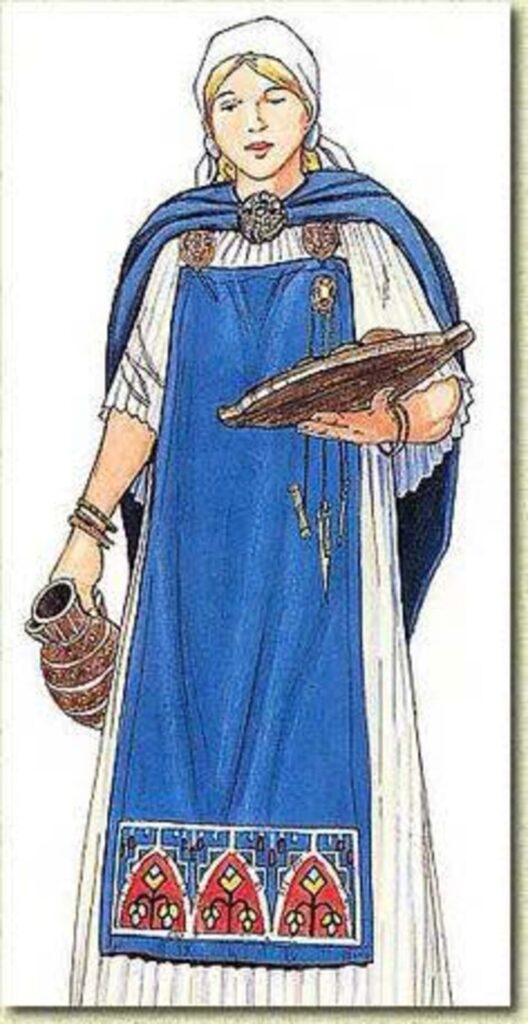
Shell-shaped brooches are strongly associated with female dress in the Viking Age and are often linked to the type of garment commonly reconstructed as a strap dress. But archaeological clothing was not uniform across Scandinavia.
Studies of Danish Viking Age textiles have shown that local dress traditions could differ from better-known reconstructions based on finds from places such as Birka in Sweden. That is why the Skonager textiles matter.
Rather than forcing the burial into an existing model, researchers may be able to work outward from the surviving fabric itself.
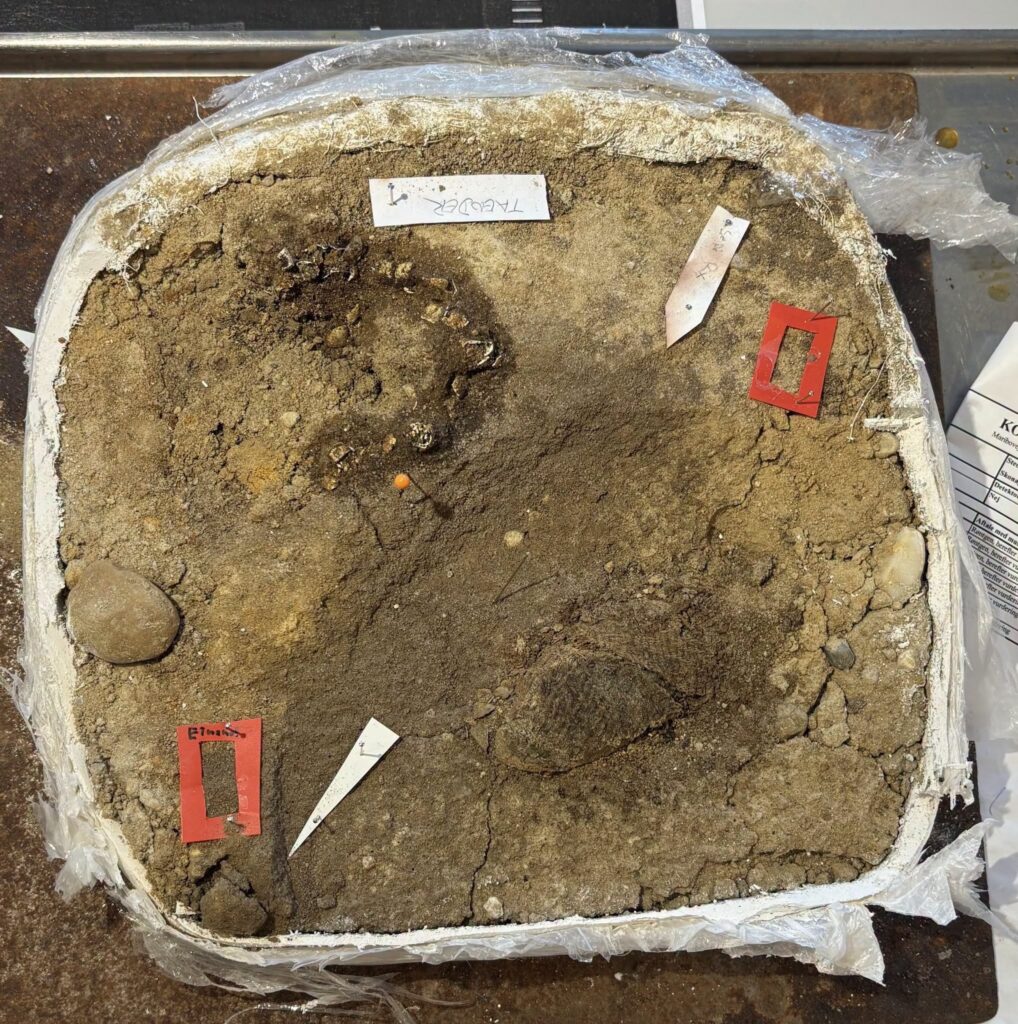
The preparation containing the brooches and surrounding soil is being excavated at Konserveringscenter Vejle, where conservators are removing sediment with extreme care.
Textile specialist Lise Ræder Knudsen is studying the fabrics, while the girl’s teeth are being examined by the Unit of Anthropology at the University of Southern Denmark.
The goal is not simply to identify fibre types. The position of each fragment could show how the garments were arranged when the girl was buried.
One repaired brooch raises another question
One of the two brooches had been repaired before it entered the grave. That small detail has opened another line of investigation.
Researchers plan to radiocarbon-date samples from the textiles to obtain a more precise date for the clothing. They can then compare that result with the archaeological dating of the brooches.
If the repaired brooch turns out to be older than the clothing, it may have remained in use for a long time before the girl was buried. It could even have been an heirloom.
There is no evidence yet to prove that, and archaeologists are treating the idea cautiously. A repaired brooch may simply have been a valued object that continued to be worn.
But the Skonager burial offers something better than speculation: the possibility of testing whether the jewellery and the clothing belonged to the same period.
Archaeologists also want to recover the colours
The investigation will not stop with the weave and construction of the fabric.
The textiles are also being examined as part of the Textile Colours of the Viking Age project, led by Ulla Mannering, with Charlotte Rimstad among the researchers involved. The project looks at dyes used in Danish Late Iron Age and Viking Age textiles.
Previous studies have shown that Viking clothing could be far more colourful than the brown and grey garments often seen in popular reconstructions. Danish finds have produced evidence for blue dyes, madder red and, in some cases, more unusual imported or high-value colourants.
Whether any original dye survives in the Skonager textiles is still unknown.
If it does, researchers could eventually reconstruct not only how the girl’s clothing was made, but what it looked like.
From a few fibres to one individual
The research has another historical connection. It is supported by the Agnes Geijer Foundation for Nordic Textile Research, named after the Swedish textile archaeologist Agnes Geijer, whose work helped shape modern interpretations of Viking Age clothing and shell-shaped brooches.
Geijer herself studied how these brooches related to female dress.
The Skonager burial now allows archaeologists to return to the same question with methods that were not available in her time: microscopic textile analysis, radiocarbon dating, modern conservation techniques and chemical dye analysis.
The result may not be a dramatic intact garment. Instead, it may be something more useful: a carefully reconstructed picture of how one young person in West Jutland was dressed when she was buried some 1,300 years ago.