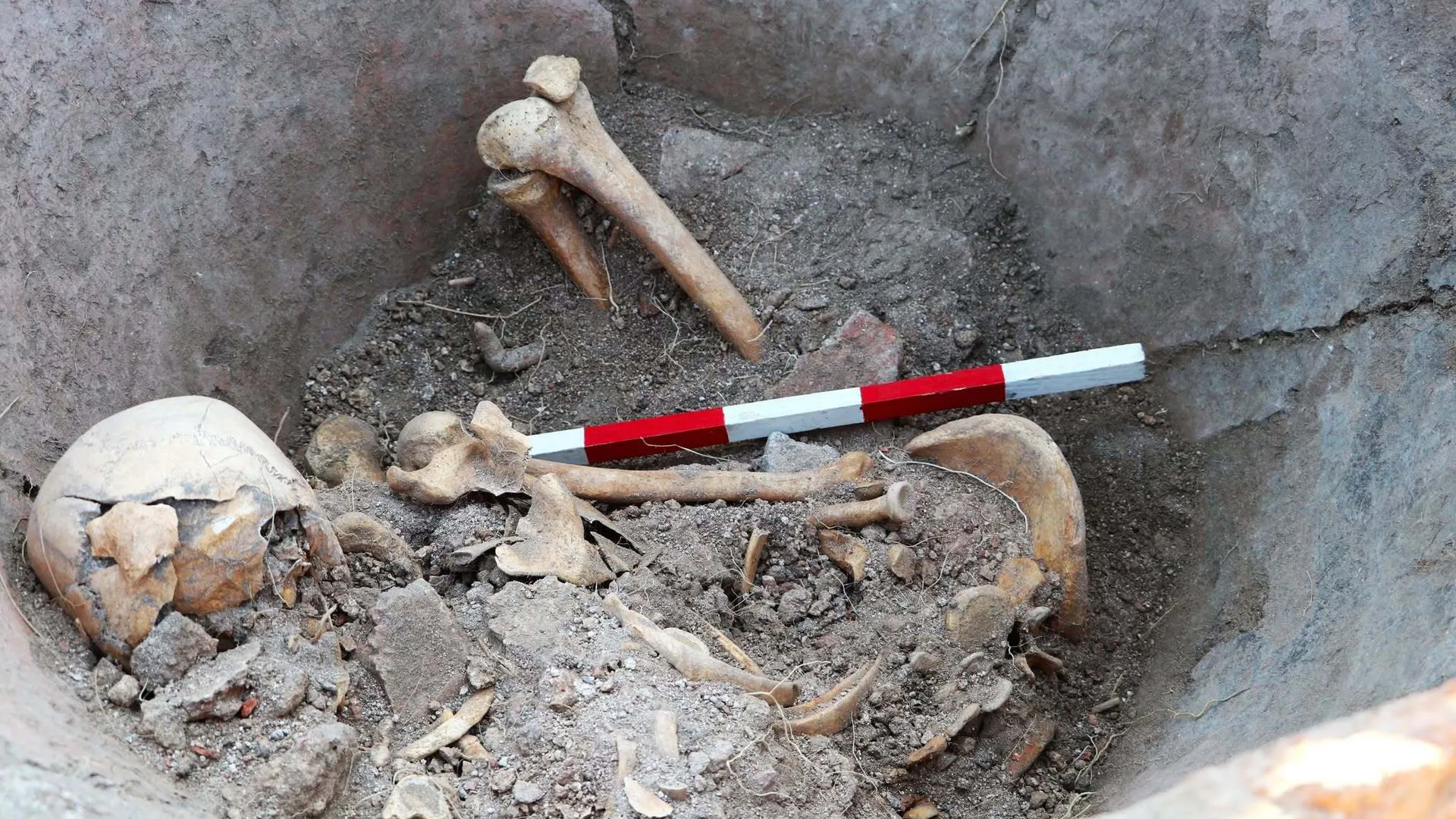
Archaeologists excavating the Roman city of Deultum in southeastern Bulgaria have discovered the skeleton of a young individual curled tightly inside a large ceramic storage vessel, apparently preserving the final moments of a violent episode that struck the city during Late Antiquity.
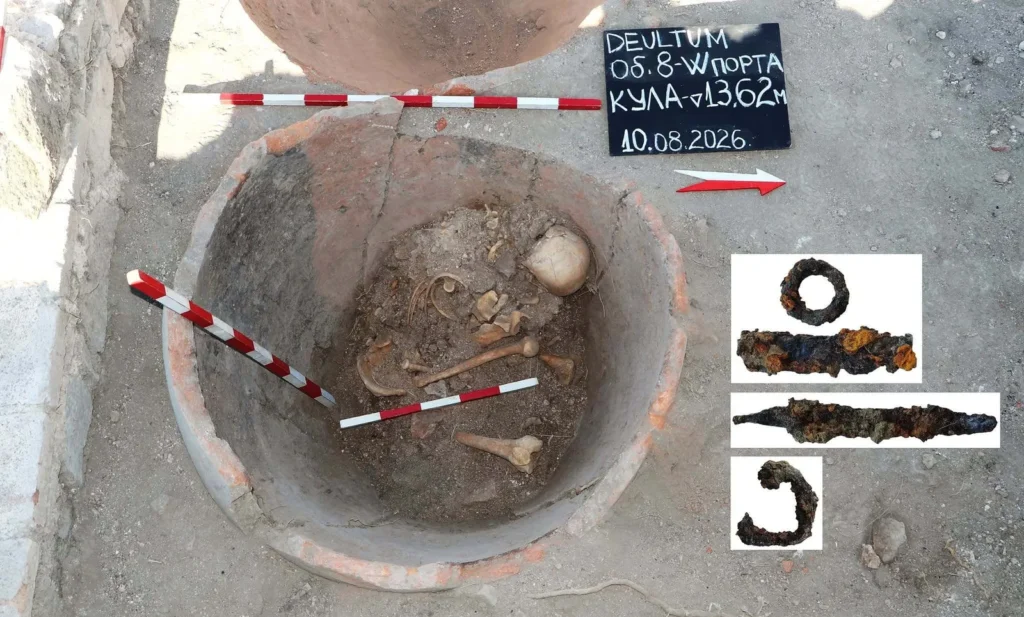
The remains were found inside a pithos, or dolium, uncovered in a newly identified tower beside Deultum’s Late Roman fortifications. Rather than representing a burial, the unusual position of the body suggests that the person deliberately climbed into the vessel while attempting to hide from an immediate threat. Archaeologists believe that threat may have been an enemy attack accompanied by a major fire.
A body where archaeologists did not expect one
The discovery was made on August 10 during work led by Professor Lyudmil Vagalinski of the National Archaeological Institute with Museum at the Bulgarian Academy of Sciences. The tower forms part of the western Late Roman gate complex at Deultum, where excavations are gradually revealing the city’s defensive architecture.
Two large storage vessels were uncovered in the area. Inside one of them, archaeologists encountered a skull and other human bones. The individual had drawn the knees up toward the chin and was positioned face downward, a posture that researchers interpreted as evidence of someone squeezing into the container to conceal themselves rather than being formally placed there after death.
The person was not entirely defenseless. Archaeologia Bulgarica reported that an iron knife was found with the individual, while a second, smaller knife was also present. Vagalinski emphasized, however, that the person does not appear to have been a soldier. The weapons may instead have been ordinary personal possessions—or the last means of protection available if whoever was outside discovered the hiding place.
Evidence surrounding the vessel points to a destructive event. Excavators documented extensive traces of fire, while further reporting from the team described ash, charcoal, burned architectural material, blackened surfaces and other debris. Ash was also found beneath the skeleton, suggesting that the individual may have entered the vessel after the fire had already begun.
The body shows no clear indication that the person subsequently attempted to climb back out. One possibility being considered is that the individual was overcome by smoke and suffocated while hiding inside the container, although the cause of death remains unconfirmed until anthropological examination is completed.
Deultum was repeatedly caught in Late Roman violence
The setting makes the attack hypothesis particularly significant. Deultum, located near modern Debelt southwest of Burgas, was founded around AD 70 under Emperor Vespasian and populated with veterans of the Legio VIII Augusta. Known as Colonia Flavia Pacis Deultensium, it developed into one of the most important Roman centers in Thrace and is considered the oldest Roman city established in present-day Bulgaria.
By Late Antiquity, however, the city occupied an increasingly unstable region of the empire. Archaeological evidence studied by Vagalinski has revealed a succession of destructive episodes between the fourth and sixth centuries. His earlier research identified attacks after AD 383 and AD 395, followed by another major disaster during the opening decades of the fifth century.
One especially intriguing possibility comes from Vagalinski’s broader study of Deultum’s destruction layers. Archaeological evidence indicates that the city suffered a serious attack in or shortly after AD 408, an event he has tentatively connected with the campaign of the Hun ruler Uldin. That does not mean the skeleton discovered this summer belongs to that particular attack. The excavators currently place the newly uncovered destruction event only approximately around AD 400, and its precise date remains under investigation.
This distinction is important. Deultum was attacked repeatedly, so identifying the attackers responsible for this specific fire will require the full archaeological context rather than a historical guess.
Sealed beneath the rebuilt city
What happened afterward may explain the skeleton’s remarkable survival. Following the destruction, residents cleared and leveled the ruined tower and constructed a new, higher floor above it. They apparently had no idea that one of the city’s inhabitants remained hidden at the bottom of the storage vessel below.
The bones have now been transferred to Sofia for physical anthropological analysis, which should provide firmer information about the individual’s sex, age and health. Excavation of the western gate will also continue, potentially narrowing the date of the destruction and clarifying whether this unusual discovery can be connected to one of the known attacks on Late Roman Deultum.
Rather than simply being another skeleton from an ancient city, the find may ultimately preserve something archaeology rarely captures so directly: an individual decision made during a moment of panic—the choice to climb into an empty jar and wait for danger to pass.