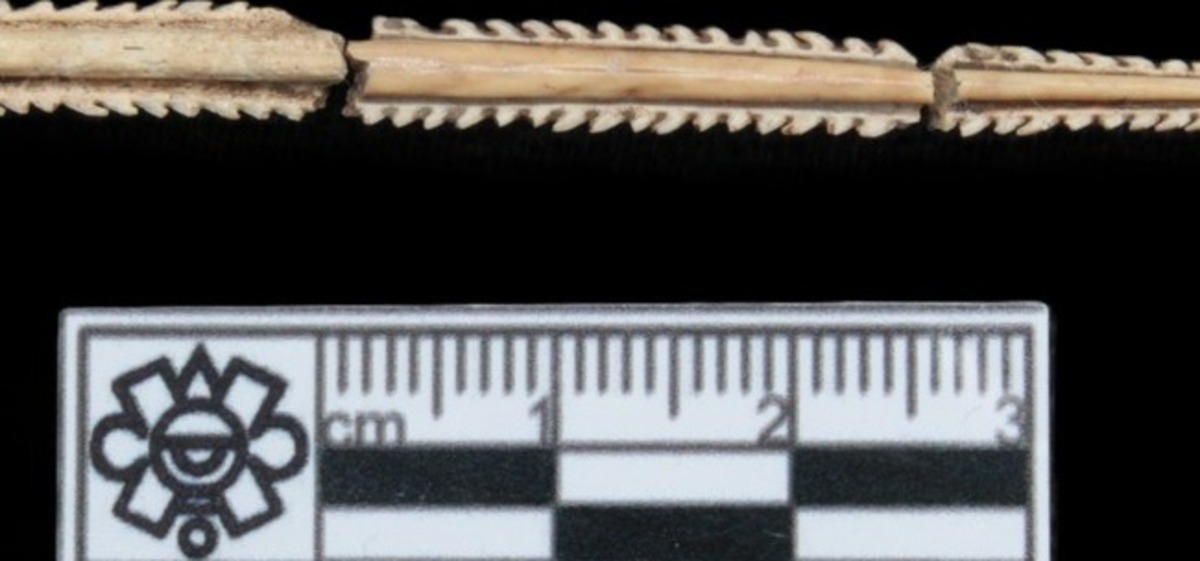
Three fragments of stingray spines and a catfish spine recovered from ancient Maya funerary contexts in southeastern Mexico are giving archaeologists a rare glimpse into one of the civilization’s most intimate religious practices: the deliberate shedding of blood.
The unusual objects were recovered near the Usumacinta River, close to Tenosique in the Mexican state of Tabasco, during archaeological salvage work connected with Section 1 of the Tren Maya project. Although excavated in June 2021, the finds are now undergoing detailed analysis by specialists from Mexico’s National Institute of Anthropology and History, or INAH.
What makes them intriguing is not simply that animal spines appeared alongside the dead. Stingray spines were among the sharpest natural objects available to the ancient Maya, and evidence from Maya art and written sources shows that they could become instruments in highly charged rituals involving blood, pain and communication with the supernatural.
Blood as an Offering
Among the Maya, bloodletting was not necessarily an act of punishment. It could be a privileged religious duty, particularly among elites, performed to maintain cosmic order, seek purification or prepare for larger ceremonies.
Archaeologist Said Amiel Luna Limón explained that self-sacrifice was practiced across the Maya world from the Late Preclassic through the Postclassic period, roughly 500 BC to AD 1520. Different parts of the body could be pierced, including the tongue, earlobes, fingertips and, in some male rituals, the penis.
Stingray spines appear repeatedly in this ritual world. In the southern Maya lowlands, they were particularly associated with bloodletting, and Maya imagery depicts blood being collected on bark paper. The blood-soaked material could then be burned, allowing smoke to rise symbolically toward the supernatural realm.
The newly studied finds therefore come with an obvious question: were these actual bloodletting tools, or were they placed with the dead because of their symbolic power?
For now, archaeologists are keeping both possibilities open.
Sharp Objects Among the Dead
The four specimens were recovered from an area covering roughly three hectares. One stingray spine fragment, measuring about three centimeters, was found in association with a burial. Its polished surface resulted partly from contact with abrasive sediments, confirming that it belonged to the same archaeological layer as the grave.
Researchers nevertheless caution that its presence does not prove it was used during a ritual. It may instead have been deposited as a funerary offering. A third stingray spine was also associated with a burial, while the catfish spine was found in a funerary context containing the remains of an adult male.
The catfish spine may turn out to be the most curious object of the group.
Marisol Arce Acosta, head of the project’s Zooarchaeology Laboratory, identified the stingray remains as belonging to the marine whipray and eagle ray families, while the catfish belonged to a freshwater group. Stingray spines are already well known in discussions of Maya bloodletting, but the ritual use of catfish spines is much less certain.
That difference opens a new line of investigation. A sharp catfish spine could physically perform the same task as a stingray spine, yet its presence may also reflect the Maya relationship with the rivers, wetlands and coastal environments that supplied both food and materials charged with ritual meaning.
For archaeologists, these small and easily overlooked objects may therefore tell a surprisingly large story. They connect the dead not only with Maya ideas about blood and sacrifice, but also with a landscape in which animals, rivers and the supernatural world were closely intertwined.