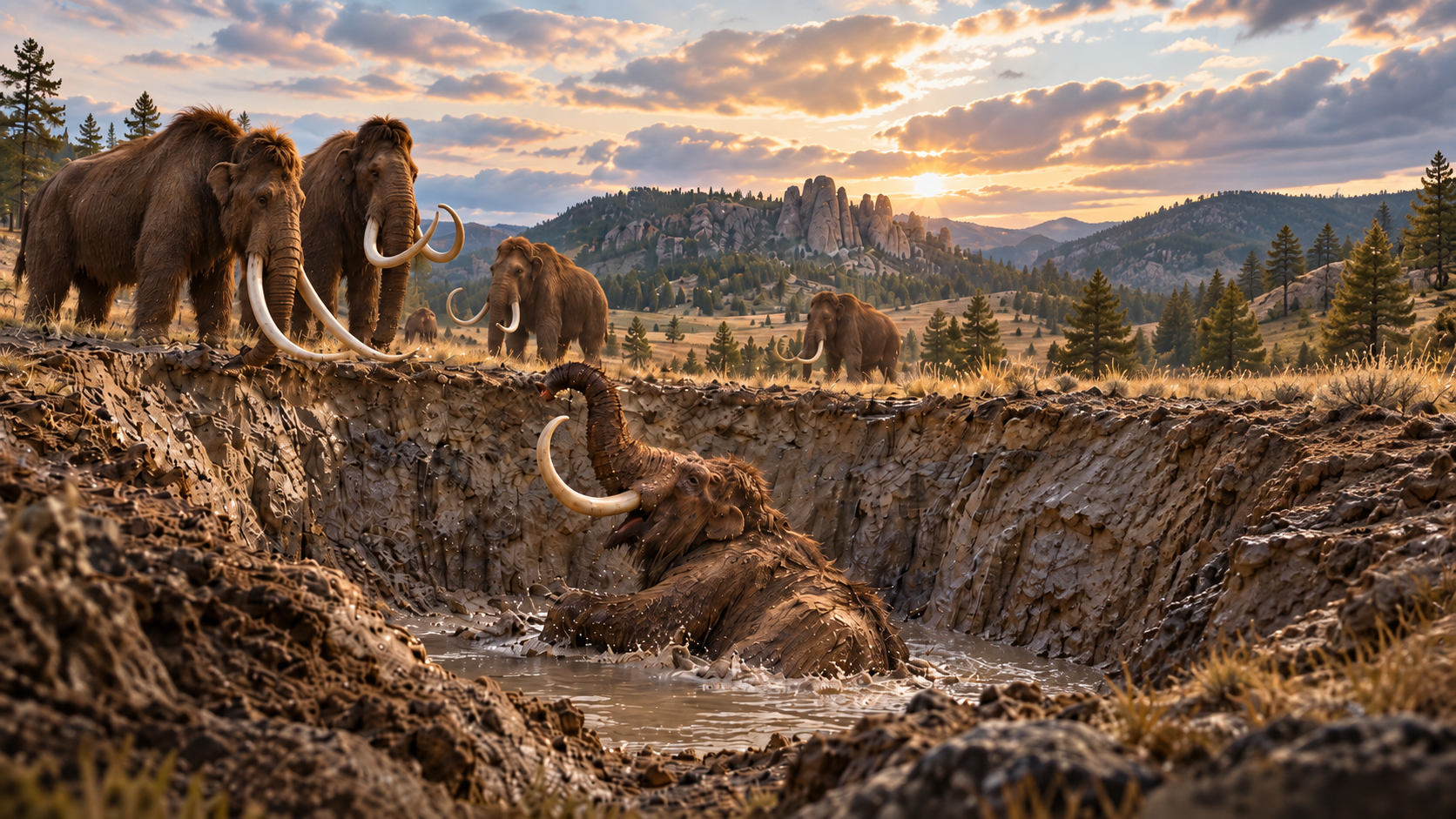
One of North America’s most spectacular mammoth graveyards has just become much older. A new study suggests that the famous Mammoth Site in South Dakota, home to the remains of more than 60 mammoths, may date back as far as 232,000 years — more than 100,000 years earlier than researchers had long believed.
The finding dramatically rewrites the timeline of the unusual natural trap at Hot Springs in the Black Hills. Earlier radiocarbon dates placed much of the bone-bearing deposit between roughly 42,000 and 23,000 years ago, but a new analysis of the sediments surrounding the fossils points instead to a period between about 232,000 and 160,000 years ago.
A Deadly Water Hole for Mammoths
The Mammoth Site was discovered almost by accident in 1974, when a hill was being cleared for a housing development and mammoth tusks appeared. Excavations eventually revealed something extraordinary: an ancient sinkhole that had repeatedly trapped mammoths.
More than 60 individuals have been identified from their tusks, making the site the largest concentration of Columbian mammoth remains known in North America. Even stranger, every mammoth identified there appears to have been male, and most were relatively young animals.
The sinkhole once contained warm spring water and may have looked like an inviting place to drink or feed. Its steep walls, however, could turn an apparently harmless pool into a trap. Mammoths continued to become trapped while several meters of sediment slowly accumulated inside the depression; by the later stages, the pond had become shallow enough for animals to enter and leave without becoming trapped.
Reading the Clock Hidden in Sediment
Dating the site has always been difficult because the mammoth bones contain little surviving collagen, the material normally preferred for reliable radiocarbon dating. Earlier researchers instead dated bone apatite, but that material can chemically change after burial and produce dates that appear much younger than the bones themselves.
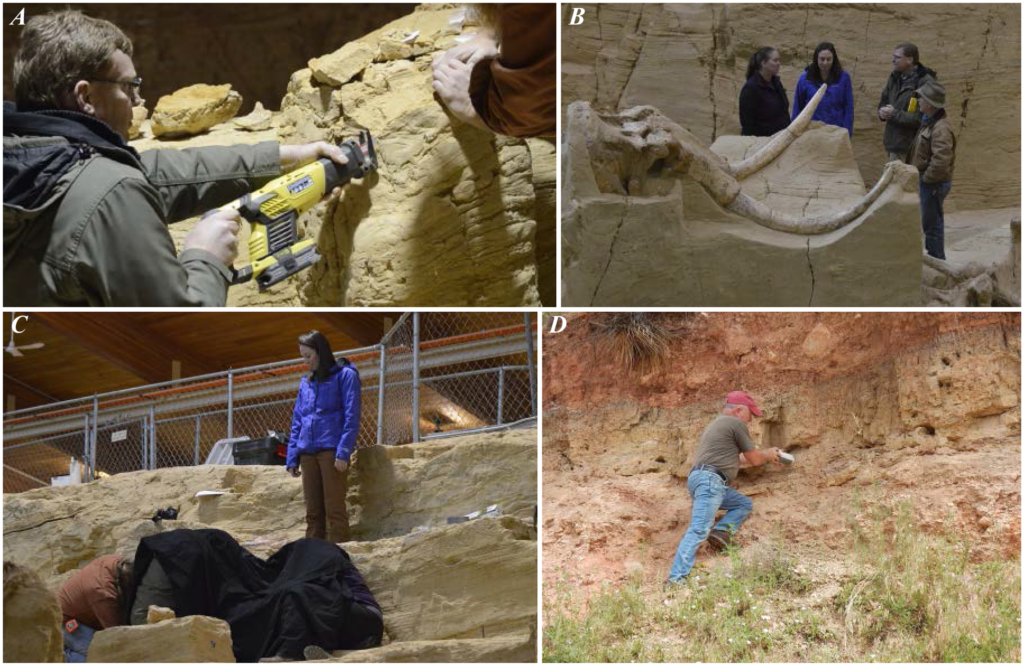
The new study took a different approach. Researchers measured luminescence stored inside mineral grains in the sediments surrounding the fossils — essentially determining how long it had been since those grains were last exposed to sunlight.
Quartz proved too old for the technique because its luminescence signal had become saturated, so the team turned to feldspar. Six samples from the bone-bearing deposits produced ages ranging broadly between about 232,000 and 160,000 years. Two separate laboratories also obtained closely matching results from duplicate samples, strengthening confidence in the new chronology.
A Mammoth Cemetery from a Different Ice Age
The revised dates place most of the bone-bearing sediments within Marine Isotope Stage 6 and perhaps the end of MIS 7, much earlier than previously thought. This matters because fossils from Mammoth Site have often been used as reference specimens for understanding the evolution of Columbian mammoths in North America.
The researchers estimate that roughly six meters of bone-bearing sediment accumulated at an average rate of about 12 millimeters per year. Rather than being filled rapidly during a short-lived catastrophe, the sinkhole appears to have accumulated sediment slowly over a long period, repeatedly catching mammoths while the spring remained active.
The younger radiocarbon dates may have been measuring something else entirely. The authors suggest that chemical changes during the later drying and cementation of the sediments could effectively have reset the radiocarbon clock. Evidence from nearby terraces indicates that the sinkhole had probably dried, hardened, and completely filled by around 73,000–61,000 years ago.
That leaves the Mammoth Site not simply as an extraordinary Ice Age graveyard, but as a much deeper window into North America’s Pleistocene past than scientists had realized.
Mahan, S. A., Mead, J. I., Hanson, P. R., Krolczyk, E. T., & Jass, C. N. (2026). Age reassignment using luminescence dating for The Mammoth Site, Black Hills, South Dakota, USA. Quaternary Research, 1–18. doi:10.1017/qua.2026.10102