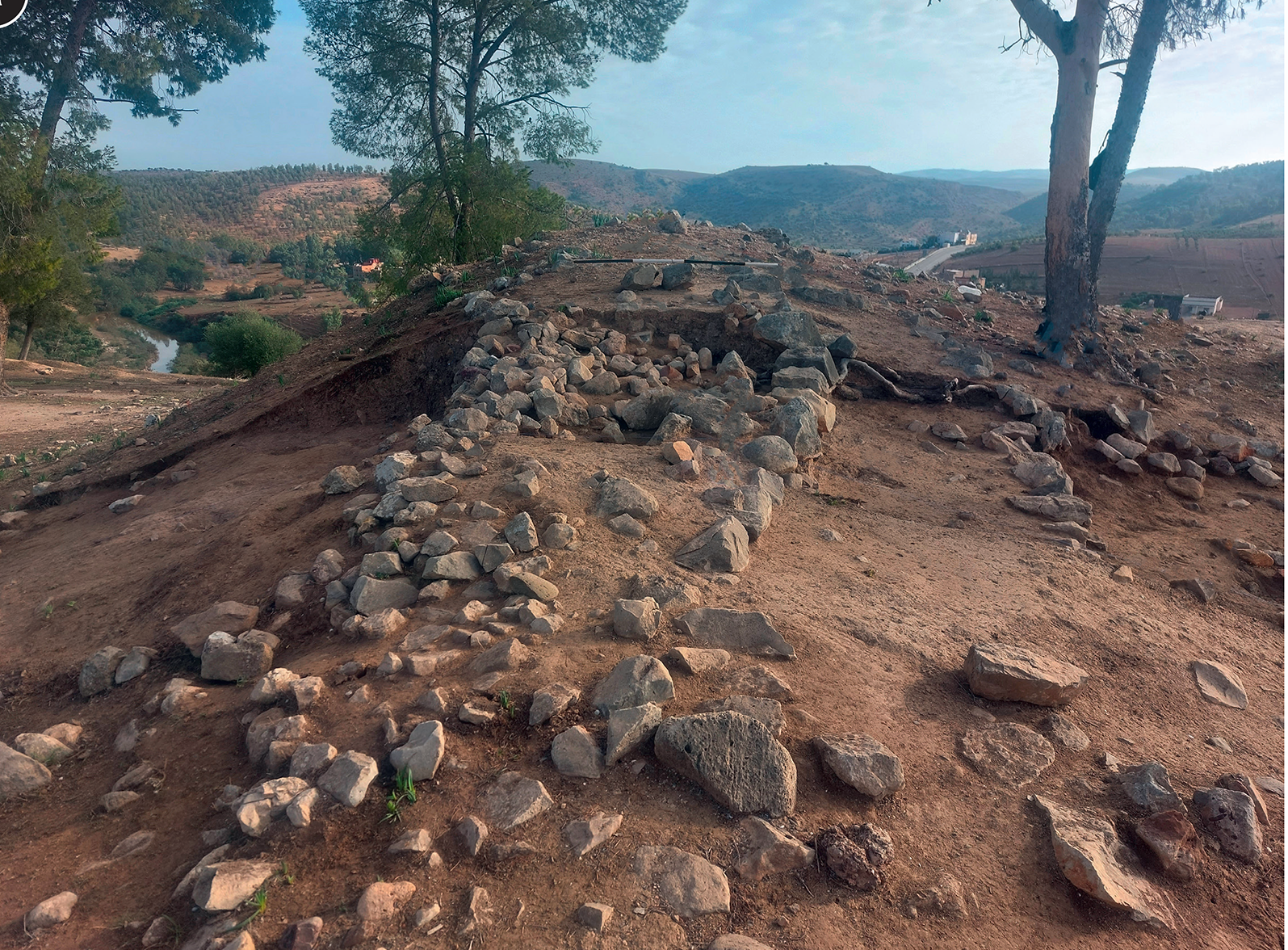
A line of walls cutting across a rocky spur in northwestern Morocco has puzzled archaeologists for nearly a century. Now, new excavations at Oued Beht suggest that what once looked like a simple wall was actually part of a much older and more complex defensive system built around 4,000 years ago.
The discovery could represent the oldest known fortification in North Africa outside the Nile Valley. It also adds a new chapter to Oued Beht, a site already famous for preserving one of the region’s largest known prehistoric farming settlements.
A wall that hid a much bigger story
The southern end of Oued Beht had attracted attention since the 1930s, when French archaeologist Armand Ruhlmann suggested that walls crossing the ridge might form an éperon barré, a naturally protected spur sealed off by artificial defenses.
For decades, however, no one knew when the structures had actually been built.
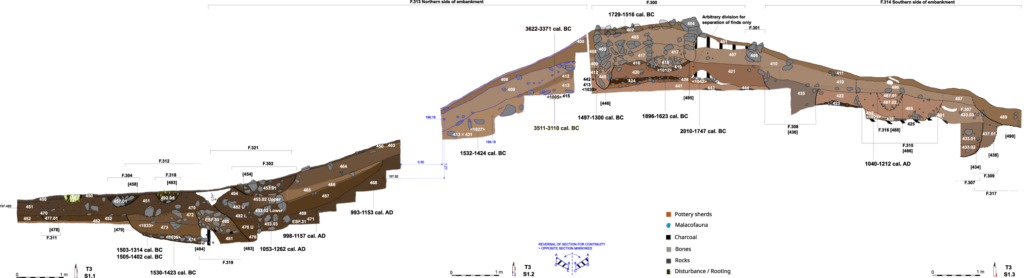
Excavations carried out in 2023 finally began to answer that question. Archaeologists opened trenches through Wall B1, one of the main visible features, and discovered that the apparent stone wall concealed several earlier construction phases.
Beneath and around it were traces of a ditch, an earthen rampart and older structural remains. The ditch alone measured at least 1.84 meters across, while layers of compacted gravel, charcoal and burned daub suggest that some of the earliest structures were built partly from earth and organic materials rather than stone alone.
Radiocarbon dates pushed the story deep into the second millennium BC. One sample from an early wall foundation dated to roughly 2010–1747 BC, while material associated with its destruction fell between about 1896 and 1623 BC.
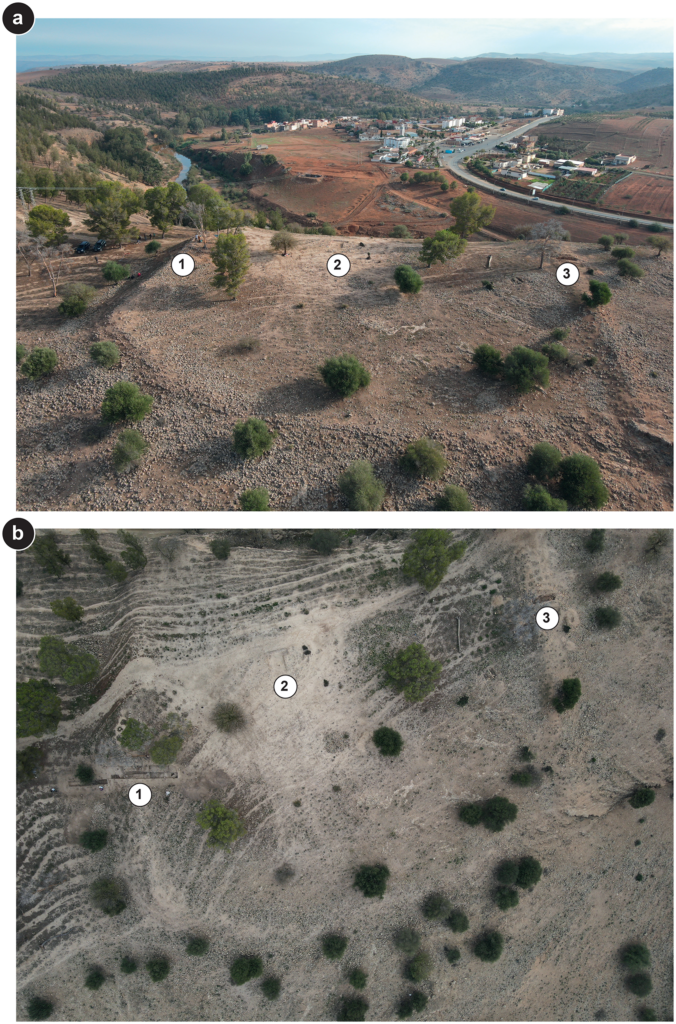
Drone views of the fortified spur at Oued Beht, showing the main excavation trenches and defensive structures, with Aït Siberne in the background. Credit: L. Farr and G. Lucarini / Oued Beht Archaeological Project, via Libyan Studies.
Built, burned and rebuilt
The defenses were not the result of a single building episode.
Archaeologists identified multiple phases of construction, burning and rebuilding. Two distinct burned layers indicate that the structure experienced serious episodes of destruction before being modified again.
Later additions to the earthwork date mainly to around the 16th to 14th centuries BC. Charred seeds recovered from ditch deposits also produced dates in this period, showing that the defensive system remained part of the landscape for centuries.
Its location was no accident. The structure cuts across the southern spur of Oued Beht at a point where steep natural terrain already restricted access. Adding a ditch and rampart would have made movement onto the spur even easier to control.
Researchers therefore consider a defensive interpretation highly plausible, although they remain cautious. The earthworks may also have helped define or enclose space, and their exact function could have changed over time.
A different Oued Beht emerges
The discovery is especially striking because it belongs to a very different phase of Oued Beht’s history.
More than a thousand years earlier, between about 3400 and 2900 BC, activity had been concentrated farther north across a large agricultural settlement covering roughly 10 to 11 hectares. That community has already transformed ideas about prehistoric life in northwestern Africa.
By the second millennium BC, however, people appear to have shifted toward the more naturally defensible southern spur.
That change may point to a different way of organizing settlement, movement and protection. The construction of a ditch, rampart, and associated walls also suggests significant planning and coordinated labor.
Centuries later, people returned yet again. During the medieval period, substantial stone defenses were built over parts of the prehistoric earthworks, showing that the strategic value of the ridge endured long after the Bronze Age builders were gone.
At Oued Beht, one wall has turned out to contain several landscapes stacked on top of one another: a prehistoric farming world, a Bronze Age defensive system, and a medieval stronghold sharing the same ground.
Lucarini G, Bokbot Y, Wilkinson T, et al. Expanding Oued Beht: Final Neolithic, Bronze Age, medieval and later discoveries from excavation and survey in 2023. Libyan Studies. Published online 2026:1-42. doi:10.1017/lis.2026.10037