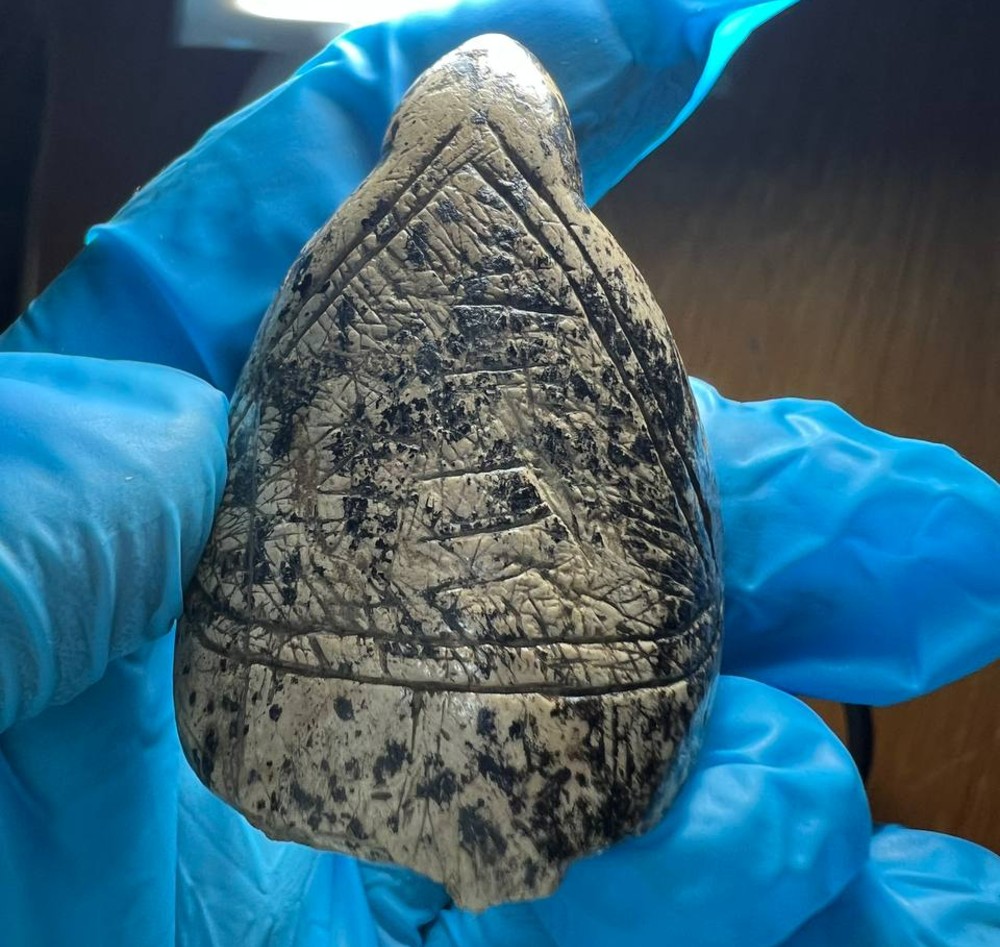
Some 18,000 years ago, an Ice Age artist picked up a piece of mammoth ivory and began carving a small human figure. The finished object was covered in geometric patterns, but the inspiration for those designs may have been hiding inside the tusk all along.
A new study of 18 prehistoric figurines discovered at Mizyn in northern Ukraine has revealed that their makers copied natural growth patterns in mammoth ivory. Using microscopic analysis and 3D technology, researchers have identified a connection between the material’s internal structure and the decorations carved onto its surface.
The discovery offers a rare glimpse into the creative decisions of people who lived thousands of years before writing, revealing how closely they observed the world around them.
The secret was inside the ivory
The Mizyn figurines belong to a tradition of prehistoric objects commonly known as Venus figurines. These small, stylized representations of the human body have fascinated archaeologists for generations, partly because their original purpose remains uncertain.
Some researchers have linked such objects to fertility, ritual practices or female identity. But rather than attempting to resolve those questions, the international research team focused on something more tangible: the way the figurines were made.
Mammoth tusks contain distinctive internal features known as Schreger and Owen lines. These patterns form as the tusk grows, producing intersecting structures and curved bands within the ivory.
The researchers found that the Ice Age carvers incorporated these natural features into their decorations. What initially appeared to be purely imaginative geometric designs may therefore have originated from patterns the artists could see in their raw material.
The finding suggests that the craftspeople did not simply choose ivory because it was available or suitable for carving. Its physical appearance may have influenced how they conceived their artwork.
A different story of Ice Age art
The discovery also raises questions about how prehistoric artistic traditions developed across Europe.
The researchers compared the Mizyn figurines with human representations from other European Paleolithic sites and reassessed their chronology using calibrated radiocarbon dates.
Their analysis places the Ukrainian objects among the earliest known European anthropomorphic images produced after the Last Glacial Maximum, a period when immense ice sheets covered much of northern Europe.
The study also identifies an apparent gap of approximately 1,000 to 3,000 years in the archaeological record of human figurine production.
When such objects reappeared, the artists at Mizyn appear to have developed a distinctive approach, rather than simply adopting the better-known styles associated with Western Europe.
For archaeologists, this matters because prehistoric art is often discussed through broad cultural traditions. The Ukrainian figurines suggest that local communities could follow different creative paths, even when producing objects that belonged to a wider tradition of human representation.
Preserving prehistoric art during wartime
The investigation was made possible by efforts to protect Ukraine’s cultural heritage during the ongoing war.
The figurines, held by the National Museum of the History of Ukraine, were digitally recorded as part of a preservation initiative led by the Ukrainian NGO Archaїc.
High-resolution microscopy and three-dimensional modelling allowed researchers from Ukraine, Norway, Germany and the United Kingdom to examine the fragile objects in remarkable detail.
The resulting digital records provided more than a safeguard for endangered heritage. They also made it possible to investigate the engravings and identify connections that had previously escaped attention.
Published in npj Heritage Science on September 11, 2026, the study demonstrates how modern technology can reveal the thinking behind objects created nearly 18 millennia ago.
The figurines cannot tell us exactly what their makers believed or why these particular human forms mattered to them. But their carefully carved surfaces preserve something equally compelling: evidence of artists who looked closely at a mammoth tusk and transformed its natural patterns into art.
Radchenko, S., Naumenko, O., Kiosak, D. et al. Internal structure of Mammoth ivory inspired the design of Mizyn (Ukraine) Upper Palaeolithic figurines. npj Herit. Sci. (2026). https://doi.org/10.1038/s40494-026-02988-5