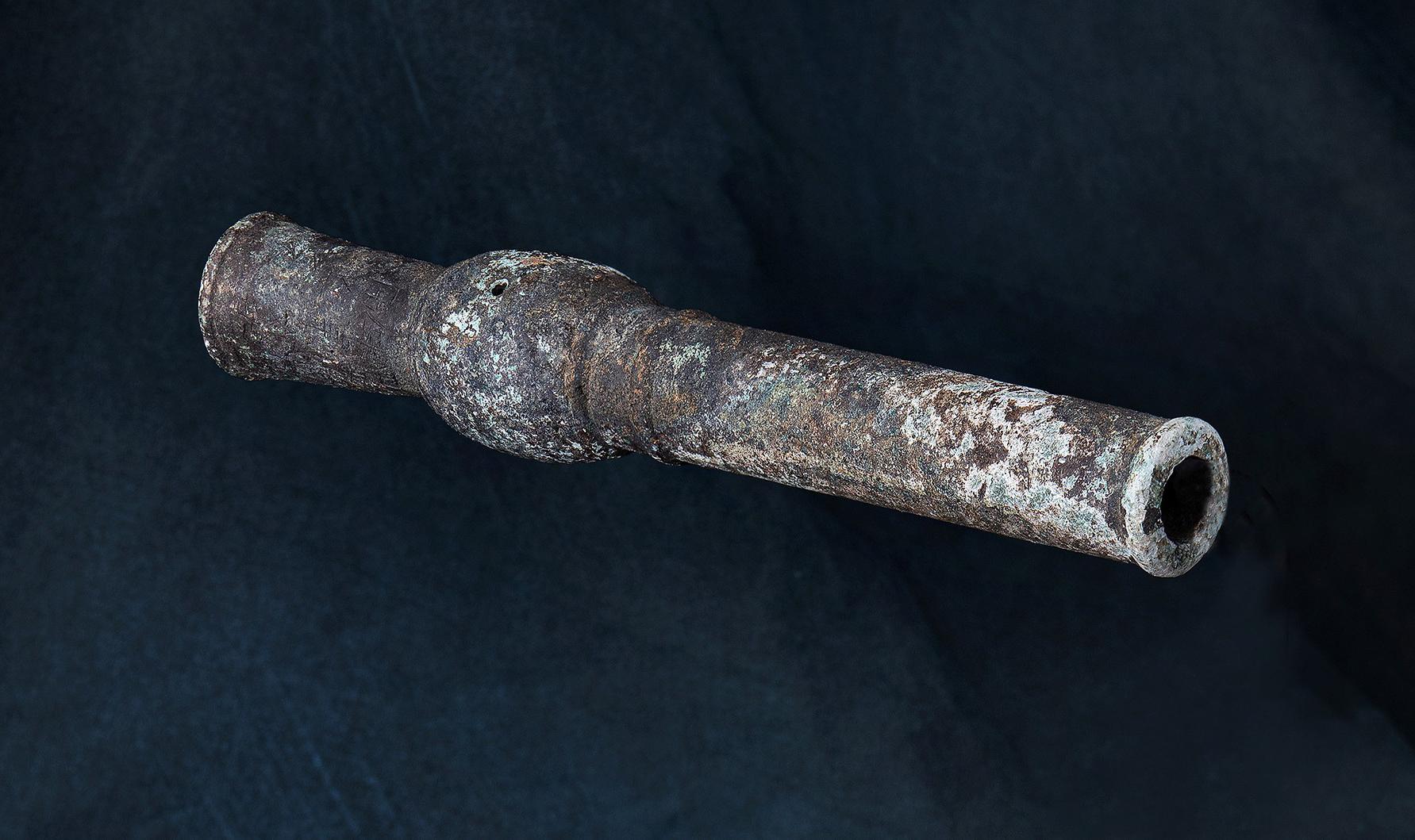
Soldiers searching for landmines on a mountain in South Korea stumbled upon something entirely unexpected: a small bronze weapon that had been lying beneath the soil for centuries. Three years later, researchers have identified the object as the oldest surviving gunpowder weapon ever found in Korea.
The remarkable discovery took place in November 2023 on Mount Geumseong in Naju, approximately 280 kilometers south of Seoul. Military personnel were conducting a mine-detection sweep ahead of planned hiking trail construction when they encountered the object, which was buried just 10 centimeters below the surface.
At first glance, the find might not have seemed particularly extraordinary. Measuring just 23.75 centimeters long and weighing a little over one kilogram, it was small enough to be carried by an individual soldier. Yet the bronze object would soon reveal a history stretching back nearly six centuries, possibly even further.
A Mysterious Message on the Ancient Weapon
Researchers at the Naju National Research Institute of Cultural Heritage spent the following three years examining the weapon. Their work revealed 28 engraved characters that identified it as a Hwangja Hwatong, a type of early handheld gunpowder weapon capable of launching arrows or other projectiles.
The inscription offered an unusually personal glimpse into its manufacture. It recorded the weapon’s original weight, the official who supervised its production, and even the name of the craftsman who cast it.
That craftsman was called Seok, while the supervising official was An Hyu-bo.
Most strikingly, the inscription included a date. But rather than solving the mystery completely, it presented researchers with two possibilities.
The weapon was manufactured in either December 1377 or December 1437. Both dates correspond to the traditional Korean cyclical year designation engraved on its surface, leaving researchers unable to determine which year is correct.
A Weapon from the Dawn of Korean Gunpowder Warfare
If the earlier date proves correct, the cannon was produced in the same year that the Goryeo Dynasty established a government agency responsible for manufacturing gunpowder weapons. The initiative was associated with Choe Mu-seon, a military innovator who helped develop Korea’s early gunpowder technology.
The alternative date places it during the reign of King Sejong, when Korean military engineers were developing and improving firearms.
Either way, the Hwangja Hwatong predates other surviving Korean gunpowder weapons whose manufacture can be established securely. Its rounded powder chamber also preserves an early design that differs from later, more sophisticated weapons.
Scientific analysis revealed another important detail. The cannon was cast from an alloy of copper, tin, and lead, with the tin content kept below 10 percent. Researchers believe this composition helped the bronze withstand the pressure generated when gunpowder ignited.
Despite its age, the weapon still carries the names of the people who made it, turning an unexpected military discovery into a rare record of medieval craftsmanship.
The Hwangja Hwatong was formally unveiled on September 21, 2026, at the National Palace Museum of Korea in Seoul. Visitors will be able to see the artifact during a special exhibition running from September 23 through November 22.