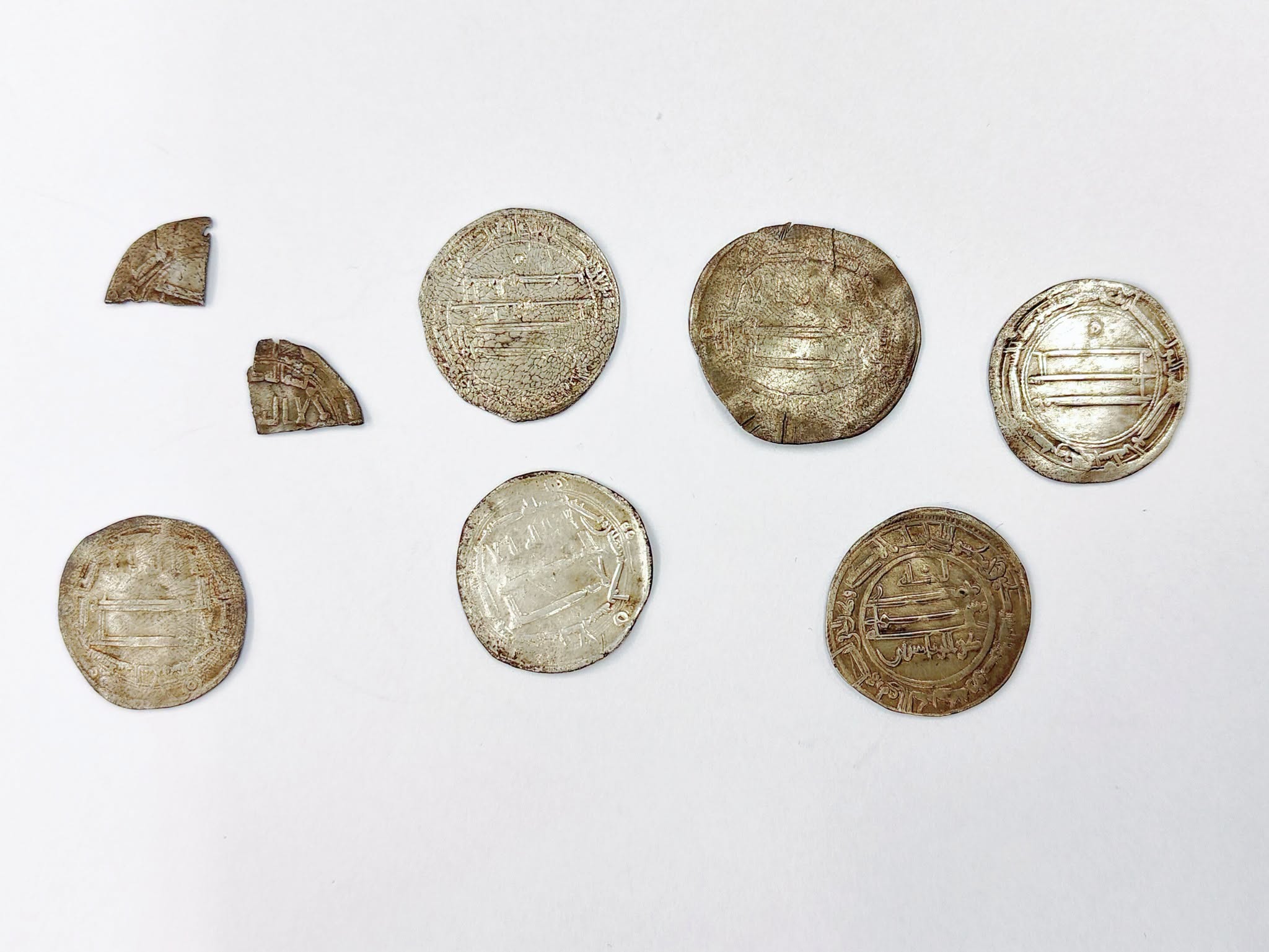
A handful of silver coins found in a forest near the Baltic coast has reopened a much larger story — one that stretches from the Islamic world to one of northern Europe’s most mysterious Viking-age trading centres.
The find consists of six early medieval Arab dirhams and two fragments of silver coins discovered during a legal search in the Młynary Forest District near Elbląg, in northern Poland. The coins date to the first half of the ninth century, a period when the nearby settlement of Truso was becoming an important hub for merchants moving goods across the Baltic and beyond.
The Archaeological and Historical Museum in Elbląg has received the coins for conservation and study. Museum archaeologists also plan to visit the discovery site, while numismatists will examine the inscriptions, mints and rulers represented on the silver.
What makes the find especially compelling is where it appeared. Truso was once one of the best-known trading places on the southern Baltic coast — and then, for centuries, it vanished from the map.
A lost city at the edge of the Baltic
Truso entered written history through the account of the Anglo-Saxon traveller Wulfstan, who sailed from Hedeby to the southern Baltic in the late ninth century. His description later appeared in the geographical writings associated with the court of Alfred the Great.
The name survived. The city did not.
For generations, historians knew that Truso had existed somewhere near the Vistula delta, but no one could say exactly where. The settlement slowly acquired the aura of a lost city, and Polish media have sometimes compared it to Troy or Atlantis — a place remembered in texts long before archaeology could put it back on the map.
That changed in 1981, when archaeologist Marek F. Jagodziński identified the remains of Truso near Janów Pomorski, on the eastern side of Lake Druzno.
Excavations eventually revealed a substantial Scandinavian trading settlement with houses, workshops, craft production, and imported goods. Finds from the site showed that Truso was not an isolated Baltic outpost. It belonged to a much wider commercial world.
Goods reached the settlement from western Europe, Scandinavia and the Islamic lands to the south and east. That is where the newly found silver becomes especially interesting.
How Arab silver reached Viking traders
Dirhams were among the most important silver currencies moving through Eurasia during the Viking Age.
In the ninth century, large quantities of Islamic silver travelled northward through river and overland routes across eastern Europe. Many of the dirhams that reached the Baltic came from the Abbasid world, where mints in cities such as Baghdad, Basra and Damascus produced silver coinage on a vast scale.
The newly discovered coins have not yet been identified individually, so it would be premature to assign them to a particular caliph or mint. Their date, however, places them within the period when Abbasid silver was reaching northern Europe in large quantities.
By the time such a coin arrived near Truso, it may have travelled thousands of kilometres and passed through many hands.
It could have belonged to a merchant. It could have changed hands several times in eastern European trading centres. It may have been valued more for its weight in silver than for the ruler whose name appeared on it.
Jakub Jagodziński of the Archaeological and Historical Museum in Elbląg has suggested that the coins may have circulated for a long time, possibly until the turn of the tenth and eleventh centuries. He linked the discovery to the commercial activity surrounding Truso.
One possibility is that merchants travelling toward the settlement carried the coins. Another is that the silver belonged to Prussian guards collecting tolls along routes leading into the trading zone.
For now, both remain possibilities rather than conclusions.
Eight pieces of silver, one much bigger story
The find itself is modest: six complete dirhams and two fragments.
But archaeology often works through small objects.
A silver coin can preserve a ruler’s name, a mint, a date, and a point of origin. When several coins appear together, they can reveal patterns of movement that are otherwise invisible — especially in places where written records remain scarce.
That is why the next stage of research matters.
Once specialists identify the coins, they may be able to compare them with other dirham finds from Truso and the wider Baltic region. The results could help clarify whether the silver arrived during one phase of trade or remained in circulation for generations.
The museum plans to conserve the coins before eventually putting them on display in Elbląg. Its archaeologists will also inspect the discovery area for additional traces that might explain how the coins ended up there.
Whether the silver belonged to a travelling merchant, a local toll collector or someone whose story has vanished completely is impossible to say for now.
But the find carries an unusually long geographical echo. More than 1,100 years ago, silver minted somewhere in the Islamic world travelled north into the trading networks of the Baltic. Today, a few of those coins have resurfaced near Truso — the city that disappeared for centuries, only to return through archaeology.