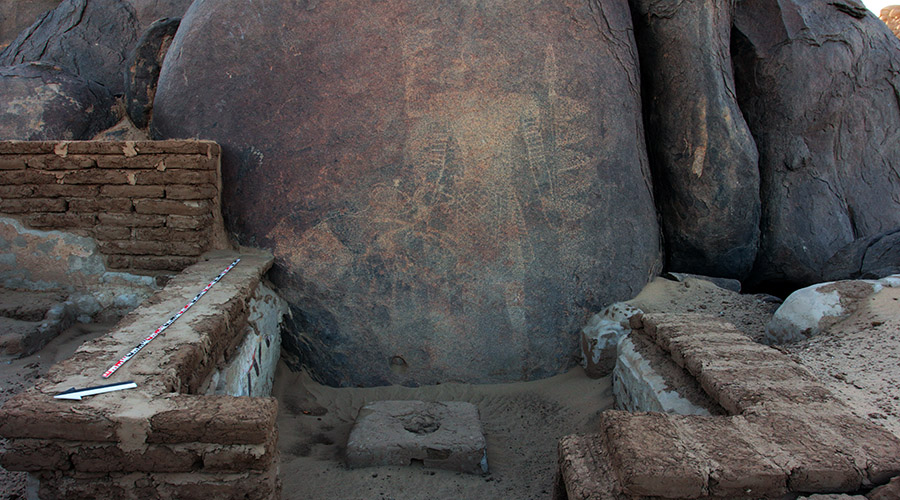
In northern Sudan, a life-size figure carved into granite has outlived kingdoms, religions and generations of local memory. The mysterious image may represent an ancient Nubian ruler, yet centuries later a Christian church rose around the same rock, turning an older monument into part of a new sacred landscape.
The site lies at Miseeda in the Mahas region, near the Third Cataract of the Nile. Archaeologists working there have documented nearly 300 sites, revealing a landscape repeatedly occupied and reinterpreted from prehistoric times through medieval Christianity and into the modern era.
At the center of the story is a monumental human figure cut into the surface of a granite outcrop at site MAS.021. Researchers describe it as life-size and suggest that it may depict a Nubian ruler associated with the Kerma or Kushite cultural world, although its exact date remains uncertain.
That uncertainty only adds to the mystery. Monumental royal rock carvings are rare in Nubia, and the researchers compare the Miseeda image with the famous representation of the Meroitic king Sherkarer at Gebel Qeili. There, the carving has been interpreted as a statement of royal authority near the edge of the kingdom. The Miseeda figure may have played a similar role in a frontier zone where northern and southern traditions met.
The ruler was not alone. Archaeologists also recorded large rock images of a lion, an elephant and what may be a rhinoceros, together with cattle figures and later carvings of crosses, ships and human forms. The collection suggests that people returned to the same rocky setting again and again, leaving behind symbols from very different eras.
Then a church was built around it
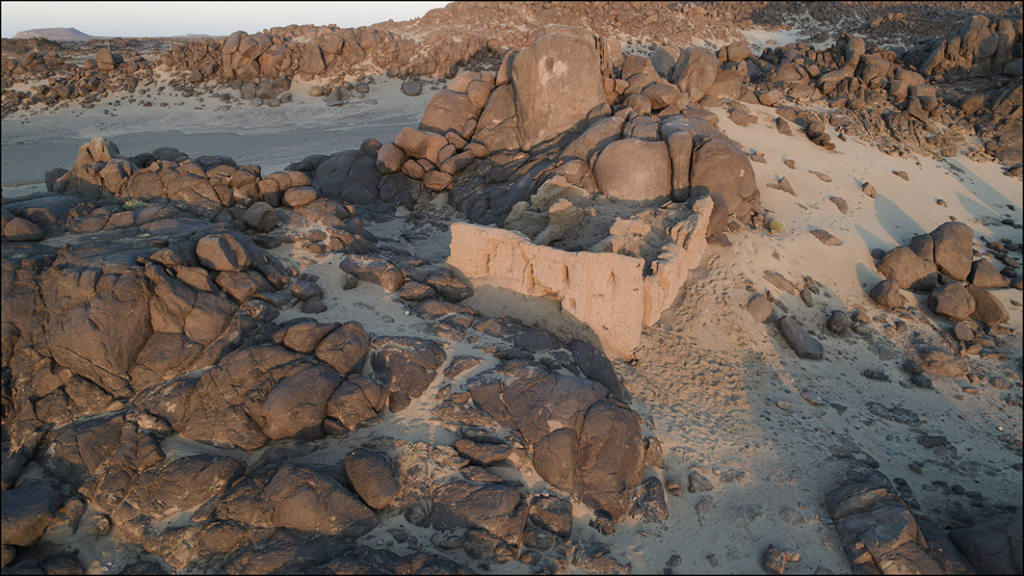
Several centuries later, the site entered an entirely different chapter. Around the seventh century, a Christian community built a church around the older carved rock, incorporating the ancient monument into a new religious setting instead of removing it.
The surrounding evidence suggests that the location had retained significance long before the church appeared. Christian-period carvings nearby include crosses and other motifs, and some seem to direct attention toward the church itself. Pottery from the area also connects Miseeda with early Christian Nubia, including the kingdoms of Nobadia and Makuria.
The result is an unusual archaeological scene: an image that may once have represented ancient political power remained visible while a later community reshaped the same place around a completely different belief system.
A landscape used for thousands of years
The wider survey shows that Miseeda was never an isolated monument. Archaeologists identified major phases of activity during the Mesolithic, the Late Neolithic and Pre-Kerma periods, and the Christian era. Evidence from the Classic Kerma through Kushite periods appears less frequently, but the monumental petroglyph stands out as one of the most striking traces from that broader span.
Pottery also reflects the region’s position between cultural worlds. Pre-Kerma and Kerma ceramics display both northern and southern traits, reinforcing the idea that Mahas functioned as a frontier where communities and traditions overlapped rather than as a remote edge of Nubian history.
This long history helps explain why the site cannot be reduced to a single period. The same rocky hill carried different meanings for different people, while its physical features remained in place.
From sacred site to stories of curses
The most unexpected chapter survives not in stone, but in local memory. Ethnographic research shows that the church, nearby ruins, and other sacred locations became associated with stories of gold, spirits, miracles, and curses. Some of these places were once used for pilgrimages and ritual offerings.
Over time, however, the church’s sacred status began to fade. Local people came to know it by names including “Beit Kitchiner” and “Beit Sheitan,” or “House of the Devil,” reflecting a shift from formal sacred space toward a landscape surrounded by supernatural stories.
That transformation may be the most revealing part of Miseeda. A figure possibly carved to represent authority later stood inside a Christian sacred center and eventually became part of a world of legends, spirits, and fear.
At Miseeda, one rock appears to have survived every change around it. Kingdoms disappeared, religions shifted, and local traditions evolved, but the carved ruler remained in place, gathering new meanings with each passing era.
Ciesielska, J. A., Drzewiecki, M., Innemée, K. C., Kurcz, M., de Lellis-Danys, K., Osypiński, P., … Zielińska, D. (2026). Miseeda: between kingdoms, through epochs—reconstructing a history of the Mahas region (Sudan). Antiquity, 1–8. doi:10.15184/aqy.2026.10427