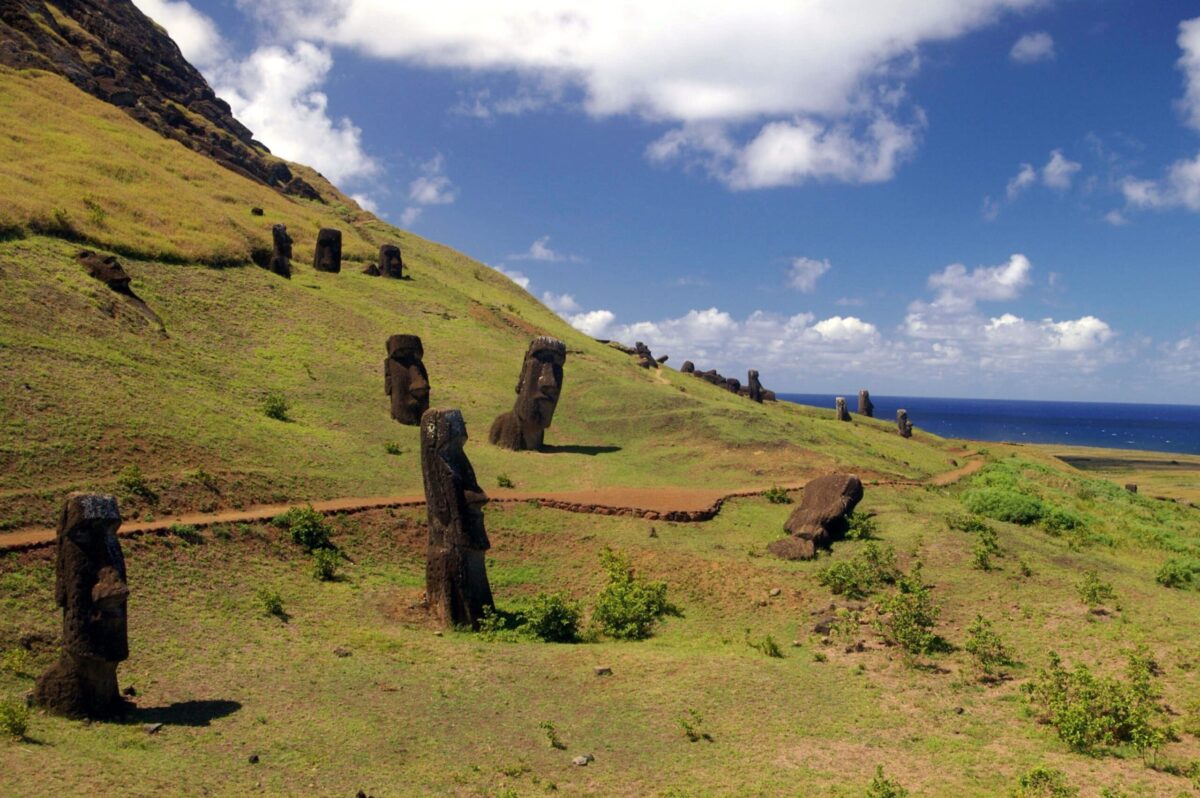
Hawaiʻi and Easter Island are about 7,000 kilometers apart, farther than New York is from Rome. Yet a new genetic study suggests the people of these two remote islands are more closely related than anyone expected, and that their ancestors’ navigation skills explain why.
Long before modern navigation tools existed, Polynesian voyagers used stars, swells, birds, and clouds to guide them across thousands of miles of open water and settle islands scattered across the Pacific. Researchers at the University of California San Diego now report that this extraordinary migration history can still be read in the DNA of Polynesian people today.
The study, published October 8 in Science, sequenced and compared the whole genomes of 1,050 people from across Polynesia. Beyond offering genetic evidence of the navigators’ skill, it suggests that the same settlement pattern helps explain why certain disease-related gene variants are unusually common on some islands.
A gene pool passed down in smaller and smaller portions
Each time a group left an established island to found a new community, it carried only part of the home population’s genetic diversity. A party leaving Mangareva for Hawaiʻi or Rapa Nui, for example, carried a limited sample of Mangareva’s gene pool. When descendants later sailed on from those new islands, they carried an even smaller sample.
Researchers compare the result to Russian nesting dolls, with the largest population holding the most variation and each later population containing a narrower slice of it. Keolu Fox, an associate professor of anthropology at UC San Diego and a corresponding author, said that every move from one island to the next selects a subset of the gene pool and reshapes the genome over time.
Distant islands, close relatives
The team combined DNA samples from multiple island groups in French Polynesia, including the Austral, Society, Marquesas, Tuamotu, and Mangareva regions. The dataset also included genetic information from Rapa Nui, Native Hawaiians, Samoans, and Tongans.
Hawaiʻi and Rapa Nui sit at opposite ends of Polynesia, roughly 7,000 kilometers apart, and each is more than 3,000 kilometers from the nearest inhabited Polynesian island. Despite this distance, genetic studies show these two remote groups are each other’s closest relatives among those studied. The researchers interpret this as a sign that both were settled by voyagers with deep ancestral ties to Mangareva.
That points to a culture capable of repeated long-distance ocean travel, which the authors call Holomoana Nui, or “great ocean voyaging.” The settlement was not a single journey but involved people moving back and forth between islands to exchange supplies, knowledge, and genes, with each new community reinforcing these genetic patterns.
The team identified multiple layers of founder effects alongside population bottlenecks, which happen when illness or other disruptions reduce a group’s size and leave survivors with reduced genetic diversity. These combined factors created one of the strongest cumulative founder effects ever recorded in human genetics.
A Variant Missing From Global Databases
A rare variant carried by a small founding group can become common among its descendants. The team found three variants linked to recessive diseases at fairly high frequencies in French Polynesia. One, in the FAN1 gene, is associated with karyomegalic interstitial nephritis, a rare condition that can lead to kidney failure. It appeared in more than 11 percent of French Polynesian participants, yet it is absent from gnomAD, a global database covering more than 800,000 people.
The gap matters because most genomic medicine has been built on data from people of European ancestry. Without detailed information on Polynesian populations, doctors may not know what to screen for. The authors also warn that combining Native Hawaiian and Pacific Islander groups into a single category can hide real differences between islands.
Fox said the findings could eventually support more precise screening, diagnosis, and treatment, including for cancer. The study itself does not set clinical guidelines or propose new treatments; it offers genetic information that future research and care can build on.
Trust Before Data, Benefits After
The project grew out of a 2017 trip by Fox, the first Native Hawaiian to earn a Ph.D. in genome sciences, to French Polynesia. A conversation there about the legacy of French nuclear testing, which saw 193 tests between 1966 and 1996, led him to ask how genomics might help communities that were exposed to environmental harm and often lacked access to specialized care. A second question followed: how could such research protect Indigenous communities and let them share in what it produces?
His answer was Variant Bio, a biotechnology company he joined as a senior advisor during the study. It works with groups historically left out of genomic research and gives them greater say over how their data are collected, stored and used. That means explaining the uses and risks of genomic data, building relationships with community leaders and involving local clinicians, nurses and health workers, whom the authors thank for making the study possible.
The company has also committed 4 percent of its revenue and 4 percent of equity-derived value to partner communities, which can direct the money to priorities such as health care, education, infrastructure, food sovereignty or energy projects. Fox sees this as part of the science itself: to recruit communities into research, he said, they must have a stake in the technology being built.
After nearly a decade on the project, Fox said that seeing the achievements of a voyaging people reflected in their genomes, and recognized on a major scientific stage, is deeply validating.
University of California San Diego (UC San Diego)
Cole Shanks et al., Message in a bottleneck: Nested founder effects from French Polynesia to Rapa Nui and Hawaiʻi.Science394,216-221(2026).DOI:10.1126/science.aec7662