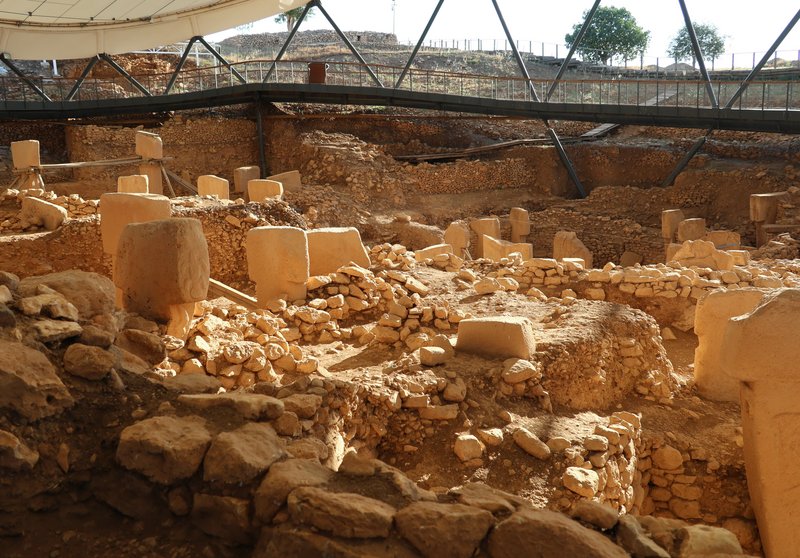
For more than 30 years, archaeologists excavating Göbeklitepe in southeastern Türkiye have faced a disturbing puzzle. Among the ruins of its monumental stone buildings, they kept finding fragments of human skulls, broken limbs, and other skeletal remains. Hundreds of bones were scattered across the site, yet their original resting places remained unknown.
Now, the discovery of Göbeklitepe’s first two burials may finally explain what happened to at least some of those ancient remains. A study published in PLOS ONE on September 22 suggests that thousands of years of erosion, rather than an elaborate death ritual, could be responsible for much of the mystery.
But the graves have revealed something else: a glimpse into the lives and burial customs of the people who inhabited one of the world’s most extraordinary Neolithic settlements.
Three Bodies in One Grave, and Possibly a Fourth
The first burial came to light in 2017 during construction work on a drainage channel near Göbeklitepe’s monumental buildings. Beneath the plaster floor of a rectangular structure, archaeologists uncovered a small, kidney-shaped pit containing the remains of at least three people.
They identified a woman aged 35 or older, a man between 20 and 30, and a girl approximately 11–14 years old. However, one skull appeared too mature to belong to the adolescent, raising the possibility that a fourth person was also buried there.
The arrangement of the skeletons was particularly intriguing. Someone had gathered the skulls in one corner, while other bones lay in the center and along the opposite side of the pit. Researchers believe the grave was reopened repeatedly, with earlier remains moved aside to accommodate new burials.
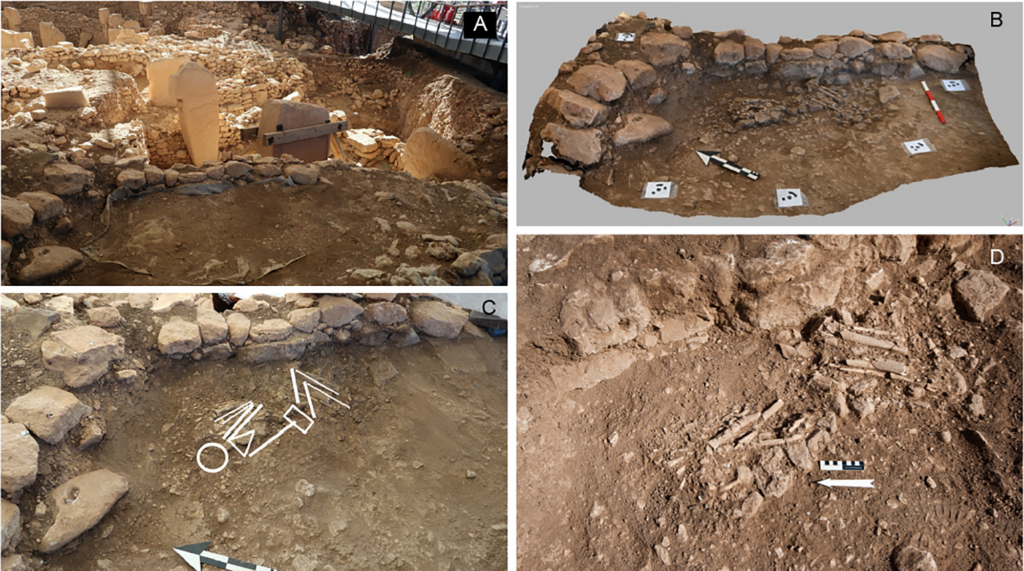
Burial of a young adult at Göbeklitepe. (A) Location beside Special Building A; (B) 3D orthophoto of the burial area; (C) reconstructed position of the body, lying on its left side and facing east; (D) skeletal remains during the 2022 excavation. Credit: Gresky, J., & Clare, L. (2026)
A Woman Who Waited Ten Years to Be Excavated
The second burial has an unusual modern history. Archaeologists first encountered it in 2012 but had to postpone the excavation. They returned a decade later, in 2022, to uncover the remaining skeleton.
The grave contained a young adult, probably a woman aged 20–30, lying on her left side with bent legs and her face turned east. Her body rested on a layer of stones immediately beside Göbeklitepe’s monumental Building A.
Although the skeleton remained largely in its original position, many bones were badly fractured. Soil pressure, calcareous deposits, and possible rodent activity had damaged the remains over thousands of years.
This seemingly ordinary burial provided an important clue. It demonstrated that human bones could become severely fragmented without anyone deliberately breaking them.
The Secret Behind 928 Scattered Human Bones
Since excavations began in 1995, researchers have collected 928 individual human bone fragments from Göbeklitepe, excluding the two newly studied burials. Many came from the fills of its monumental buildings, where they appeared mixed with limestone rubble, animal bones, and other archaeological material.
For years, archaeologists wondered whether prehistoric inhabitants had intentionally deposited these remains as part of an elaborate mortuary tradition. The new research offers a different possibility: some bones may have arrived there entirely by accident.
Researchers Julia Gresky and Lee Clare suggest that people originally buried their dead beneath the floors of buildings on higher ground. Over time, erosion and slope movements carried soil, debris, and fragmented human remains downhill into the monumental structures.
This process could explain why bones belonging to different individuals ended up scattered across such a large area. Nevertheless, the researchers caution that natural processes cannot explain every unusual feature of Göbeklitepe’s human remains.
The Ancient Skull Ritual That Remains a Mystery
Some discoveries at Göbeklitepe still point toward deliberate treatment of the dead. Researchers have identified skull fragments from five individuals bearing deep incisions, suggesting that certain people received distinctive treatment after death.
Similar practices have emerged at other Neolithic settlements in southeastern Türkiye. At Sefertepe, archaeologists discovered a chamber containing at least 21 human skulls, most positioned facing southeast. Karahantepe has also yielded skull fragments with intentional cuts and traces of burning.
These findings suggest that burial traditions varied considerably among the region’s earliest communities. The newly examined graves also strengthen the growing evidence that Göbeklitepe was more than a ceremonial center: it was a place where people lived, carried out daily activities, and buried their dead.
The first two burials may explain the origin of many scattered bones, but the full story of Göbeklitepe’s ancient inhabitants remains unfinished. Further analysis and dating will be needed to determine how its different burial practices developed over time.
Gresky, J., & Clare, L. (2026). First burials give insights into mortuary rites at Göbeklitepe, Early Neolithic Türkiye. PLOS ONE, 21(9), e0358979. https://doi.org/10.1371/journal.pone.0358979