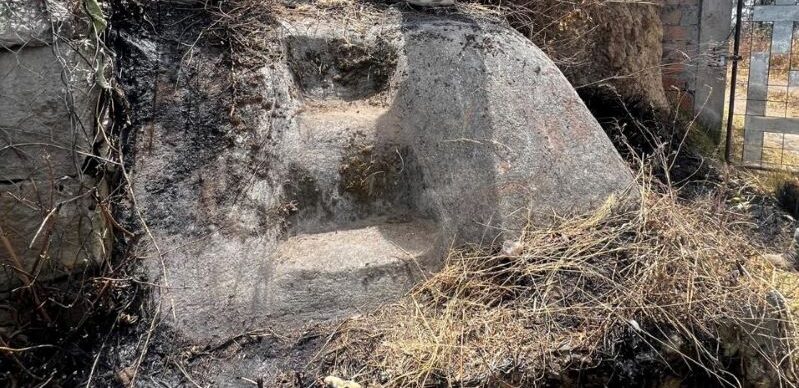
A wildfire on Cerro Casitagua, north of Quito, has revealed an archaeological feature that had been hidden beneath dense vegetation: a short stairway carved directly into the rock.
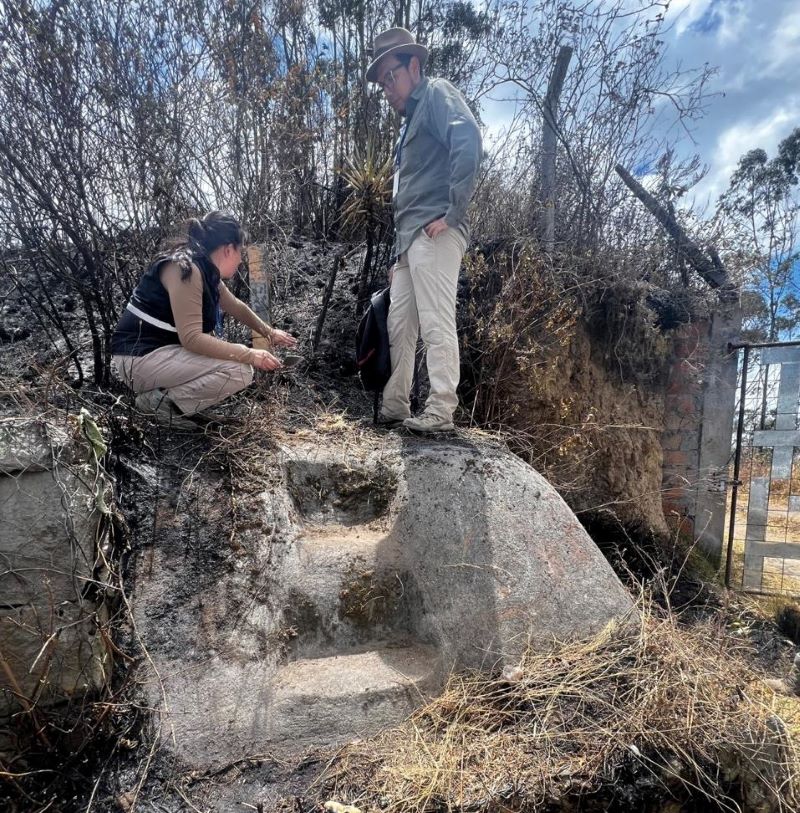
The structure appeared after flames swept across the mountain in September, stripping away vegetation and exposing parts of the landscape that had previously been difficult to see. Archaeologists from Quito’s Metropolitan Heritage Institute, or IMP, identified the feature while inspecting known archaeological areas affected by the fire.
What they found immediately raised an intriguing possibility. The stairway lies close to the Radioloma culunco, an ancient pre-Hispanic route, and IMP specialists say it may have an Inca connection. That interpretation remains preliminary, but the setting gives archaeologists good reason to investigate further.
A discovery revealed by fire
The Casitagua wildfire affected hundreds of hectares and prompted heritage specialists to inspect archaeological zones across the mountain. At several known sites, the fire caused visible damage to vegetation but no obvious harm to archaeological remains.
Near Radioloma, however, the burned landscape revealed something unexpected: steps cut into the natural rock.
The feature had not previously been documented. With vegetation gone, archaeologists could see its form more clearly and begin considering how it might relate to the nearby ancient route.
For now, its date is unknown. No scientific dating has been announced, and IMP has not claimed that the structure is definitively Inca. Instead, the institute has described that connection as a possibility requiring further study.
Why the Inca connection is plausible
The location matters.
Casitagua sits within the wider Lulumbamba and Pomasqui landscape, an area rich in archaeological remains from many different periods. Ancient paths, settlement areas, and fortified sites known as pucarás are all known from the region.
The Incas expanded into northern Ecuador during the late pre-Hispanic period and incorporated this landscape into a wider network of movement, settlement and political control. Pomasqui is also associated with mitimae communities, populations relocated under Inca administration.
Nearby Rumicucho is one of the clearest signs of that presence. The fortified site has long been connected with Inca activity and with control over routes through the northern highlands.
That does not prove the Casitagua stairway is Inca, but it explains why archaeologists are considering the possibility. A rock-cut feature beside an established pre-Hispanic trail fits comfortably within a landscape shaped by movement and occupation before the Spanish conquest.
A landscape with a much older history
The mountain’s archaeological story began long before the Incas arrived.
Earlier investigations at the Tagshima site on Casitagua uncovered floors, hearths, postholes, stone tools, ceramics and animal remains dating roughly between 1500 and 500 BCE. Those finds show that people were using this high-altitude landscape more than a thousand years before Inca expansion reached the region.
That deeper history is important because it keeps the new discovery open to several interpretations.
The stairway may eventually prove to be Inca. It may belong to an earlier community. Or it could have been reused across different periods.
What is already clear is that the wildfire exposed a new piece of a heavily layered archaeological landscape. In this case, an environmental disaster briefly removed the vegetation covering the mountain and revealed a feature that had remained hidden in plain sight.