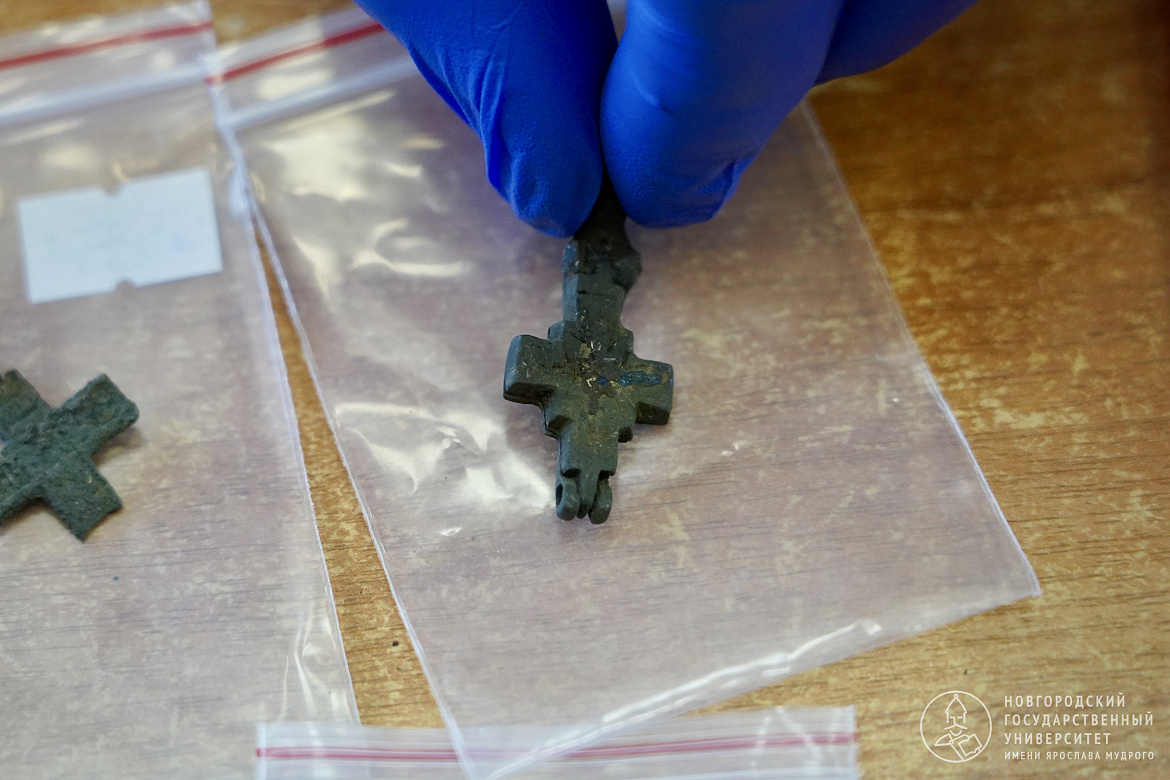
Archaeologists have unearthed a remarkably well-preserved 11th-century Christian cross in Staraya Russa, Russia. The small copper-alloy pendant remains closed after nearly 1,000 years underground, raising an intriguing possibility: it may still contain sacred relics placed inside by its medieval owner.
The copper-alloy cross measures just three centimeters and belongs to a type known as an encolpion, a small reliquary worn around the neck. Unlike an ordinary pendant, it consists of hinged sections that could hold religious objects, including fragments believed to come from saints’ remains, consecrated oil, or earth collected from sacred places.
Researchers from Novgorod State University discovered the cross during excavations at the Pyatnitsky site in Staraya Russa’s historic center. According to the university’s October 16 announcement, it ranks among the earliest known examples of its kind from medieval Rus’.
A Thousand-Year-Old Mystery Inside a Tiny Cross
The most intriguing detail is that archaeologists found the cross completely closed. Most encolpia discovered during excavations survive as separate halves, but this example retains its original form. Although a small hole is visible on the reverse, researchers believe its contents might have survived.
Sergey Toropov, director of Novgorod State University’s Center for Archaeological Research, explained that the cross was probably a serially produced object rather than a unique commission. Nevertheless, its maker decorated the metal with intricate grooves intended to hold niello, a dark substance used to create contrasting patterns on metalwork.
Such crosses were valuable personal possessions. Their owners could wear them for decades and sometimes pass them down through generations, preserving both their religious significance and their connection to family history.
The discovery also recalls an earlier find from Staraya Russa. In 2001, archaeologists uncovered another 11th-century encolpion at the Borisoglebsky excavation site. When researchers examined its contents, they identified human hair that may have formed part of a sacred relic.
That precedent makes the newly discovered cross particularly interesting, although archaeologists have not yet established whether anything remains inside it.
Scientists Hope to Look Inside Without Opening It
Rather than risk damaging the delicate artifact, the research team plans to examine it using X-ray imaging and electron microscopy. These techniques may help specialists investigate its interior, assess its preservation, and determine the composition of the metal.
Although the cross appears to be made from a copper alloy, its exact composition remains unknown. Toropov explained that laboratory analysis will establish whether the material is brass, bronze, or another alloy.
The artifact is currently undergoing temporary conservation. Following laboratory investigations, researchers plan to transfer it to the collections of the Novgorod Museum-Reserve.