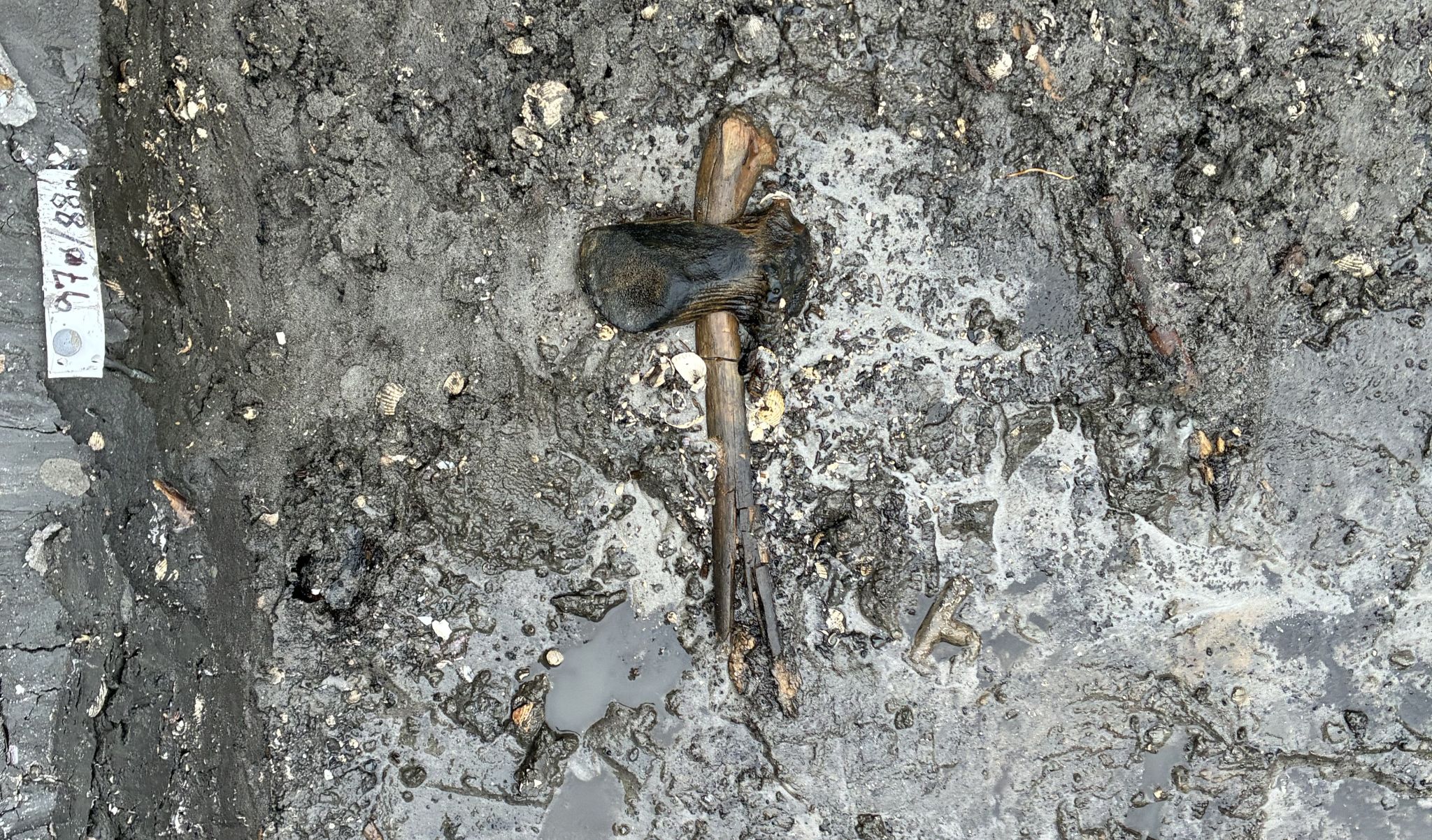
Archaeologists excavating a prehistoric settlement on Denmark’s Egholm Island have discovered a rare 8,400-year-old deer antler axe with its wooden handle still preserved. The exceptional find offers new evidence of the woodworking skills and toolmaking traditions of Scandinavia’s Mesolithic hunter-gatherers.
A prehistoric axe found in waterlogged soil on the island of Egholm, near Aalborg in northern Denmark, is providing archaeologists with an unusually complete example of Stone Age tool construction. Unlike most surviving implements from this period, the object preserves two materials that ancient craftspeople originally combined: a working head made from deer antler and a wooden handle.
The discovery was made by archaeologists from Nordjyske Museer during excavations associated with the planned third Limfjord crossing, a major infrastructure project connecting areas around Aalborg. The approximately 8,400-year-old implement belongs to the late Maglemose culture, a prehistoric hunter-gatherer tradition that flourished in southern Scandinavia long before farming reached the region.
Torben Sarauw, head of archaeology and cultural heritage at Nordjyske Museer, has emphasized the rarity of finding an antler axe with its wooden shaft intact. Although archaeologists have identified similar antler tools at other Mesolithic sites, complete examples remain exceptionally uncommon because wooden components generally decay over time.
An Ancient Axe Preserved in Waterlogged Soil
The axe survived because the archaeological deposits on Egholm remained saturated with water, creating conditions that limited the decomposition of organic materials. Such environments can preserve wooden implements, animal remains and other fragile objects that would normally disappear from the archaeological record.
This preservation makes the Egholm discovery particularly valuable. Archaeologists can investigate not only the shape of the antler head but also how prehistoric craftspeople attached it to a wooden shaft. The relationship between these two components may reveal practical choices concerning strength, balance and the use of available raw materials.
Antler offered Mesolithic toolmakers a durable yet workable material. Its natural form could be adapted into implements for various tasks, while a fitted wooden handle allowed people to apply greater leverage and force. However, the precise function of the Egholm axe has not yet been established, and its construction alone cannot determine how its owner used it.
The discovery therefore provides an opportunity to examine prehistoric technology beyond the stone artefacts that dominate many archaeological collections.
A Mesolithic Settlement Filled with Organic Remains
The antler axe is part of a wider collection of discoveries from Egholm, where archaeologists are investigating traces of communities that occupied the Limfjord region thousands of years ago.
Excavations have produced animal bones, flint artefacts and unusually well-preserved organic material. Among the more striking discoveries is an approximately 8,500-year-old killer whale tooth, while remains of deer, wild boar and fish provide evidence of the animals present in the prehistoric environment.
Archaeologists have also identified microliths, small and carefully shaped flint pieces that formed part of Mesolithic hunting equipment. These miniature blades could be inserted into wooden shafts and secured with birch-bark pitch, creating composite tools and weapons whose damaged components could be replaced individually.
Together, the microliths and antler axe illustrate the importance of combining different materials in prehistoric toolmaking. Wood, flint, antler and natural adhesives formed part of technological traditions that required knowledge of material properties and careful craftsmanship.
Egholm’s Changing Landscape and Its Archaeological Importance
The settlement also occupies an important position in the reconstruction of northern Denmark’s postglacial environment. Since the end of the last Ice Age, changing water levels have repeatedly transformed the landscape surrounding the Limfjord, submerging some areas while exposing others.
These environmental changes influenced where prehistoric communities could live and hunt. They also helped create the sedimentary conditions responsible for preserving archaeological material at Egholm.
According to Nordjyske Museer, archaeological knowledge of the region has traditionally been stronger for the later Ertebølle culture than for the earlier Maglemose communities. The ongoing investigations could help reduce that gap by supplying evidence from settlements where organic materials have survived alongside stone tools.
The newly discovered axe is particularly relevant because it preserves a combination of materials rarely encountered together after more than eight millennia. Its examination may help archaeologists reconstruct manufacturing techniques and assess the possible activities carried out by the people who used it.
As excavations continue along the planned Limfjord crossing, Egholm is emerging as an important source of information about the hunter-gatherer societies that occupied northern Denmark’s changing coastal landscapes.