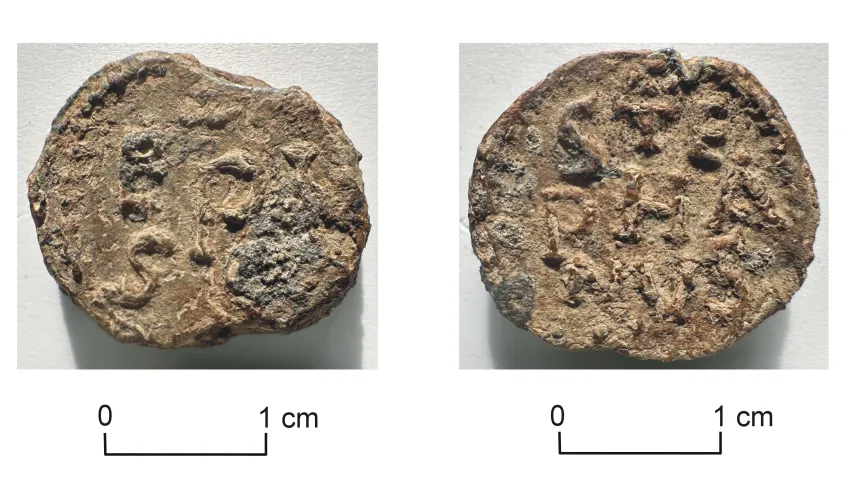
A tiny lead seal discovered on a rocky island in Croatia has preserved the name of a bishop whose identity remains unknown. Dating to the 6th or 7th century, the object bears the Latin inscription STEPHANVS EPISC, identifying a man named Stephen who held the office of bishop nearly 1,400 years ago.
Polish and Croatian archaeologists discovered the seal on Lukovac, a small uninhabited island near Rab in the northern Adriatic Sea. Researchers believe it could rank among the oldest known episcopal seals from the eastern Adriatic, potentially adding an unfamiliar name to the region’s early Christian history.
A Bishop’s Name on a Coin-Sized Seal
Measuring just 22 by 19 millimetres, the lead seal is roughly the size of a one-euro coin. One side carries STEPHANVS across three lines, while the other displays EPISC, an abbreviation of the Latin episcopus, meaning bishop. A wreath surrounds the lettering, and two four-petalled rosettes decorate the side bearing the name.
The object, known as a bulla, once secured an official letter or legal document. A cord passed through a channel in the lead disc, allowing its owner to seal correspondence. Breaking that seal would have left visible evidence of interference.
Professor Fabian Welc of Cardinal Stefan Wyszyński University in Warsaw, who leads the Polish research team, explained that such seals verified the identity of a document’s sender. Although Byzantine seals frequently used Greek, Latin remained common in parts of the western Byzantine world, particularly Italy.

An Unknown Bishop in Adriatic History
The name Stephen presents archaeologists with an intriguing historical problem. Researchers have yet to identify a bishop with that name in surviving written records from the region.
One possibility connects him to the nearby island of Rab. Historical lists of Rab’s bishops contain a substantial gap between Titianus, documented in the 6th century, and Peter I, mentioned in 986. Stephen could potentially belong to this missing chapter, although the seal offers no direct proof.
Other possibilities include the dioceses of Osor and Krk. Archaeologists cannot yet establish where Stephen served, where his document originated, or who received it.
The seal’s archaeological context makes the discovery particularly valuable. Unlike many ancient seals that entered collections through the antiquities market, the Lukovac example came from a documented archaeological layer. Researchers can therefore examine the object alongside evidence from the settlement itself.
A Small Island with Mediterranean Connections
Since 2019, Polish and Croatian archaeologists have investigated Lukovac under a project directed by Welc and Croatian archaeologist Ana Konestra of the Institute of Archaeology in Zagreb.
The island contains a fortified settlement dating to the 6th–8th centuries, including an early Christian church and a water cistern. Excavations have also uncovered Egyptian porphyry tiles, decorated 7th-century bronze belt buckles, and amphorae originating from Byzantine Egypt.
These objects demonstrate that Lukovac maintained connections with distant Mediterranean regions despite its small size and isolated location.
Konestra believes the newly discovered seal may indicate that the settlement served more than defensive and religious purposes. People associated with ecclesiastical, military, or secular elites may also have used the island.
The original document has disappeared, leaving archaeologists with only its lead seal. Yet the surviving inscription preserves the name and official position of a man whose place in Adriatic history remains unresolved.