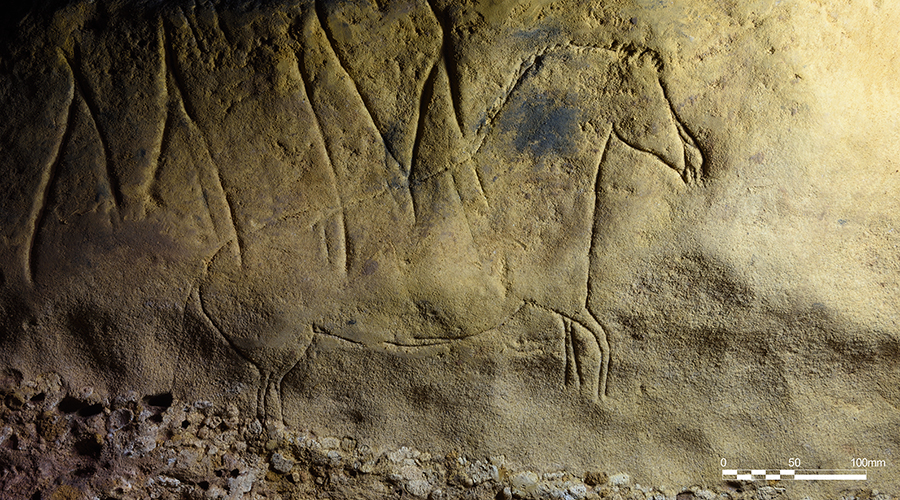
For decades, visitors explored a famous cave in Spain, unaware that some of its walls contained hundreds of prehistoric engravings. Some tourists even carved their names over artwork that may date back tens of thousands of years.
The remarkable discovery at Cova de la Font Major in Catalonia includes horses, deer, wild cattle, and a rare bear. A new study published in Antiquity reveals how one of Spain’s most important collections of Ice Age cave art remained overlooked in a place visited by thousands of people.
Ancient Artwork Mistaken for Ordinary Scratches
The story begins in Espluga de Francolí, a town in northeastern Spain. Tourists have explored the cave’s underground galleries for decades, particularly since local authorities developed the site as a visitor attraction in 1993.
Nobody suspected that hundreds of ancient figures covered sections of the walls. Modern graffiti made the situation even more confusing, as visitors scratched names and dates directly across prehistoric markings.
Everything changed on October 30, 2019, when archaeologist Josep Maria Vergès Bosch noticed several unusual engravings among the graffiti. Their shapes suggested something far older than the casual scratches left by modern visitors.
What followed was a detailed investigation that identified 280 graphic elements approximately 250 meters inside the cave. Vergès Bosch and fellow researcher Míriam Salas-Altès have now published their findings, revealing the extraordinary importance of the long-overlooked artwork.
A Prehistoric Gallery of Horses, Deer and a Bear
Of the 280 documented graphic elements, 55 depict animals. Researchers identified horses, deer, wild cattle, and goat-like creatures, alongside a particularly unusual representation of a bear.
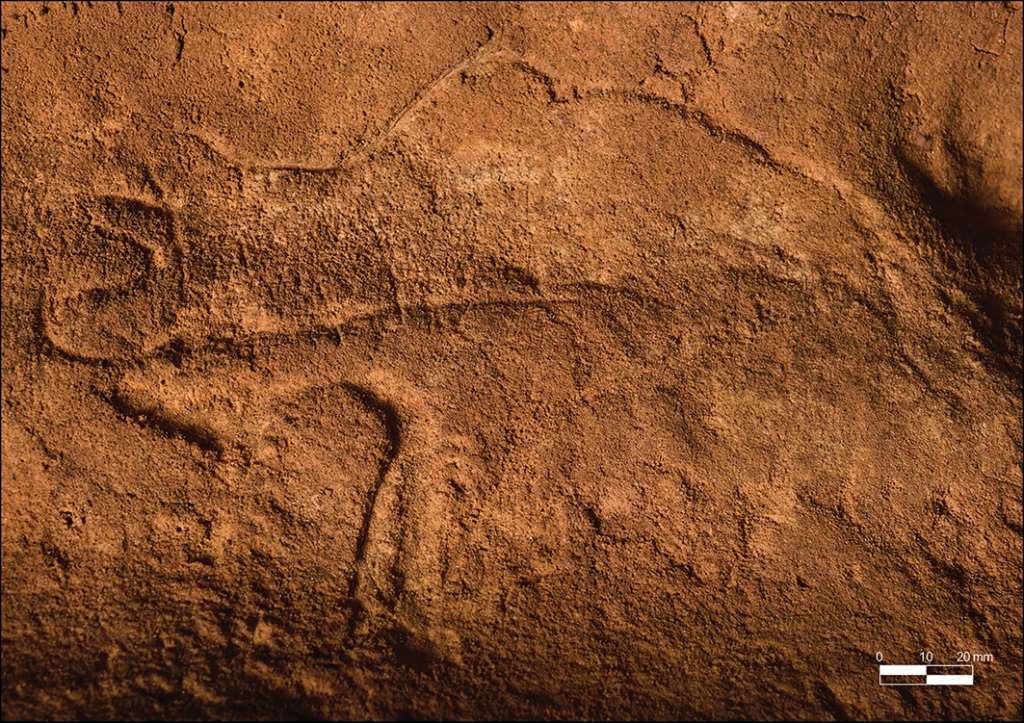
The bear engraving shows the animal’s ears facing forward and its mouth slightly open. Another striking image portrays an aurochs, the extinct wild ancestor of domestic cattle, with prominent horns.
The ancient artists did not simply draw on flat surfaces. They sometimes appear to have incorporated natural cracks and rock boundaries into their compositions, turning irregular stone surfaces into parts of animal figures.
One horse seems to stand on a line created by the boundary between two rock layers. In another engraving, a deer’s muzzle meets a horizontal crack that may have represented the ground or a water surface.
Not everything on the cave walls represents animals. Researchers also recorded parallel lines, geometric markings, and numerous loop-shaped engravings whose precise origins remain uncertain.
How Could Everyone Have Missed Them?
The answer lies partly in the cave’s geology. Its rough walls, uneven surfaces, and relatively shallow engravings made the ancient figures difficult to recognize.
Modern visitors added another obstacle. Decades of graffiti, accidental contact, and surface damage obscured some prehistoric markings, while other engravings may have disappeared entirely.
The cave had been accessible through its main entrance since 1957, and thousands of people passed directly in front of the engraved surfaces. Yet the archaeological importance of the figures remained unrecognized until 2019.
A Discovery That Rewrites Catalonia’s Ice Age Art History
Researchers have not directly dated the engravings. However, radiocarbon evidence places human activity in the cave’s deeper galleries between approximately 40,800 and 25,900 years ago, while artistic comparisons suggest that many figures may belong to early phases of the Upper Paleolithic.
Before this discovery, archaeologists knew of only two cave representations tentatively attributed to the Upper Paleolithic in Catalonia. The new collection makes Cova de la Font Major the third-largest known Paleolithic cave art assemblage along the Mediterranean side of the Iberian Peninsula, measured by animal figures.
The discovery raises an intriguing possibility: other well-known caves may still contain prehistoric artwork hiding beneath modern graffiti or blending into natural rock formations. At Cova de la Font Major, the evidence was in front of visitors for decades, but recognizing it required a different way of looking.
Vergès Bosch, J. M., & Salas-Altès, M. (2026). Filling gaps: the Palaeolithic rock art of the Cova de la Font Major on the north-east Iberian Peninsula. Antiquity, 1–22. doi:10.15184/aqy.2026.10447