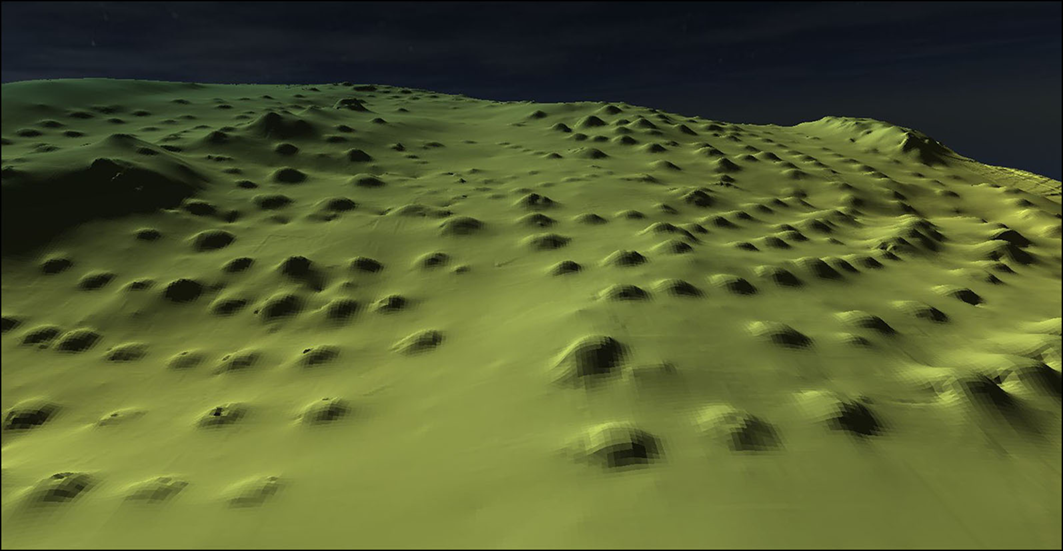
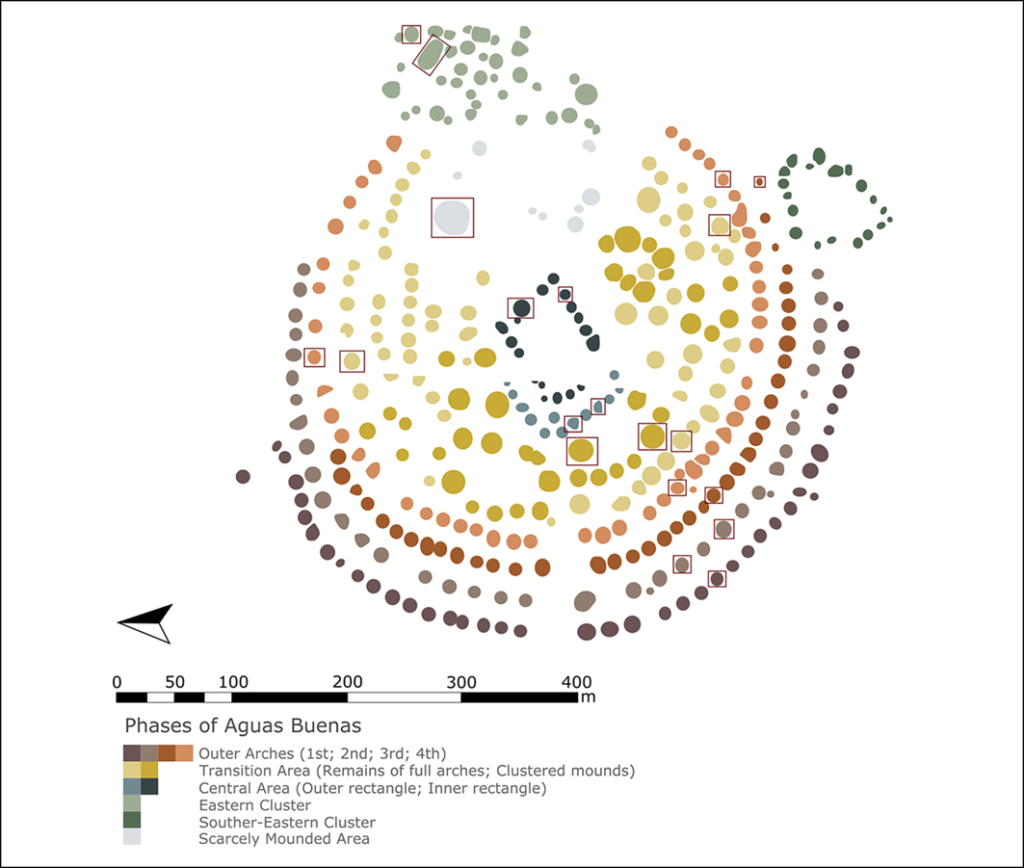
Imagine walking across a grassy field in Nicaragua, unaware that the small rises beneath your feet belong to an enormous ancient monument. From the ground, there is little to suggest anything extraordinary. But archaeological mapping reveals a remarkable sight: at least 372 mounds arranged in a vast geometric pattern covering more than 30 hectares.
The site, known as Aguas Buenas, has puzzled archaeologists for years. Now, new research published in the journal Antiquity suggests that its builders did not complete this enormous project in a single construction campaign. Instead, generations of people may have gradually shaped, maintained, and transformed the landscape.
An Ancient Monument Without Towers or Pyramids
When people think of monumental architecture in the ancient Americas, Maya pyramids and the enormous stone constructions of the Andes often come to mind. Southern Central America, however, followed a different architectural tradition.
For decades, researchers often treated the region as peripheral because it lacked the towering monuments associated with better-known ancient civilizations. Yet Aguas Buenas challenges the assumption that monumental achievements must rise high above the surrounding landscape.
Here, ancient communities created something different: a sprawling arrangement of earthen and stone mounds forming a carefully planned semicircular pattern.
The scale is impressive. Previous calculations suggest that constructing the site required moving approximately 50,000 cubic metres of stone, representing at least 426 person-years of labour.
And there is another mystery. Archaeologists have found no clear evidence of a powerful ruling elite or centralized political authority capable of directing such an enormous undertaking.
Could communities have organized the work themselves?
The researchers consider communal cooperation a plausible explanation, although the absence of evidence for rulers does not prove that no political leaders existed.
Twenty Mounds Reveal a Different Story
To understand how the site developed, an international team led by Dita Auziņa of Leiden University returned to Aguas Buenas in 2025.
The researchers excavated 20 mounds across different parts of the complex, examining layers of soil, stone and archaeological material. They also used portable optically stimulated luminescence measurements to investigate the sequence in which sediments accumulated.
What emerged was not the story of a single ambitious building project.
The excavated mounds contained evidence of repeated construction episodes, with people adding new materials, modifying existing structures and renewing their surfaces over time.
At least 10 mounds displayed successive layers of white rhyolite capping. The researchers suggest that maintaining their appearance may have mattered to the communities responsible for them.
This repeated attention suggests that the significance of Aguas Buenas developed through continued activity rather than one moment of construction.
Strange Deposits Beneath the Mounds
The excavations also revealed clues about activities taking place around the monuments.
Beneath four mounds in the outer sections, archaeologists identified deposits containing large ceramic vessels. These may represent communal consumption events or deliberate offerings associated with construction.
Closer to the centre, the team encountered more abundant pottery, stone tools, charcoal and traces of building materials, suggesting more sustained human activity.
Another intriguing discovery came from beneath nine mounds: layers of volcanic material. Researchers are investigating whether earlier volcanic events influenced the landscape in which the monuments eventually developed.
The precise purpose of Aguas Buenas remains uncertain. Previous excavations found little clear evidence of domestic occupation, agriculture, or burials, leaving archaeologists without a straightforward explanation for the complex.
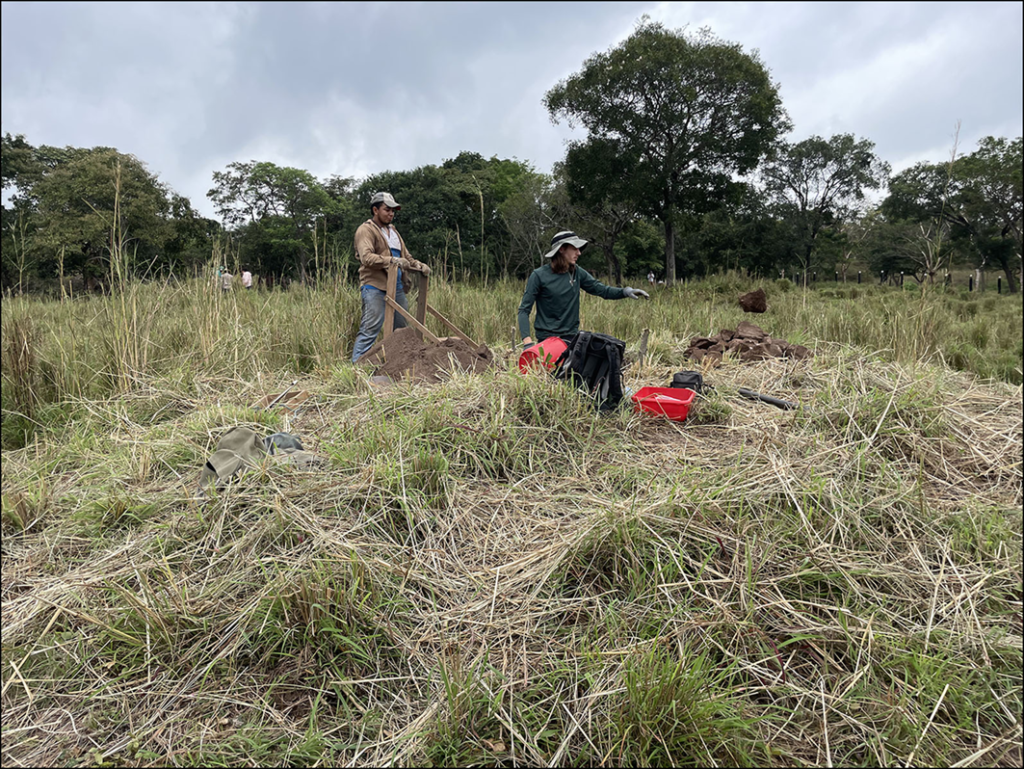
Archaeological teams working among the grassy mounds of Aguas Buenas in Nicaragua. Although the monuments form an extensive geometric pattern, neither the individual mounds nor their overall arrangement is easily visible at ground level. Credit: Auziņa et al., Antiquity (2026).
A Monument Built Through Time
Earlier radiocarbon evidence places some activity at Aguas Buenas between AD 404 and 666, while ceramic comparisons suggest broader use between approximately AD 300 and 900.
Scientists are continuing laboratory dating to establish when individual mounds were constructed and how long the different building episodes lasted.
For now, Aguas Buenas offers a compelling alternative to the familiar image of ancient monuments commissioned by powerful rulers. Its hundreds of low mounds suggest that monumental landscapes could also emerge through repeated communal efforts, gradually transforming an ordinary stretch of land into something extraordinary.
Auziņa, D., Egberts, E., Cerón González, A., Martínez, M., & Geurds, A. (2026). Revealing slow monumentality: luminescence and soil narratives from Aguas Buenas, central Nicaragua. Antiquity, 1–8. doi:10.15184/aqy.2026.10480