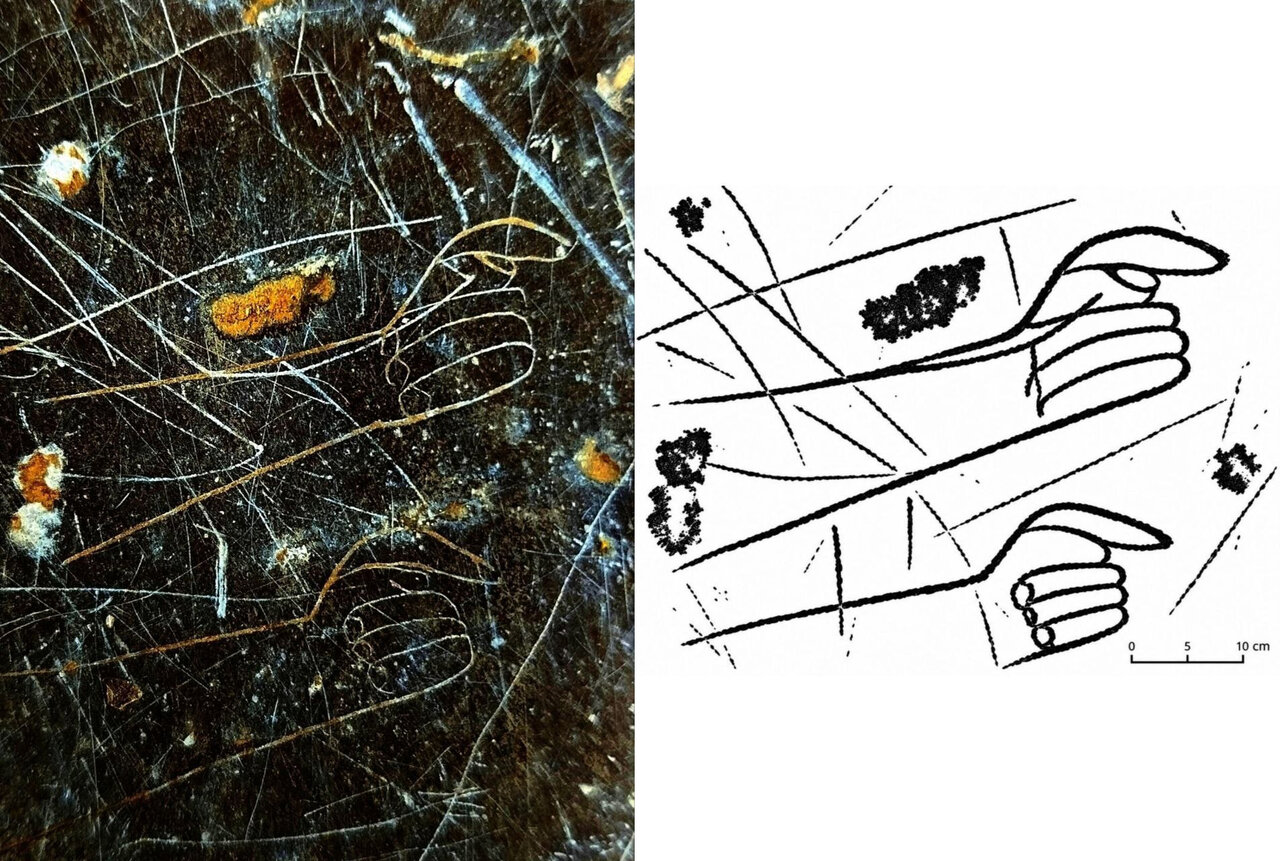
Archaeologists in southern Iran have identified previously undocumented rock carvings depicting human hands and forearms dating to the Sasanian Empire. The unusual engravings, discovered in the historic Marvdasht Plain in Fars province, may offer new insights into ancient Persian traditions of prayer, oath-taking and religious devotion.
Unlike the monumental Sasanian rock reliefs depicting kings, warriors and divine figures, the newly documented carvings portray hands without accompanying human figures. A Middle Persian prayer inscription beside one of the engravings provides an important clue to their possible religious significance.
According to a report by the Tehran Times, archaeologist and historian Abolhassan Atabaki identified the carvings during ongoing archaeological surveys and documentation efforts in the Marvdasht Plain.
The symbolic language of human hands
Atabaki attributes the engravings to the Sasanian period (224–651 CE) on the basis of their artistic characteristics. Although gestures of respect frequently appear in Sasanian reliefs, the independent representation of hands follows a less familiar artistic tradition.
Researchers have identified comparable imagery on Sasanian seals and seal impressions in collections ranging from the British Museum to the University of California, Berkeley. One example from Takht-e Soleyman in northwestern Iran features a hand alongside the Pahlavi inscription abestan o yazdan, meaning an appeal for divine assistance.
Historian Najmeh Ebrahimi argues that hands could communicate ideas of devotion, goodwill and commitment without the need for a complete human figure. The position of the fingers and the straight termination of the forearms in the Marvdasht engravings may help researchers interpret their intended meaning.
Some scholars also associate similar imagery with Mithra, an ancient Iranian deity closely connected with covenants and oaths. However, researchers have not established a direct connection between the newly documented carvings and the worship of Mithra.
The Sasanian Empire and Iran’s cultural identity
Ardashir I founded the Sasanian Empire in 224 CE after overthrowing the Parthian dynasty. Over the following four centuries, the Sasanians established one of the most powerful states of late antiquity, rivaling Rome and later the Byzantine Empire.
The dynasty strengthened Iranian political and cultural identity, established Zoroastrianism as its state religion and developed artistic traditions that influenced societies across Europe and Asia. Its architectural achievements, metalwork and religious iconography continued to shape Iranian culture long after the empire collapsed in 651 CE.
Fars province occupied a central place in Sasanian history. The region contains some of the dynasty’s most celebrated monuments, including the rock reliefs of Naqsh-e Rustam and Naqsh-e Rajab, where kings commemorated military victories and proclaimed their divine right to rule.
Against this background, the Marvdasht hand carvings offer a different perspective on Sasanian artistic expression. Rather than celebrating royal authority through monumental scenes, these simpler engravings may preserve expressions of religious devotion.