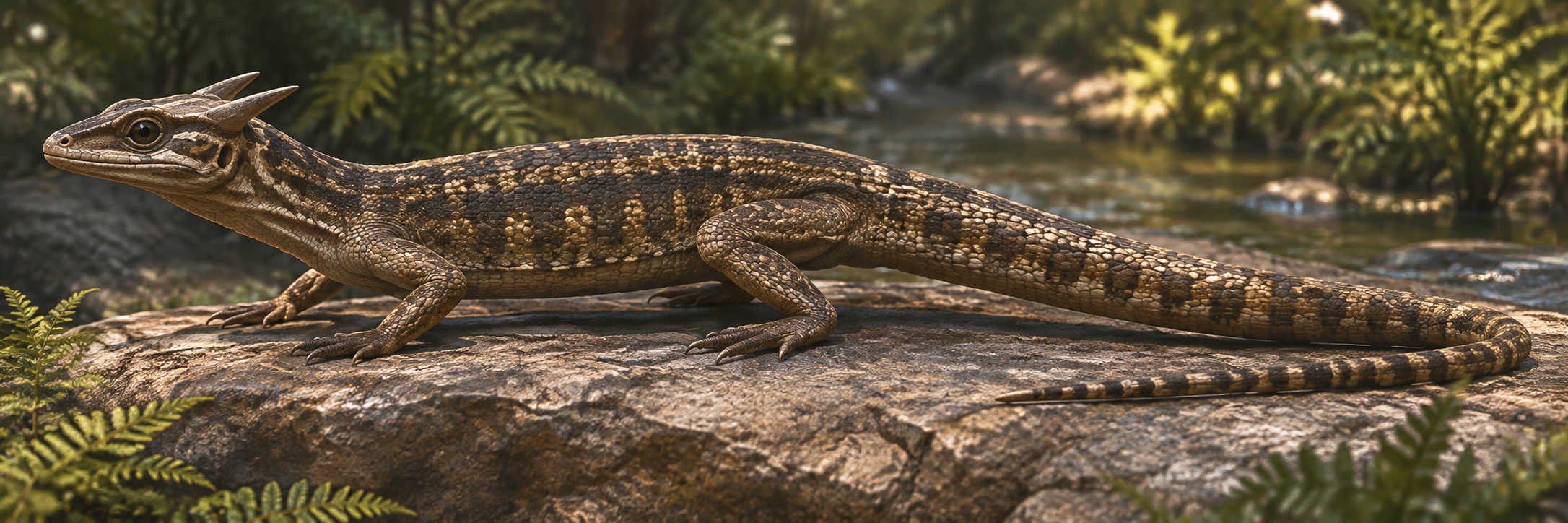
A 156-million-year-old fossil discovered in Wyoming has revealed a previously unknown species of prehistoric reptile, complete with unusual horn-like projections at the back of its skull. The small animal, measuring approximately 45 centimeters (18 inches) in length, remained largely concealed inside sandstone until scientists used advanced imaging technology to examine its skeleton without damaging the fossil.
Named Meilynodraco amonamarthi, the reptile belonged to an extinct group known as choristoderes, which lived alongside dinosaurs for millions of years. Researchers describe the specimen as the oldest known choristodere from North America and one of the most complete early representatives of the group.
The discovery, published in Royal Society Open Science on November 18, 2026, provides new evidence about the evolutionary relationships of these ancient reptiles.
A Small Fossil Among Jurassic Giants
The fossil was discovered in August 2022 by a team from Switzerland’s Aathal Dinosaur Museum at the Meilyn Quarry in Wyoming. The surrounding Morrison Formation is famous for the remains of enormous Jurassic dinosaurs, including Diplodocus, Stegosaurus, and Allosaurus.
This discovery, however, involved an animal considerably smaller than its dinosaur neighbors.
Only a few vertebrae were initially visible on the sandstone slab. Most of the skeleton remained hidden inside the rock, making identification difficult. Researchers considered several possibilities, including a juvenile dinosaur or a reptile related to snakes or crocodilians.
After the specimen was transported to Switzerland, an international team led by researchers including Pavel Trtik of the Paul Scherrer Institute and Torsten Scheyer of the University of Zurich began investigating its internal structure.
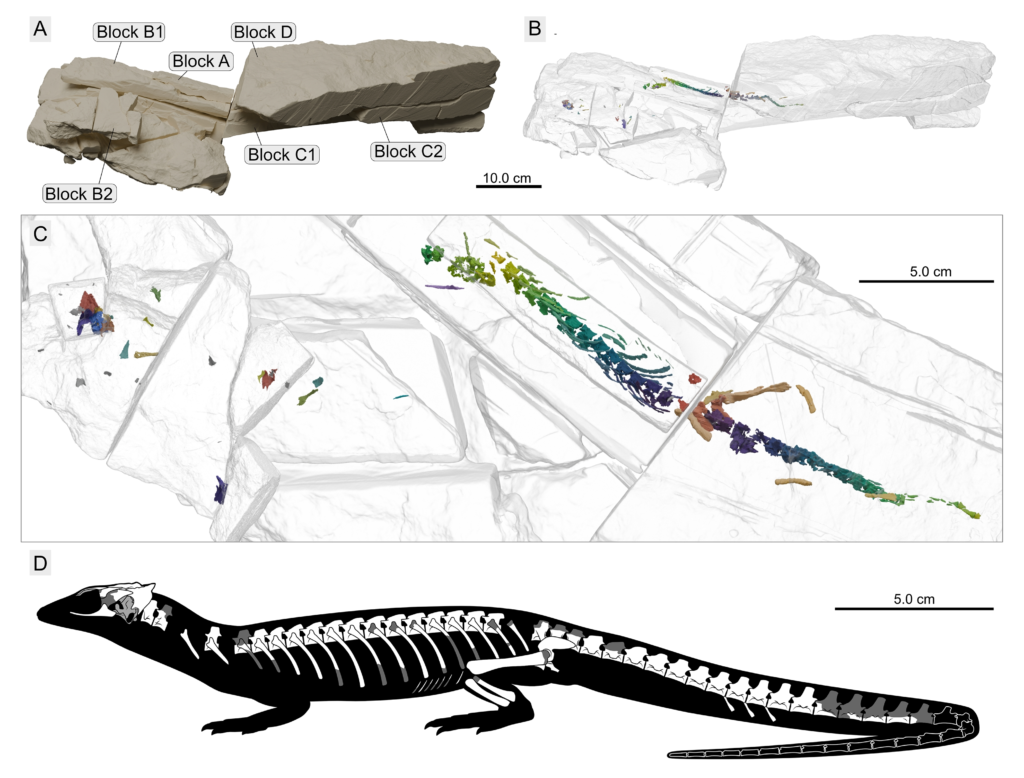
Rather than removing the surrounding rock, the scientists combined neutron tomography with X-ray imaging. Neutrons proved particularly useful because they could distinguish the fossilized bones from the sandstone through differences in their chemical composition.
Thousands of individual scans were assembled into detailed three-dimensional images, revealing anatomical features that conventional fossil preparation might have damaged or overlooked.
A Tiny Skull Offers Evolutionary Clues
The scans exposed parts of the pelvis, hind limbs, and a remarkably well-preserved braincase less than two centimeters wide.
The skull was separated from the rest of the skeleton, although researchers could not establish exactly how this happened. One possibility is that the animal had been attacked by a predator, but the evidence does not establish that explanation.
More importantly, the fossil preserved delicate structures of the inner ear that helped scientists investigate the animal’s evolutionary relationships.
Choristoderes were a diverse group of reptiles, some resembling crocodiles and others possessing long necks or more compact bodies. Their precise position within the reptile family tree has remained uncertain.
The newly identified species provides additional anatomical evidence for examining those relationships. Its skull features support a closer evolutionary connection between choristoderes and certain other reptile lineages, although the broader question remains unresolved.
The fossil also demonstrates how much information can remain inaccessible inside seemingly unremarkable pieces of rock.
A Jurassic Reptile With a Heavy Metal Name
The new species has an unusual scientific name.
Meilynodraco refers to the Meilyn Quarry where the fossil was discovered, with draco meaning “dragon.” The name also reflects the animal’s distinctive projections at the back of its skull.
The species name, amonamarthi, honors the Swedish melodic death metal band Amon Amarth, reflecting paleontologist Torsten Scheyer’s interest in the group’s music.
Despite its dragon-inspired name, the animal was neither a dinosaur nor a flying reptile. It was a small member of an extinct reptile lineage whose early evolutionary history remains incompletely understood.
The specimen is expected to feature in a traveling fossil exhibition organized by the Aathal Dinosaur Museum in early 2027.
For researchers, its significance extends beyond the identification of another Jurassic species. The discovery illustrates how modern imaging techniques can uncover previously invisible anatomical details, transforming a small fossil embedded in sandstone into an important source of evidence about prehistoric life.
Torsten M. Scheyer, Gabriela Sobral, Valentin Buffa, Jonathan Pople, Robert Zboray, Seren Azad, I. Augustine Benjamin, Scarlett Clarke, David C. Medich, Vadim V. Yakovlev, Yolanda Schicker-Siber, Hans-Jakob Siber, Nils Knötschke, Pavel Trtik; Neutron and X-ray computed tomography reveals new early-branching choristodere from the lower Morrison Formation of Wyoming, USA. R. Soc. Open Sci. 1 November 2026; 13 (11): 261553. https://doi.org/10.1098/rsos.261553